Introduction
US startups often begin with keyword targeting because it feels concrete: pick a phrase, write a page, watch rankings. But the search landscape now rewards more than matching words. It increasingly rewards meaning, context, and entity coverage—so the difference between semantic SEO and keyword SEO matters when you are deciding how to structure content, measure progress, and scale topical authority through topic clusters.
This comparison is especially useful if you already have some keyword pages and now need to decide what comes next. The core question is not whether keywords matter at all. It is whether your pages are organized around exact phrases or around the concept your audience is trying to understand.
That shift changes everything, from page architecture to reporting. It also affects whether your content feels thin and isolated, or interconnected and credible enough to support broader topical authority.

Definitions: What Semantic SEO and Keyword SEO Target
Semantic SEO targets concepts/entities (people, places, things) rather than exact text strings
Semantic SEO is built around what a searcher means, not just the exact words they type. In the framing used by Kamran Asghar, traditional SEO targets individual strings of text, while semantic SEO targets concepts and entities such as people, places, and things. That is the key mental model shift.
In practice, ranking for a concept means your content covers the full idea behind the query. The page does not need to repeat one phrase over and over; it needs to explain the topic clearly enough that both readers and search systems can tell the subject is covered. That is why semantic approaches aim for natural-language comprehensiveness and topical depth—making the page read like an authoritative explanation and supporting the underlying intent. It’s also why semantic SEO shifts the unit of optimization from phrase to meaning, using broader coverage, context, and stronger internal relationships to build a connected subject map.
Keyword SEO (Traditional SEO) targets individual keyword phrases and mechanical matching
Keyword SEO focuses on aligning one page with one phrase—often described as traditional SEO when emphasizing mechanical matching. The traditional model depends on exact or near-exact keyword matching, and some descriptions of it also emphasize backlink volume and repeated phrases as key success signals. Yogrow Solutions describes this as mechanical keyword matching.
This approach is simpler to plan, because each page has a narrow target. However, it can also lead to thin, independent pages that do not reinforce one another. When that happens, the site may have many pages but little connected authority.
Purpose in US SERPs: Intent Matching vs Keyword Targeting
Semantic SEO aligns with intent, context, and depth signals that systems use to decide relevance
Keyword SEO tries to map a page to the words a user enters. Semantic SEO tries to map the page to the meaning behind those words. That difference matters because modern ranking systems are built to interpret context, not just count repeated phrases.
For US websites, this means a page can still be relevant even when the wording is not identical to the query. If the content fully addresses the concept, the intent match is stronger than a simple phrase match. Semantic SEO is also increasingly framed around AI-forward outcomes, including topical authority and eligibility for AI citations, which makes depth more than a branding exercise.
Keyword SEO aligns with explicit query-to-phrase matching
Keyword SEO still has a place when the query is specific and the page needs to map tightly to it. The limitation is that explicit phrase matching can be brittle if the system interprets the intent differently than expected. In other words, the page may be optimized for the wording but not for the question.
That is why keyword research remains useful, but only as input. It helps you understand audience language. It should not force repetitive copy or narrow your page to a single phrase when the topic deserves broader treatment. HMDigitalSolution makes that distinction clear by noting that keyword research is useful for understanding language, but no longer dictates content repetition.
Semantic SEO is framed as relevant to AI/search interpretation and AI citations eligibility
The newer semantic framing also changes what success looks like. Kamran Asghar distinguishes keyword rankings from topical authority and eligibility for AI citations. That means the measurement lens shifts from one query position to broader evidence that your site understands the subject.
This is why semantic SEO is often the better fit for search environments that reward explanatory depth. It is not just about winning one keyword. It is about making your content easier for search and AI systems to trust as a source.
Benefits: Why Semantic SEO Can Outperform Keyword SEO
Topic clusters build authority through interconnected coverage instead of isolated keyword pages
A semantic strategy reduces fragmentation. Instead of producing thin pages for every variation, you group related pages into a topic cluster that reinforces a central concept. Kamran Asghar describes this as interconnected topic clusters that establish authority, which is the opposite of the independent-page model.
That structure helps readers move through a subject naturally. It also gives search systems more signals that your site owns the topic, not just one keyword. For competitive US niches, that difference often matters more than exact-match repetition.
Comprehensive natural-language content supports both search engines and AI systems
Semantic content is not just longer. It is clearer. Yogrow Solutions says modern SEO strategy requires comprehensive, natural-language content that search engines and AI systems can process as an authoritative source.
That is a practical advantage because it reduces dependence on awkward repetition. You can explain the subject once, then expand with supporting details, examples, and related subtopics. Readers get a better experience, and the page becomes easier to interpret as a whole.
Semantic measurement emphasizes topical authority and AI citation eligibility
Keyword-only reporting can make a site look healthier than it is. You may rank for a few phrases while still lacking breadth across the topic. Semantic measurement shifts the question to whether the site is actually establishing authority.
That matters most when the goal is durable visibility, not just one-page wins. If your content is meant to support brand trust, lead generation, or AI-assisted discovery, topical authority is a more meaningful signal than a short list of keyword positions.
Note: This “semantic measurement” framing—linking topical authority to outcomes like AI citation eligibility—is described as a useful framework in sources such as Kamran Asghar, but it does not (in the material cited here) include quantitative validation or case-study evidence showing that this measurement approach consistently produces better, measurable results in practice.
Examples: What Semantic SEO vs Keyword SEO Looks Like on US Website Pages
Keyword SEO example: a page targeting a single keyword phrase with supporting mentions
A keyword-first page usually starts with one phrase, then builds the page around repeating that phrase in headings, copy, and metadata. The page may answer a narrow query well, but it often stays inside one lane. It is easy to publish, but it can miss the surrounding questions users ask before or after that query.
This works best when the topic is narrow and the intent is clear. The downside is that it often creates a page that exists on its own, without a larger subject structure around it.
Note: The following examples illustrate the described structural difference—they are illustrative and not research-backed case studies.
Internal linking difference (keyword SEO):
On a keyword SEO page, internal links often point to a few unrelated “next steps” (e.g., the homepage, contact page, or a general blog category) and may only link to one or two other posts that also target the same keyword. For instance:
- /best-running-shoes/ links to:
- /running-shoes/ (another page repeating similar phrasing)
- /blog/ (general category)
- It may not consistently link out to closely related subtopics users expect, like sizing charts, shoe care, or foot-type guidance.
Semantic SEO example: a concept/entity coverage page plus supporting cluster pages
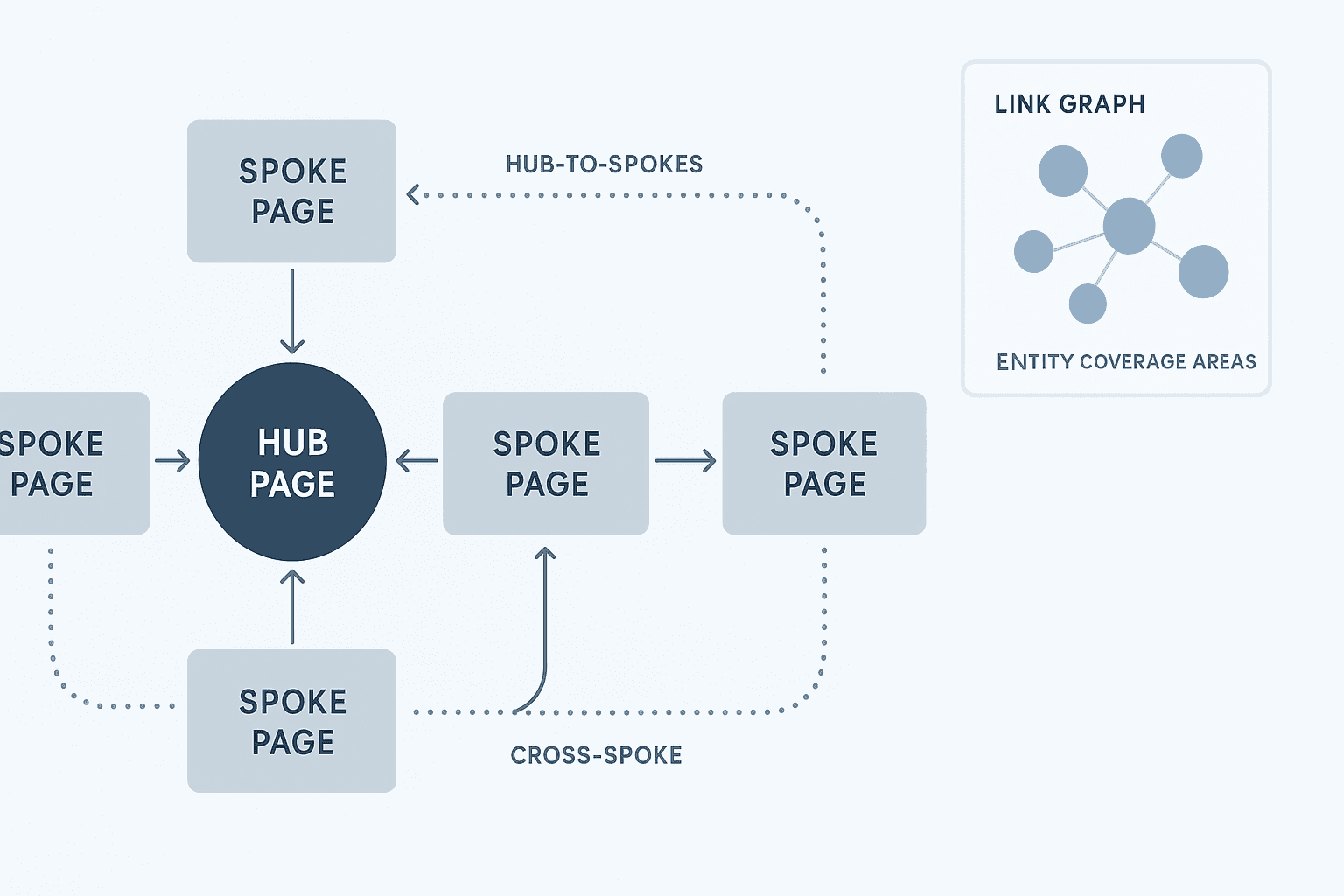
A semantic page starts with the concept, then breaks it into connected subtopics. For example, a central hub can cover the main idea, while supporting pages cover definitions, comparisons, use cases, internal processes, and related entities. The internal links show how those pieces belong together.
That is where the topic cluster becomes powerful. It turns separate articles into a navigable map of the subject. Users can move from broad explanation to specific implementation without leaving the site, and the site becomes easier to understand as a whole.
Internal linking difference (semantic SEO):
On a semantic SEO cluster, the hub page links out to the specific supporting pages it needs, and those supporting pages link back to the hub using meaningful anchor text. For instance:
- /running-shoes/ (hub) links to:
- /running-shoes/sizing-chart/
- /running-shoes/for-arch-types/
- /running-shoes/care-and-cleaning/
- /running-shoes/best-for-new-runners/
- Each supporting page then links back to the hub and to adjacent subtopics (e.g., sizing pages link to shoe care or arch-type guidance). This creates a clear internal path through the subject, not just a set of standalone pages.
Explain “thin vs interconnected” and how it affects user satisfaction and eligibility
The difference between thin and interconnected content is not just visual. Thin pages answer one phrase and stop. Interconnected pages show relationships, which helps users keep learning and helps search systems see topical depth.
A simple before-and-after view makes the shift obvious:
- Before: one keyword page, one target phrase, limited breadth.
- After: one hub page, several supporting pages, clear internal links, and a fuller subject map.
That structure is especially helpful when you want your content to feel authoritative rather than isolated.
Limitations: Where Keyword SEO Can Fall Short (and Semantic SEO Gets Harder)
Keyword SEO limitation: mechanical exact-phrase repetition risks underperforming when meaning matters
Mechanical matching can still produce pages, but it is fragile when interpretation matters more than wording. Yogrow Solutions describes traditional SEO as relying on repeating exact phrases and building backlink volume, which shows why the model can become too narrow. If the page is built around repetition instead of meaning, it may not satisfy the broader intent.
That is the core weakness of keyword SEO in a semantic environment. It can look optimized on the surface while failing to demonstrate depth underneath.
Keyword SEO limitation: thin independent pages struggle to build durable topical authority
A second limitation is structural. If every page stands alone, the site has little connective tissue. Kamran Asghar contrasts this with semantic SEO’s interconnected clusters, which suggests why thin pages can struggle to compound authority over time.
Backlinks can help, but volume alone does not fix weak topic coverage. A page may attract links and still fail to represent the subject well enough to support broader trust. The content has to earn its place in the topic, not just collect signals around it.
Semantic SEO limitation: requires more content breadth, entity coverage, and planning
Semantic SEO is stronger strategically, but it is also more demanding operationally. You have to map entities, decide which subtopics belong in the cluster, and keep the structure coherent as the site grows. That takes planning before publishing, not after.
The tradeoff is worth it when the topic matters. But teams should be honest about the lift. Semantic SEO is less about writing one strong page and more about orchestrating a content system.
Use Cases: When a US Website Should Choose Semantic SEO vs Keyword SEO
New site or early traction: start with keyword coverage for immediate query mapping, then expand into entities/topics
If you need quick alignment with clear searches and have limited resources, keyword-first can be a practical starting point. It gives you a direct path to specific queries and keeps the content plan simple. That can be useful when the site is new and needs fast execution.
But keyword-first should not be the end state. Once the first pages are live, the next step is usually to expand into related concepts and turn the site into a cluster-based structure.
Ecommerce category and product discovery: semantic clusters help cover attributes, use cases, and related entities
Semantic SEO is a strong fit for category and product discovery because shoppers rarely search one narrow phrase and stop. They compare attributes, look for use cases, and explore related products. A cluster model gives you space to cover those variations without forcing them onto one page.
That makes the site easier to browse and easier to interpret. It also helps the content reflect the full decision path, not just the first query.
Content hubs and thought leadership: semantic SEO naturally matches intent breadth and topical authority goals
If your goal is to build authority around a subject, semantic SEO is usually the better default. Thought leadership depends on breadth, clarity, and connected ideas. A keyword-only structure tends to underdeliver on all three.
This is where the shift from phrase to concept matters most. You are not just answering a search. You are building a reference point for the topic.
High-competition SERPs: prioritize semantic topical authority to improve eligibility for AI-driven results
In competitive spaces, meaning and depth become more valuable because many pages can target the same phrase. The differentiator becomes how comprehensively the topic is covered, and how clearly the site signals expertise. That is also where semantic measurement, including topical authority and AI citation eligibility, becomes more useful than a narrow rank report.
In short, choose keyword-first for speed and semantic-first for durability. Many US sites end up using both, but the order matters.
Implementation (US): How to Operationalize Semantic SEO with Topic Clusters
Plan around concepts/entities: define the target concept and map related entities/subtopics
Start by choosing one core concept, not one keyword list. Then map the related entities, user questions, and subtopics that belong to it. This gives you a content boundary, so you know what should be included and what should stay out.
Use a semantic map to clarify the concept before you draft the copy, so the scope is intentional and the relationships are clear.
Build interconnected topic clusters: replace thin pages with hub plus supporting pages that reinforce context
Next, convert the page plan into a cluster. Create one hub page for the concept, then assign supporting pages to the most important subtopics. Each page should have a clear role in the cluster, so the structure feels intentional.
A useful check is simple: if a page can stand alone without linking to the rest of the subject, it may be too thin. The cluster should make the relationships obvious through navigation and internal links.
Write comprehensive natural language so search engines and AI systems can process you as authoritative
Once the structure is in place, revise the copy for coverage. Use natural language, answer the full question, and avoid treating exact-match repetition as the main tactic. The page should read like a helpful explanation, not a keyword template.
This does not mean you ignore query language. It means you use it as a guide, then write around the concept in a way that is clear, direct, and complete. That is what makes the content easier to process as an authoritative source.
Measurement setup: track keyword ranks, if used, plus semantic-style topical authority and AI citation eligibility
Finally, update reporting. Keyword rankings can still be useful, especially for diagnosing visibility at the page level. But they should not be the only signal you trust.
Add a second layer of evaluation around topical authority and eligibility for AI citations. Kamran Asghar highlights this exact shift, and it is one of the clearest ways to tell whether semantic SEO is working. If the content is growing as a cluster, your reporting should reflect that growth.
Note: The steps above are conceptual implementation guidance based on described principles. They are not a prescriptive, tooling-specific workflow or a set of schema/technical requirements tied to a single, tested methodology.
Keyword research’s real role: language discovery, not exact-match repetition
Keyword research is still valuable, but its job has changed. It helps you understand how people describe a topic, which phrases they use, and where their language differs from your internal terminology. That makes it a discovery tool.
What it should not do is dictate how often you repeat a phrase on the page. HMDigitalSolution makes that distinction directly, and it is one of the most useful lines in the semantic SEO conversation. If you use keyword research to shape coverage, not repetition, it becomes far more strategic.
In a semantic workflow, keywords are inputs, not instructions. They help you choose the right concept language, but the content itself should be organized around meaning, intent, and topic relationships.
Frequently Asked Questions
Is semantic SEO the same as entity SEO or topic clustering?
They are closely related, but not identical. Entity SEO emphasizes the people, places, things, and concepts behind a topic. Topic clustering is the content structure that helps express that coverage. Semantic SEO usually includes both.
Does keyword research still matter if I’m doing semantic SEO?
Yes. It still helps you understand audience language. The difference is that it should guide topic selection and wording, not force repetitive exact-match copy.
How long does it take for semantic SEO to show results compared to keyword SEO?
It often takes more planning to build, because the structure is broader. Keyword SEO can be quicker to launch, but semantic SEO is designed to build more durable topical authority over time.
Can a small US startup do semantic SEO without building hundreds of pages?
Yes. You can start with one concept, one hub, and a small set of supporting pages. The important part is the relationship between pages, not the total volume.
What should I measure if I’m optimizing for AI citations instead of keyword rankings?
Track both, if possible. Keyword rankings show page-level visibility, while semantic SEO calls for looking at topical authority and whether the content is becoming eligible to be treated as an authoritative source.
Conclusion
Semantic SEO and keyword SEO are not just two ways to write pages. They are two different ways to think about what a site is trying to rank for. Keyword SEO targets phrases, while semantic SEO targets concepts, context, and the full topic structure around a user’s intent.
For US websites, the practical choice is usually not binary. Start with keyword mapping when you need speed, then expand into clusters when the subject deserves depth and durable authority. That approach gives you a way to build pages that search systems can interpret as meaningful, while also making the site easier for real users to navigate.
If you already have keyword pages, the next move is simple: audit your top pages, identify the thin ones, and expand one concept into a hub with supporting subtopics. A semantic SEO vs keyword SEO comparison only becomes useful when it changes how you build, measure, and improve your content.
Article created using Hovers.ai