Introduction
Semantic SEO matters when a startup needs search visibility without chasing every keyword variation by hand. For US teams, the real challenge is not just ranking for phrases, but building content that clearly explains a topic, its related entities, and the intent behind a query—this is where a content strategy anchored in topic modeling thinking becomes practical. In practice, semantic SEO is about meaning coverage and retrieval legibility, which means search engines and users can both understand what your page is truly about.
That matters because startups often publish content across blogs, landing pages, docs, and feature pages. If those pages do not reinforce one another, the result is confusion, thin coverage, and wasted effort. This guide gives you a shared mental model for semantic SEO, so content, product marketing, and growth teams can align on what to publish, how to organize it, and what to expect.

Use this as a hub page. The sections below stay high level on purpose, while more detailed sub-pages can cover implementation, signals, schema, internal links, and ecommerce use cases in depth.
Semantic SEO: Definition, Scope, and How It Differs From Keyword SEO
Definition and scope of semantic SEO
Semantic SEO is the practice of optimizing for meaning, context, and entities so a page satisfies the intent behind a search, not just the exact words used. Keyword SEO still matters, but it is only the starting point for discovery and prioritization. Semantic SEO extends that work by covering the topic relationships that help a page feel complete.
Google’s Search documentation emphasizes that search results are shaped by understanding content and how it matches a query—not solely by exact word matching—supporting the idea that optimizing for meaning/context is central to how modern search interprets pages (Google Search Central: How Search Works).
Common semantic SEO misconception: “semantic = keyword stuffing” (and why that’s wrong)
A common mistake is to treat semantic SEO as repetition of related terms. That is not the goal. Entity stuffing can make content awkward and thin, while natural language and topic coverage usually do the opposite. If the content reads like it was written for people and still maps the topic well, it is closer to semantic SEO than a page packed with repeated phrases.
Quick mental model: mapping meaning + context to user intent
A useful TOFU mental model is simple: start with the searcher’s problem, identify the core entities involved, then explain how those entities relate to each other and to the action the reader wants to take. That creates a page that is easier to interpret, easier to trust, and easier to connect with related pages later.
Purpose: Why Semantic SEO Matters for US Startup Growth
Purpose: why semantic SEO helps startups improve relevance and visibility
For startups, semantic SEO targets a few practical outcomes: better relevance, broader topic coverage, stronger authority signals, and answers that are easy to extract. It also helps teams avoid publishing pages that compete with one another for the same intent. That matters when every page has to earn its place.
Topic authority and intent coverage as compounding growth levers
The compounding effect comes from structure. A pillar page plus supporting cluster pages can expand a site’s indexable topical footprint over time, especially when each page covers a distinct intent. Instead of one page trying to do everything, the site becomes a network of related answers.
One practical way this shows up is through increased coverage of semantically related keywords and questions that share the same underlying intent. For example, Backlinko’s analysis of Google search results found that pages that rank for a set of keywords often include semantically related terms, suggesting that topical/semantic breadth is tied to better visibility across a topic (source: Backlinko, “On-Page SEO: The Definitive Guide,” https://backlinko.com/on-page-seo). In practice, startups that build clusters around a pillar typically see compounding lift because each new cluster page adds another “entry point” into the same topic ecosystem—so improvements in topical authority can help multiple URLs rank as the topic library grows.
Reduced fragility and better internal alignment as queries and language evolve
Semantic coverage makes content more resilient when query wording changes. Users may phrase the same need in different ways, but a well-built page still addresses the underlying concept. It also strengthens alignment inside the team: shared definitions and a clearer topic model reduce churn between content, SEO, and product marketing teams. When everyone agrees on how topics and intent map to real user language, the team spends less time rewriting pages and more time improving coverage where it matters.
Benefits: What Semantic SEO Helps You Achieve (Outcomes, Not Buzzwords)
Building on the Purpose section above, this is where Semantic SEO turns strategy into measurable outcomes—without relying on buzzwords.
Benefits: improved relevance for intent, stronger topical authority, and better SERP feature capture
Semantic SEO helps align content to search intent, improves the likelihood that your answers match user queries, and reduces cannibalization between similar pages. For evidence that structured, semantically clear content can improve how search systems interpret and present information, Google states that it uses page structure (including headings) to understand content (source: Google Search Central, “Using headings effectively” / “How Search Works”). When pages use clear, directly answering sections and coherent structure, search engines are better able to show the most relevant parts to users (source: Google Search Central, “Search snippets” and related documentation).
It is also a better way to build topical authority because the site covers the topic from multiple angles instead of repeating the same idea in slightly different words.
Better internal retrieval: users and crawlers find the right page faster
Good semantic structure helps both readers and crawlers. Clear page hierarchy, descriptive headings, and natural internal links make it easier to understand which page should answer which question. That improves navigation and supports crawl efficiency, especially on growing startup sites.
Content efficiency: fewer near-duplicate pages, more purposeful coverage
A semantic approach also lowers content waste. Instead of producing several near-duplicate posts, you can map one intent to one primary page and use other pages for adjacent questions. That gives each piece of content a clearer role in the broader site.
Trust signals as a semantic quality layer
E-E-A-T matters here because credibility shapes how useful the page feels, especially to US audiences comparing options or evaluating advice. Clear authorship, source discipline, and useful explanations all support trust. In semantic SEO, trust is part of meaning, not an afterthought. For additional context on how Google views search quality signals and experience, Google’s Search Quality Rater Guidelines emphasize evaluating expertise, experience, authoritativeness, and trustworthiness as key aspects of content quality (source: Google Search Quality Rater Guidelines).
Use Cases: Where Semantic SEO Fits in a US Startup Website
Use cases without diving into full execution: where to apply semantic thinking
Semantic SEO fits almost anywhere a startup publishes useful content. The strongest use cases are pillar guides, cluster posts, landing pages, help docs, comparisons, templates, and glossary pages. Each one can serve a different intent without overlapping too much with the others.
Content types: blogs, landing pages, documentation, and product or feature pages
For a B2B SaaS startup, onboarding docs may answer setup questions, feature pages may explain value, blog posts may educate, and comparison pages may handle evaluation intent. Semantic SEO connects them so the reader can move through the journey without losing context.
Topic clustering by customer questions, not only keyword lists
The simplest workflow is: identify customer intents, group them into topic families, then assign one pillar page and a set of supporting cluster pages. If the concept already has a page and only needs deeper meaning coverage, update it. If it represents a new intent, create a new page.
When to create new cluster pages vs update existing ones
Use new pages when the question is meaningfully different. Use updates when the topic is adjacent and the existing page can absorb more entity depth. This is where the sub-pages fit naturally: How to Implement Semantic SEO in Your US Content Strategy, Semantic SEO Content Framework for Agencies in the US, and The Practical Guide to Semantic SEO for Ecommerce US Pages all belong as dedicated cluster content, not as one oversized guide.
Examples: What Semantic SEO Looks Like in Real Content
Example patterns: entity-rich explanations, relationship coverage, and snippet-ready answers
Here is the core shift. A keyword-focused page may repeat a phrase and stop there. A semantic page explains what the concept is, how it relates to adjacent concepts, and what the reader should do next. That makes the page more useful and more legible.
| Before | After |
|---|---|
| Repeats the same phrase in headings | Uses natural headings that answer different sub-questions |
| Talks about a topic in isolation | Connects the topic to related entities and decisions |
| Hides the answer deep in the page | Gives a direct answer early |
Information architecture example: pillar page + cluster mapping for a startup concept
A pillar page can define the topic, explain the major relationships, and link to narrower pages. Supporting pages can then handle specific questions like implementation, comparison, structured data, or internal linking. That is how a broad concept becomes a usable content system.
Entity-based content strategy example: weaving entities and relationships naturally
If your startup is in payments, for example, the page might naturally mention checkout flow, fraud checks, billing, integrations, and buyer trust. The goal is not to repeat those terms endlessly. The goal is to show how they interact in the workflow.
Intent alignment example: direct answers, FAQ-style sections, and “what this is / who it’s for / how it works” structure
The best semantic pages often start with a direct definition, then move into purpose, context, and action. That structure helps readers, and it gives search systems a clearer summary of the page. Internal anchor text should then point readers to the most relevant cluster page, not just a generic navigation label.
Limitations: What Semantic SEO Can’t Do (and What to Expect in Practice)
Limitations of semantic SEO: not instant, not a replacement for technical SEO or quality
Semantic SEO is an ongoing coverage strategy, not a one-time fix. It does not replace keyword research, crawlability, page performance, or technical hygiene. If the site is hard to crawl or the content is weak, meaning-based optimization will not rescue it.
Constraints: thin clusters, duplicate content, and low author credibility
The most common failure modes are entity stuffing, thin cluster pages, cannibalization, duplicate content, schema misuse, and unclear intent. Those issues weaken both relevance and trust. When that happens, the site may look active without becoming clearer.
Common pitfalls: over-optimizing entities unnaturally, misusing schema
Schema helps when it clarifies what is already visible on the page. It does not help when it tries to force meaning that the content does not actually support. The safe rule is simple: mark up what you show, and only use the minimal necessary types.
When to prioritize semantic work vs other growth levers
A good prioritization rule is to tackle semantic improvements that unlock new intent coverage first. If the site has major technical issues, fix those too. If the product message is unclear, semantic SEO will inherit that confusion.
Information Architecture for Semantic SEO: Pillars, Clusters, and Content Hierarchy
Information architecture for semantic SEO
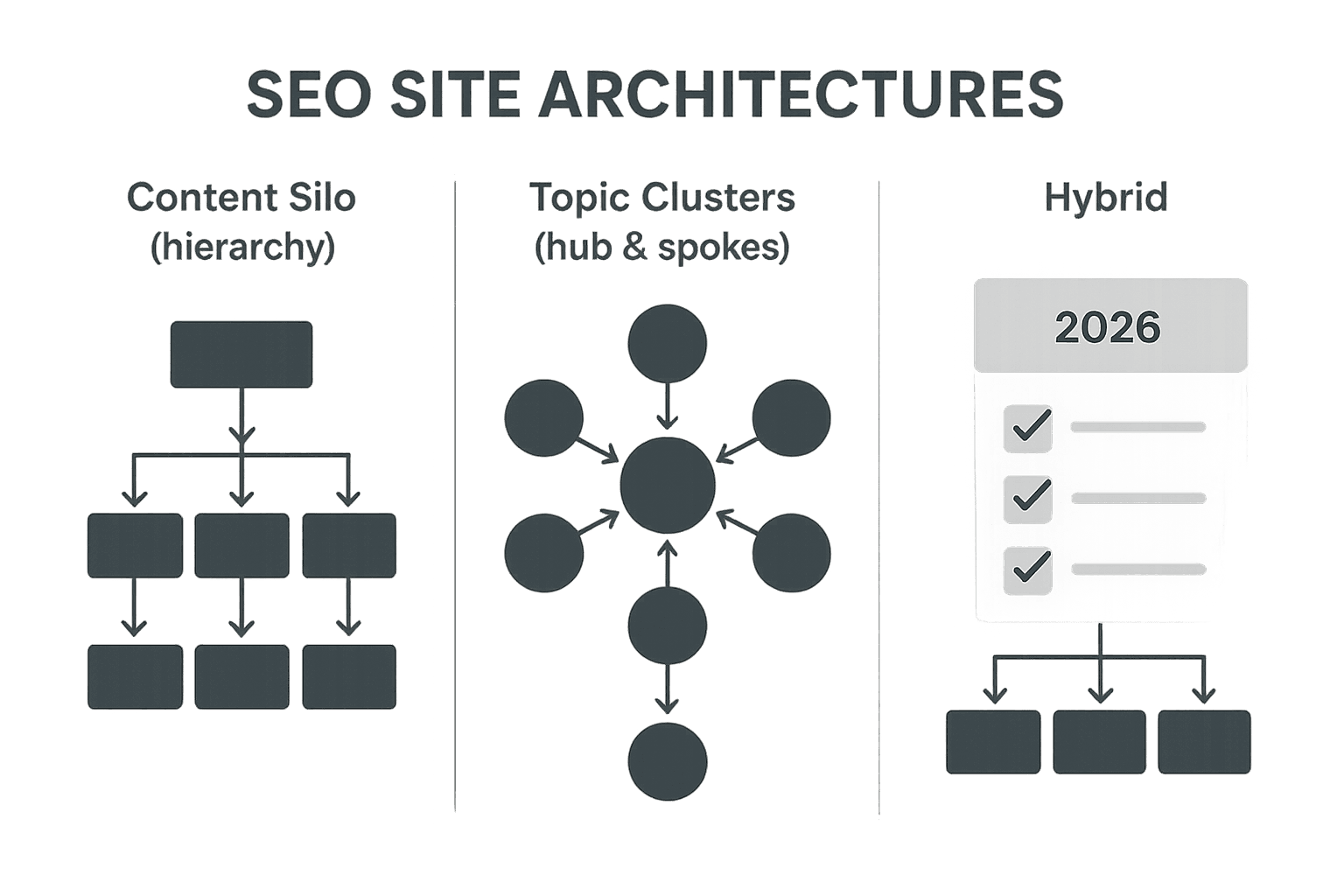
Pillar pages own the broad topic. Cluster pages own narrower intents. Together, they create a hierarchy that tells readers and search systems what matters most. A flat content model makes that hierarchy harder to see.
Pillar plus cluster implementation checklist for startups
A practical content map might look like this: one pillar page, then a few cluster pages for implementation, comparison, topic modeling, structured data, and internal linking. For example, a startup could build around one core concept and support it with cluster pages such as How to Create Semantic Hubs for Topic Authority in the US and Ways to Build Semantic Internal Links for US Startups.
Avoiding orphan pages and preventing cluster duplication
Each page should own one main intent. If two pages answer the same question, one of them should be merged or redirected into the stronger page. That prevents orphan pages and keeps the site easier to navigate.
Topic cluster design: how to pick subtopics that map to user questions
The best cluster topics come from real questions, buying-stage concerns, and product education needs. If the page does not serve a distinct question, it probably does not need to exist yet.
Entity-Based Content Strategy: Research Entities, Cover Relationships, and Build Topical Completeness
Entity-based content strategy
Entity research is practical when you treat it as a list of the people, products, concepts, and organizations that shape the topic. Then validate those entities against your market so you know which ones matter. That keeps the page grounded in real language, not invented jargon.
Entity mapping for a startup niche
Entities belong in definitions, examples, comparisons, and process steps. For a startup audience, that can include product categories, integrations, workflow steps, decision criteria, and adjacent tools. The point is to reflect the meaning of the topic, not to name-drop everything you can think of.
How to weave entity mentions naturally across pillar and clusters
Relationships matter as much as mentions. Show how the entities interact in a workflow, how they influence one another in a decision, or how one tool connects to another. Topical completeness means covering the meaning behind the intent, not inflating word count.
Concrete example (three-entity relationship mapped across pillar + clusters):
Imagine your pillar is “Customer Support Automation for Startups” and your clusters cover ticket routing, chat-to-ticket workflows, and help center setup. You might research and validate three core entities that repeatedly co-occur in the customer journey:
- CRM (e.g., Salesforce/HubSpot as the system of record for customers)
- Help desk (e.g., Zendesk/Freshdesk as the place tickets live and get routed)
- Live chat (e.g., Intercom as the channel that captures conversational intent)
Workflow you can write across the pillar and clusters:
- Pillar (entity relationship framing): Explain that a startup typically starts with Live chat to capture user intent, then uses the CRM to enrich context (plan, account type, lifecycle stage), and finally creates or updates a case in the Help desk for routing and resolution. The relationship is: Live chat → CRM enrichment → Help desk ticket creation/routing.
- Cluster: ticket routing (relationship drives the “how”): Describe the decision criteria for routing once the Help desk receives a new ticket: routing depends on CRM fields like subscription tier and product area. In practice: If CRM indicates “Pro” and the issue is “Billing,” route to Billing queue in the Help desk.
- Cluster: chat-to-ticket (relationship drives the “when”): Show the trigger conditions that determine when Live chat escalates into a Help desk ticket, using CRM context. Example: When the visitor’s issue matches an unresolved FAQ topic, and CRM shows they’re an active user, create a ticket in the Help desk and pre-fill account details from the CRM.
- Cluster: help center setup (relationship shows “why”): Connect the entities by explaining how Help desk automation reduces repeat contacts by linking chat and tickets to help articles, while the CRM helps personalize article recommendations (e.g., product-specific documentation).
This worked example demonstrates relationship mapping in practice: the point isn’t repeating each entity everywhere—it’s using their interaction (system-of-record enrichment, ticket creation, routing rules, escalation triggers) to express the meaning behind the search intent naturally.
Topical completeness: what enough meaning coverage looks like
A quick sanity check helps: does the page define the topic, explain the main relationships, use terms naturally, and avoid awkward repetition? If yes, the content is probably closer to semantic completeness.
Intent Alignment: Answer Questions Clearly for Snippet-Like Extraction
Intent alignment
A useful structure maps intent to section type. Definitions answer what it is, problem sections explain why it matters, how it works sections explain the process, alternatives cover comparison intent, and FAQs capture remaining questions. That gives the page a clean logic.
How to structure direct answers within a semantic page
Put the answer early, then expand after. That way the reader gets clarity fast, while the page still remains useful for deeper evaluation. This is especially helpful for US users who scan quickly and want to know whether the page solves their problem.
Snippet-readiness formatting
Snippet-friendly pages often use short definition blocks, numbered steps, and concise comparisons. FAQs should support the page’s intent, not exist only to add more keywords. The goal is to answer the question that was actually asked.
Aligning sections with the way US users phrase problems
If a searcher asks about setup, answer setup. If they ask about differences, answer differences. Mismatched answers are a common source of weak performance because the page may be relevant in theme but not in utility.
Schema Markup for Semantic Clarity: When and How to Use JSON-LD
Schema markup for semantic clarity
JSON-LD helps reduce ambiguity by describing the page in a machine-readable way. For startup sites, the main schema types to consider are Article, Organization, and FAQPage. Use them when the page visibly supports them.
What to mark up for startup content types
Article works well for editorial content, Organization helps define the company entity, and FAQPage fits real question-and-answer sections. The trigger is not desire for more markup. The trigger is content that genuinely matches the schema type.
When schema helps vs when it’s unnecessary or risky
The simplest rule is, only mark up what you show. If the page does not contain an FAQ section, do not add FAQPage markup. If the content does not reflect the marked-up entity, the markup becomes a liability rather than a signal.
Avoiding misuses: wrong entities, mismatched content, over-markup
A safe workflow is implement, test with validators, then monitor whether the page is eligible for richer display. Overuse can blur the page’s meaning instead of clarifying it. That is why schema should support semantic SEO, not attempt to replace it.
Internal Linking Strategy: Hub-and-Spoke Structure and Anchor Text That Reinforces Meaning
Internal linking strategy
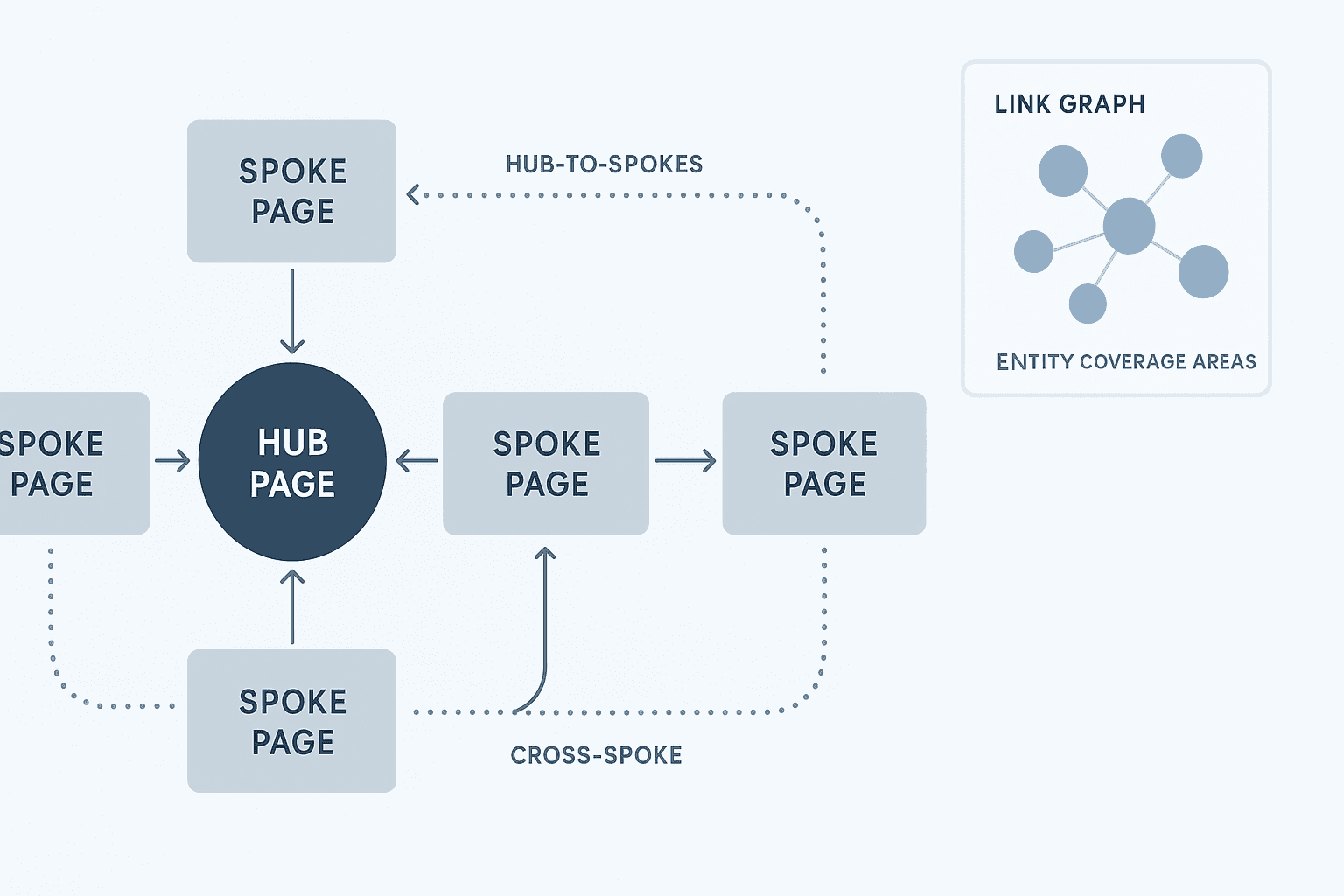
Hub-and-spoke linking works well for semantic SEO because the pillar page acts as the hub and the cluster pages act as spokes. A flat linking pattern, where every page links everywhere, makes it harder to see what the site considers most important.
Anchor text selection to reinforce conceptual hierarchy
Anchor text should describe the destination intent in natural language. For example, link to a page about internal structure with language that reflects that topic, not with a vague phrase. That improves both clarity and topical reinforcement.
How internal links support crawl and index coverage of cluster pages
The pillar should point to the cluster pages that own the related intent. Cluster pages should also connect back to the pillar so the hierarchy stays visible. This is especially useful for helping search systems discover and prioritize the deeper pages.
Preventing orphan pages and reducing duplicate intent overlap
A quick checklist helps: every cluster page should be reachable from the pillar, every important page should have at least one contextual inbound link, and no two pages should claim the same intent. That keeps the content system coherent.
Operationalizing E-E-A-T for Semantic SEO: Publishing Process, Proof, and Trust Signals
E-E-A-T operationalization for startups
A startup-friendly workflow is simple: one person drafts, a subject-matter reviewer checks accuracy, and an editor verifies sources, structure, and trust signals. That process is lightweight, but it makes the content feel more credible.
Experience signals: what your team has actually done
Experience content is especially persuasive when it reflects real implementation details, lessons learned, and practical tradeoffs. That kind of specificity makes the page feel grounded instead of generic.
Expertise signals: credentials and subject-matter ownership
Strong author bios, clear editorial standards, and visible ownership all help. So do citations and update dates, because they show the content is maintained rather than abandoned.
Authoritativeness and trust: citations and update cadence
A pillar page should be revisited on a regular schedule, and high-impact cluster pages should be checked alongside it. Before publishing, confirm that the page answers the intended question, reflects real experience, uses trustworthy sources, and is accurate about what it claims.
Measurement & KPIs for Semantic SEO: Coverage Proxies and Retrieval Signals
Measurement and KPIs
Semantic SEO is best measured with proxies rather than single magic numbers. Useful leading indicators include topical breadth, crawl and index coverage of cluster pages, and internal link depth. Those show whether the content system is growing in a structured way.
How to measure semantic coverage without guaranteed rankings attribution
Segment KPIs by pillar and cluster. The pillar should show broad topic coverage and clear hierarchy, while cluster pages should show whether they are discoverable and distinct. That helps diagnose whether the issue is structure, coverage, or page quality.
Tracking indexability and internal linking depth as leading indicators
Index coverage can reveal whether important pages are being discovered. Internal linking depth can show whether the site is reinforcing the right relationships. Together, they tell you whether the semantic structure is visible.
SERP feature capture and content extraction visibility
You can also watch for snippet-like visibility and FAQ-style results through Search Console and SERP tools. Review changes weekly for indexing and monthly for broader visibility trends. Just avoid over-attributing a single change to one update, because semantic SEO usually works as part of a larger system.
Common Pitfalls: How Startups Get Semantic SEO Wrong (and How to Fix It)
Common pitfalls
The biggest mistakes are entity stuffing, thin cluster pages, duplicate content across clusters, schema misuse, and unclear intent. Each one creates a different symptom, such as low visibility, poor snippets, or internal cannibalization.
What thin looks like: missing intent coverage and weak relationship coverage
A thin page often has a definition but no relationships, or a list of terms without useful explanation. The fix is not more repetition. The fix is better coverage of the underlying meaning.
Use this diagnostic checklist to see whether your semantic coverage is truly thin:
- Intent coverage
- Does the page clearly answer the primary question implied by the keyword (not just define the terms)?
- Can a visitor tell what to do next (e.g., steps, criteria, examples, decision points) without finding another page?
- Does it cover the most common related sub-questions users ask (pain points, “how it works,” “why it matters,” “how to choose”)?
- Entity coverage (not just term mentions)
- Do you describe the entities involved (people, tools, concepts, constraints) in a way that’s understandable on its own?
- Are key entities introduced with enough context that they’re not interchangeable or generic?
- Does the page distinguish between similar concepts (what’s the difference, when to use which)?
- Relationship coverage
- Does the page explain how entities interact (cause/effect, inputs/outputs, prerequisites, comparisons)?
- Are relationships shown in context (within scenarios, examples, workflows) rather than just listed?
- If you remove a sentence and replace it with another synonym, does the relationship still make sense and remain specific?
- Evidence of usability
- Is there at least one concrete example, mini-case, workflow, checklist, or snippet that demonstrates the meaning—not just the vocabulary?
- Would someone who knows the topic broadly still learn something meaningful from this page?
- Cross-cluster signals
- Are you trying to cover multiple distinct intents on the same page (and accidentally flattening everything)?
- Does this page overlap heavily with another cluster page while still failing to be the best “home” for one intent?
Entity over-optimization and unnatural repetition risks
If the content sounds forced, the semantic signal probably got weaker, not stronger. Natural language wins because it helps the page feel usable and trustworthy.
To self-check, ask:
- Does the page repeat the same entities/phrases unusually often compared to how a human would explain the topic?
- Are sentences written to “include terms” rather than to communicate a relationship, example, or decision?
- Does rewriting in more natural language reduce the perceived clarity of the page—or does clarity actually improve?
Duplicate and near-duplicate cluster content
When two cluster pages overlap too much, merge them or choose one to own the intent. That consolidation usually makes the remaining page stronger and easier to maintain.
Practical checks:
- Do both pages target the same primary question with only minor wording differences?
- Do they share the same structure, examples, and claims (not just overlapping themes)?
- If a user reads one page, is the other still necessary to fully answer their intent?
Schema misuse patterns and safer alternatives
If markup is present but the page does not visibly support it, remove it. Keep the schema minimal, accurate, and aligned with the content that users can actually read.
Use these rules of thumb:
- Does every structured data field map to content that appears on the page (not hidden, not implied)?
- Is the schema type appropriate for the page purpose (avoid forcing the “best fit” that doesn’t match)?
- If you remove the schema, would the page still be helpful and complete for the user?
Frequently Asked Questions
Is semantic SEO just another term for keyword research?
No. Keyword research helps you find the topic and understand demand, but semantic SEO is about meaning, context, and relationships. Think of keyword research as the input and semantic SEO as the full content model.
How long does it take for semantic SEO changes to show results?
It is not a one-page fix. Semantic SEO usually improves over time as you publish or refine pillar and cluster content, strengthen internal links, and improve coverage. The practical expectation is ongoing iteration, not instant payoff.
Should we use schema markup on every page or only some?
Only where the page content clearly supports the schema type. Article, Organization, and FAQPage are useful when they match visible content. If they do not match, leave them out.
What’s the difference between a topic cluster and a pillar page?
The pillar page is the hub that covers the broad topic. Cluster pages are the spokes that answer narrower questions or support adjacent intents. Together, they create a clearer information architecture.
How do we avoid duplicate content across cluster pages?
Assign one intent to one primary page. If two pages chase the same question, consolidate them or rewrite one to cover a different angle. That reduces cannibalization and improves clarity.
Can semantic SEO help with product or feature pages, not just blog posts?
Yes. Feature pages, docs, and landing pages can all benefit from semantic structure when they explain what the product does, how it fits into a workflow, and what problem it solves. The model is the same, even if the page type is different.
Conclusion
Semantic SEO gives US startups a practical way to organize content around meaning instead of repetition. When you combine pillar and cluster architecture, natural entity coverage, direct answers, careful schema use, and strong internal links, the site becomes easier for both users and search systems to understand.
The best next step is to choose one core topic, map the main intents around it, and decide which page should own each one. From there, build the pillar, add the cluster pages, and use a lightweight E-E-A-T workflow to keep the system trustworthy and current. That is the foundation of a durable semantic SEO program.
Article created using Hovers.ai