Introduction: What “silo” and “topic clusters” really mean for rankings
Topic Clusters vs Silo Structure (SEO): Which Works Best in 2026? The honest answer is that neither wins by name alone. What matters is how each model shapes internal links, crawl paths, and topical coverage, because that is what search engines actually process.
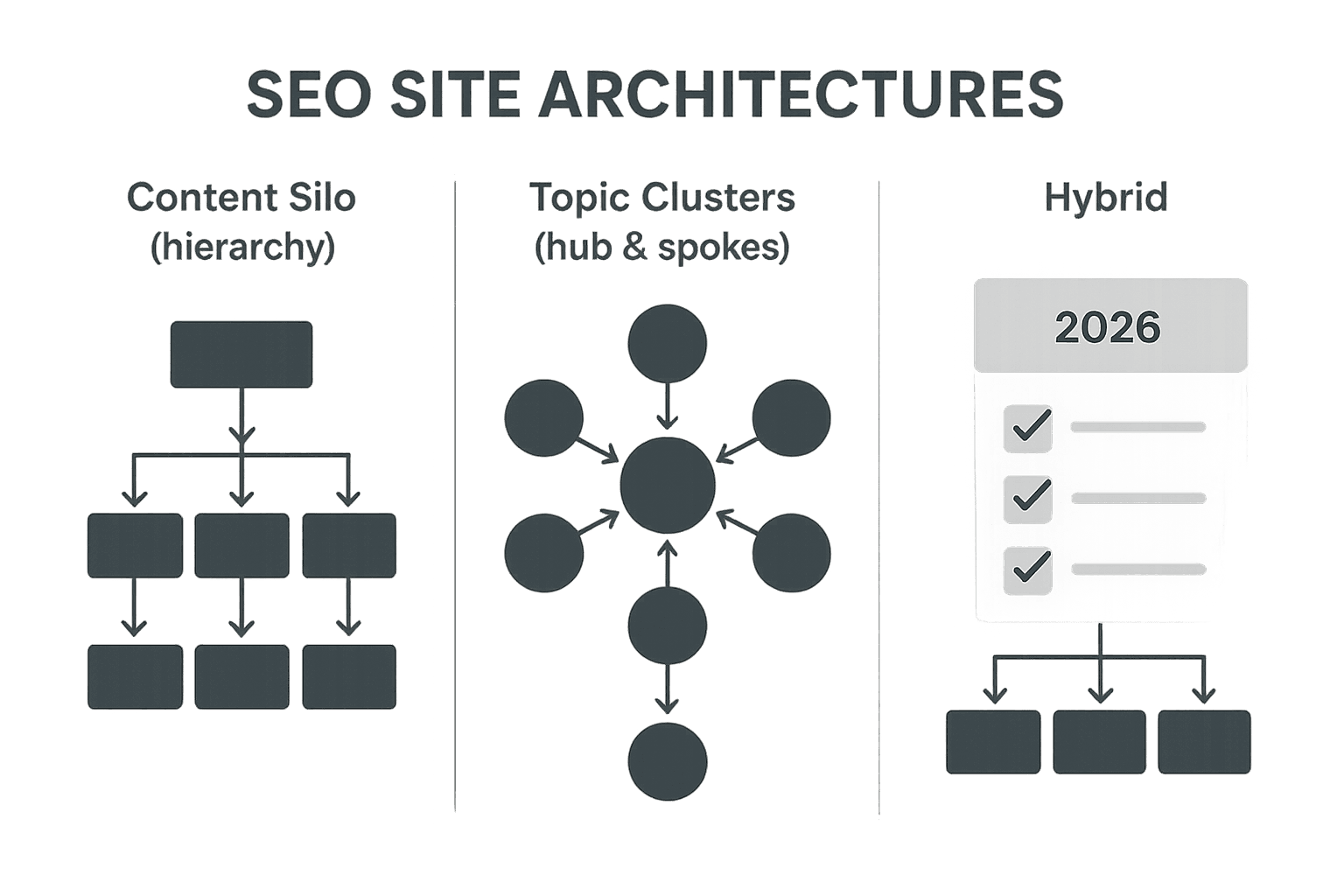
A silo keeps related pages tightly grouped, usually with a clear parent page and limited cross-linking. A topic cluster also has a hub and supporting pages, but it usually allows more flexible linking between closely related pages when it helps users and search discovery. In practice, the difference is less about labels and more about whether your architecture helps Google find, understand, and trust the whole topic set.
If you want a deeper foundation on cluster planning, the complete guide to topic clusters for digital SEO success is the right companion piece. This article stays focused on the decision you actually need to make in 2026, which structure is easier to implement, scale, and measure without creating mess later. 
The new reality is simple. Search systems reward clarity, but they also reward breadth, freshness, and connected coverage. So the real question is not, “Which structure is more elegant?” It is, “Which structure gives your site the cleanest route from keyword to crawl to ranking?”
Quick comparison table: Silo vs Topic Clusters vs Hybrid
Here is the fast version. Use this when you already know your constraints and want the practical tradeoff.
| Criterion | Silo structure | Topic clusters | Hybrid model |
|---|---|---|---|
| Internal linking | Tight, hierarchical, controlled | Hub-led, flexible, contextual | Structured, but not rigid |
| Crawlability | Clear paths, fewer surprises | Strong if hubs are well linked | Usually best balance |
| Topical coverage | Good for narrow topics | Better for broad topic expansion | Best for growing libraries |
| Orphan page risk | Lower if maintained well | Lower if hub planning is solid | Lowest when managed properly |
| Cannibalization risk | Lower, but can become isolated | Higher if links and intent overlap are sloppy | Moderate, but manageable |
| Best for | Small to mid-sized sites with clean categories | Content-heavy sites that need semantic depth | Sites that need scale without chaos |
| Maintenance | Easier at small scale, brittle at large scale | Easier to expand, harder to govern | Most practical for mature teams |
The blunt takeaway is this. A silo works when you want control. Topic clusters work when you want growth. A hybrid works when you want both and you have enough discipline to manage it.
How site architecture affects internal links, crawlability, and topical coverage
Search engines do not rank your architecture directly. They respond to what the architecture enables. That usually breaks into three mechanisms: internal link flow, crawl discovery, and query coverage.
A silo concentrates link equity inside a section. That can help a core page receive strong internal signals, especially when you have a clear category tree. The downside is that silos often become too sealed off. Pages inside the silo may rank for narrower terms, but the site can miss broader semantic relationships because cross-topic relevance is hidden from crawlers and users.
Topic clusters work differently. They build a hub around a theme, then connect supporting pages through contextual links that reflect sub-intents, not just folder location. This makes it easier for search engines to see depth across the subject, which matters when Google is evaluating whether your site deserves to own a topic, not just a keyword.
Google’s own guidance on crawlable links and site structure reinforces the point. If crawlers cannot reliably reach your pages through plain HTML links, discovery suffers. See Google Search Central on making links crawlable and organizing a website structure. Search Console also shows how URL and query impressions expand over time, which is exactly what you want to monitor after any architecture change.

Mechanically, a cluster usually wins when your goal is to cover a topic completely. It creates more opportunities for related queries to share signals, which helps search engines understand topical intent at a page and section level. A silo can still perform well, but it often needs stronger editorial discipline to avoid dead ends, thin sections, and buried pages.
Internal linking patterns that scale: silos vs cluster hubs
The difference shows up in how pages relate to each other. In a silo, links often move vertically. Category page to subcategory, subcategory to article, article back to parent. That is clean, but it can become too linear. In a cluster, the hub is the anchor, and supporting pages can link laterally when the user journey calls for it.
That matters because internal linking is not just navigation. It is a signal of priority, relevance, and relationship. Search Engine Land and Ahrefs have both written extensively about the role internal links play in discovery and ranking signals. If you want a practical reference, Ahrefs’ guide to internal linking is a strong starting point, and it aligns with what SEOs keep repeating in Reddit threads and SEO communities: the structure matters less than whether important URLs get enough qualified links.
A few rules hold up in both models:
- Link from high-authority pages to new or underperforming pages.
- Keep anchor text descriptive, not cute.
- Avoid isolated content that only lives in XML sitemaps.
- Use hub pages to organize subtopics, not to dump every related link into one wall.
- Keep related pages connected by intent, not just by folder.
That is why many teams now prefer a hybrid. It keeps the order of a silo, but uses the flexibility of a cluster where users and search engines need it.
Pros, cons, and best-fit use cases (by site type and content maturity)
A lot of SEO advice treats architecture like a philosophy. It is not. It is an operational choice. The right model depends on how many pages you have, how often you publish, and how much overlap exists between topics.
Silos are useful when the site is small, the categories are obvious, and the goal is to stay tidy. They are also easier for stakeholders to understand. The problem appears when the site grows. Over time, strict silos can create content gaps between related themes, weak cross-linking, and duplicate effort when separate teams publish content that should have shared a hub.
Topic clusters are stronger for editorial scale. They let you map search intent more naturally, which is critical in 2026 because SERPs often reward depth across multiple query variations. The tradeoff is governance. If you do not manage hub scope, supporting page overlap, and internal linking discipline, clusters can blur into a mess.
A hybrid model gives you room to grow. It lets you keep category boundaries where they matter, then use cluster logic to connect related intents. For most mature SEO programs, that is the practical answer.
Winner by scenario: which model best fits eCommerce, local, SaaS, and agencies
| Site type | Better fit | Why |
|---|---|---|
| eCommerce | Hybrid | Category silos help structure inventory, while clusters help education, comparisons, and buying guides |
| Local business | Silo, usually | Smaller sites often need clarity more than complexity, especially with service and location pages |
| SaaS | Topic clusters | Product education, problem-aware content, and use-case pages benefit from broad semantic coverage |
| Agencies | Hybrid | Service silos stay organized, while cluster content supports expertise, lead gen, and topical breadth |
For eCommerce, a pure silo can be too rigid if you need to connect product education, category pages, and comparison content. For local sites, you usually do not need a large cluster machine unless the business has multiple services, locations, or content teams.
For SaaS, topic clusters usually win because the funnel is wider. Users search by problem, solution, feature, and comparison. Cluster logic maps to that behavior naturally. For agencies, hybrid is the sweet spot. Service pages need structure, but thought leadership and educational content need flexible linking to build authority.
The community consensus is pretty consistent. In SEO forums, the most useful advice is rarely “pick the perfect model.” It is “pick the model you can maintain.” Broken architecture loses to disciplined execution every time.
How to choose and migrate: a practical decision framework for 2026
If you are choosing from scratch, start with the simplest question. What do you need your site architecture to do, support a stable catalog of pages, or expand topical authority fast? If the answer is stability, lean silo. If the answer is expansion, lean clusters. If the answer is both, build hybrid from day one.
Here is a practical framework.
-
Audit your current page universe.
Group pages by search intent, not by CMS category. Look for overlap, orphan pages, and duplicate subtopics. -
Identify your primary hub themes.
A hub should represent a meaningful search topic, not just a label in navigation. If the theme cannot support multiple useful subpages, it is too small for a cluster. -
Check internal link reach.
Count how many clicks separate important URLs from your strongest pages. If important pages are buried, architecture is already hurting discovery. -
Map cannibalization risk.
If two pages target the same intent, decide which one owns it. Do this before migrating links. -
Choose the control model.
Use silo logic for fixed sections, cluster logic for content expansion, and hybrid for most real-world sites. -
Launch in stages.
Never rebuild everything at once. Start with one hub, one section, or one content family. Validate, then expand. -
Verify in Search Console and analytics.
Watch URL discovery, query expansion, and landing page behavior before you move to the next section.
If you want automation here, this is where Hovers fits well. It can generate a cluster map from a single keyword, research intent, draft hub and supporting pages, and plan internal links without the usual spreadsheet sprawl.
Migration checklist: from silo to clusters (or clusters to hybrid)
Use this sequence to avoid the common failure modes.
- Freeze new content in the old structure until the new hub map is approved.
- Choose one canonical page per intent.
- Redirect or consolidate overlapping pages before expanding new ones.
- Rebuild internal links from hubs to the strongest supporting pages first.
- Keep hub scope tight. Do not overload a single hub with unrelated subtopics.
- Preserve URL consistency where possible. If URLs must change, use clean 301 redirects.
- Review canonical tags, breadcrumbs, and sitemap entries together.
- Test the whole path in a crawler before publishing.
The biggest migration mistakes are simple. Teams change URLs before mapping intent. They merge too many pages into one hub. They leave old silo links in place, which creates mixed signals. Or they create clusters that look smart on paper but do not reflect how users search.
Measuring impact: KPIs to track in Google Search Console and analytics
Do not guess whether a structure change worked. Measure the behavior it is supposed to improve.
In Google Search Console, the most useful signals are URL discovery and query expansion. If a cluster is healthy, you should see more pages receiving impressions for related long-tail queries. You should also see clearer differentiation between pages that target adjacent intents. When the architecture is clean, cannibalization usually drops because one page owns one intent more clearly.
Track these metrics first:
- Impressions by URL group, not just by page.
- Clicks from non-brand queries tied to the cluster theme.
- Average position by query family, especially long-tail queries.
- Number of ranking URLs per intent, to catch cannibalization.
- Indexed pages vs submitted pages, to spot discovery issues.
- Internal links to hub pages and priority support pages, if you track them in a crawler.
In analytics, look at engagement signals that suggest the architecture makes sense to users. If a hub works, people should move deeper into the topic instead of bouncing after one page. That means watching landing page engagement, scroll depth, session paths, and conversion assists where relevant.
For authoritative references, Google’s Search Console help documentation is useful for understanding indexed coverage patterns, and Google Search Central explains how internal links affect crawl discovery. Use those as your baseline, then add your own site data.
A simple validation window is 4 to 12 weeks after implementation, depending on crawl frequency and site size. If nothing changes after the new links and hub structure are indexed, the problem is usually not the model. It is the execution.
Final verdict: Which structure should you build and where Hovers fits
Here is the no-nonsense verdict. If you run a small site with stable content, a well-built silo is enough. If you run a growing content program, topic clusters usually outperform because they scale better across intent, discovery, and coverage. If you are serious about long-term SEO, a hybrid model is often the smartest choice because it preserves structure without sacrificing flexibility.
So the answer to Topic Clusters vs Silo Structure (SEO): Which Works Best in 2026? is this, topic clusters win for expansion, silos win for simplicity, and hybrid wins for most teams that need both order and momentum. The best architecture is the one that makes your internal linking obvious, your crawl paths short, and your topical coverage complete.
If you want to implement topic clusters fast, start with Hovers. It can turn one keyword into a full cluster map, then let autonomous agents research intent, draft hub and supporting pages, and plan internal links around the structure that search engines can actually follow. If you are ready to move from theory to execution, book a demo or request access and see how a cluster-first workflow uses GSC insights to keep topical authority moving in the right direction.