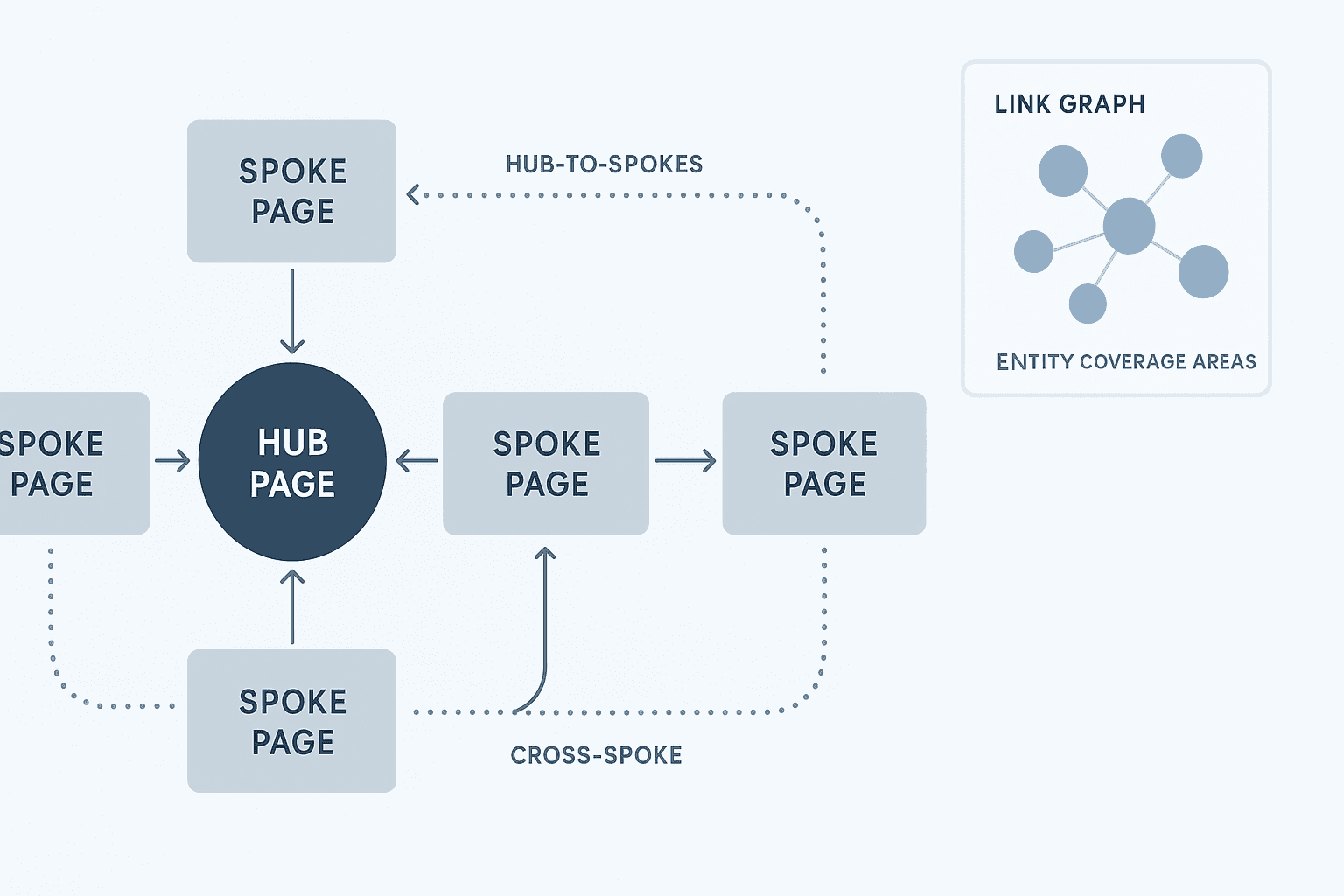
Technical Overview: What Topic Clusters Really Are (as a Link Graph + Entity Model)
If you want to how to build topic clusters for SEO at scale, stop thinking about them as a loose content idea and start treating them like a system. At implementation time, a topic cluster is not just a “hub page plus some related articles.” It is a set of documents that cover a bounded entity space, connected by a deliberate internal link graph, with clear rules for what belongs, what links where, and what gets updated when search behavior changes.
That shift matters because most cluster failures are not strategic. They are technical. Pages drift out of scope. Internal links become inconsistent. Similar pages compete for the same query. Orphans appear. The result is a cluster that looks organized in a spreadsheet but behaves like fragmented content in crawl and indexing.
Here is the useful model: entities define what should exist, documents encode that coverage, and links define how search engines and users move through the cluster. If one of those layers is weak, topical authority never fully forms. If you are already familiar with the pillar page framework from the Complete Guide to Topic Clusters for Digital SEO Success, this article goes one layer deeper and focuses on the architecture that keeps clusters stable as they scale.

Caption: A cluster should behave like a controlled graph, not a pile of related posts.
A practical way to think about this is simple. The hub page owns the broad intent. Spokes own specific sub-intents. Internal links express hierarchy, sibling relationships, and supporting evidence. That is why tools like Hovers.ai are useful when you are scaling, because the work is no longer just keyword research. It becomes graph design, template governance, and continuous validation.
How Topic Clusters Work in Practice: From Keyword to Link Graph
A cluster becomes operational when you convert research into a deterministic structure. In other words, one seed keyword should produce a predictable set of entities, page types, and links. That is the difference between “we covered the topic” and “the site can maintain coverage without manual chaos.”
Search engines do not need your brand story. They need signals that a set of pages covers a topic deeply, consistently, and with clear relationships. The cluster’s job is to make those relationships easy to crawl and hard to misunderstand. Community discussions around internal linking at scale usually land on the same point: structure beats vibes. That is still true in 2026.
A repeatable workflow (research → content map → linking plan → publish → validate)
-
Research the entity set first.
Start with the core topic, then expand into related entities, subtopics, modifiers, questions, and task-based intents. This is where the cluster boundary gets defined. If the boundary is fuzzy, the cluster will sprawl. -
Map each entity to one document type.
Decide whether the entity belongs on a hub page, a spoke page, a supporting glossary entry, or a utility page. One entity should have one primary home. That prevents duplication and later cannibalization. -
Generate the link graph before writing.
Do not write first and link later. Define which pages link to the hub, which spokes link to each other, and which anchors are reserved for major navigational routes. This turns internal linking into a rule set, not a judgment call. -
Publish with template constraints.
Templates should control title patterns, intro framing, internal link slots, FAQ blocks, schema, and canonical logic. The content team should not reinvent the cluster on every page. -
Validate against crawl and query data.
After launch, use Google Search Console to see whether pages are getting impressions for the intended entity set, whether the hub is absorbing broad queries, and whether spokes are winning distinct long-tail terms.
For technical context on internal links and crawlability, Google’s SEO Starter Guide and crawl guidance on managing crawl budget for large sites are worth keeping close.
Step-by-Step Implementation Blueprint for Scaling Topic Clusters (2026)
Scaling clusters is a governance problem as much as a content problem. The blueprint needs to work when one strategist manages ten pages, and also when a team ships hundreds of pages across multiple categories, locales, or product lines. The answer is not more manual review. The answer is more structure upfront.
Implementation steps that work for large catalogs
-
Create a cluster registry.
Every cluster needs a source of truth: core entity, target intent, hub URL, spoke URLs, status, owner, and refresh date. Without a registry, orphaning and duplication creep in fast. -
Define naming conventions.
Use consistent naming for topic groups, page templates, and URL slugs. That makes QA, automation, and analytics much easier. If one team calls it “keyword cluster” and another calls it “content set,” you already have drift. -
Assign one primary page per intent.
Broad informational intent belongs on the hub. Narrower informational, transactional, or diagnostic intent belongs on spokes. If two pages target the same primary intent, expect cannibalization. -
Standardize internal link slots.
Each template should include fixed positions for related hub links, sibling links, and contextual links. That keeps link distribution consistent and prevents accidental overlinking or underlinking. -
Add editorial rules for anchors.
Anchors should be descriptive, varied, and entity-based. Avoid repeating the exact same anchor every time. The goal is clarity, not mechanical repetition. -
Build QA into publishing.
Every new page should pass checks for canonical tag, indexability, title uniqueness, H1 alignment, outgoing links, and cluster membership. If it fails QA, it does not ship. -
Wire in search feedback.
Use Google Search Console data to compare intended page targets with actual queries. If a spoke is attracting the hub’s broad query, the page hierarchy is probably wrong. -
Schedule refresh logic.
Clusters are not one-and-done. When a hub starts losing impressions or a spoke gains traction on a broader query, the cluster should be re-evaluated. The architecture must allow page reclassification without breaking the entire set.
For teams that want automation, this is where an AI workflow helps. Hovers.ai is relevant because it can start from a single keyword, research intent, build the cluster map, plan internal links, and then use Search Console signals to keep improving the structure over time.
Core Components / Building Blocks (So Your Clusters Don’t Collapse)
The easiest way to break a cluster is to treat it as a content calendar. The safer approach is to manage it as a system with owned components. Each component has a job, a failure mode, and a QA rule.
| Component | Purpose | Common failure | Control rule |
|---|---|---|---|
| Hub page | Owns the broad entity and primary intent | Too generic or too long | Define one clear promise and one primary query family |
| Spoke page | Covers a specific sub-intent or entity facet | Overlaps the hub or another spoke | Map each spoke to one unique intent |
| Internal anchors | Signal relationship and hierarchy | Repetitive or vague anchor text | Use descriptive, varied phrases |
| Link slots | Ensure predictable outgoing links | Inconsistent placement across templates | Reserve fixed positions in templates |
| Governance layer | Prevent drift across teams | Pages added outside the model | Require registry approval before publish |
| Measurement layer | Validate performance and coverage | Blind optimization | Track query-page fit, impressions, and orphan status |
A good cluster needs more than pages. It needs rules. The biggest technical win is determinism: if someone enters the same topic tomorrow, the system should tell them what page to create, what it should link to, and what it should not touch.
That is also where cluster collapse starts to show up. If templates drift, the hub may stop linking to the right spokes. If content is added ad hoc, new pages can become orphaned. If a team publishes two pages for the same entity because they both “felt relevant,” the cluster starts to cannibalize itself. These are not content opinions. They are architecture faults.
Real-World Technical Examples: Hub/Spoke Internal Linking Patterns That Scale
Internal linking at scale works best when patterns are explicit and repeatable. The point is not to make every page identical. The point is to make page relationships obvious to crawlers and stable for editors. That is what people in SEO communities keep circling back to when they ask how to architect internal links at scale.

Caption: Scalable clusters use repeatable link routes, not ad hoc links from every page to every page.
Three scalable link patterns (and when not to use them)
-
Hub to spoke, spoke back to hub
This is the standard pattern. The hub links to every major spoke, and each spoke links back to the hub using a descriptive anchor. Use it when the topic family is tight and the hub genuinely owns the broad intent.
Do not use it when the hub page is only a thin directory. Thin hubs create weak crawl signals and poor user value. -
Hub to spoke, spoke to sibling spoke only when needed
This pattern works when two subtopics are naturally adjacent, such as setup and troubleshooting, or strategy and measurement. It helps users move laterally without forcing them to return to the hub every time.
Do not use it if sibling links are becoming a substitute for clear hierarchy. Too many lateral links can blur page roles. -
Cluster with supporting nodes
In large sites, some clusters need extra layers, such as glossaries, template guides, or diagnostic pages. These supporting nodes sit between the hub and deeper spokes, or between closely related spokes.
Do not use this pattern unless the topic is large enough to justify it. Extra layers make crawl paths cleaner only when the cluster has real depth.
The anti-pattern is easy to spot. It looks like every page linking to every other page, often with near-duplicate anchors. That creates noise, not authority. Another anti-pattern is using the same generic anchor everywhere, like “learn more” or “related post.” Search engines and users both need context.
The practical rule is this: link by function, not by habit. A hub link should say, “This is the main page for this entity.” A spoke link should say, “This is the detailed page for this sub-entity.” If the anchor does not communicate that, it probably needs rewriting.
Benefits & Drawbacks (2026) + Common Technical Challenges and Fixes
The technical upside of cluster architecture is real. It gives you cleaner topical coverage, easier internal linking governance, better crawl paths, and clearer page ownership. It also makes large sites more manageable because every new page has a place in the system.
But clusters are not magic. They create new obligations. You need more discipline around templates, page intent, canonicalization, and maintenance. The larger the site, the more those details matter.
One benefit of this model is that it reduces accidental fragmentation. Instead of publishing standalone articles that each chase a few related keywords, you build a connected structure that can absorb new queries over time. Another benefit is that it makes refresh work more rational. You can update the hub, prune weak spokes, or split overloaded pages without guessing.
The downside is operational complexity. Teams often underestimate the amount of governance needed to keep clusters clean. Once content volume grows, the failure modes become predictable.
Troubleshooting checklist for cluster failures
-
If a hub is underperforming, check intent match.
The page may be too broad, too thin, or not clearly framed around the primary entity. -
If a spoke is cannibalizing the hub, narrow the spoke or reassign the target.
Two pages should not chase the same main query family. -
If pages are not being indexed reliably, inspect internal links and canonicals first.
Orphaned pages and conflicting canonical signals are common reasons clusters fail. -
If crawl paths are inconsistent, audit template-level link slots.
Manual links are not enough in a large system. -
If the cluster is bloated, split it by entity family.
A single cluster can become too large to remain coherent. -
If anchor text is repetitive, diversify it by intent.
Use entity language, not recycled phrases. -
If refreshes are random, assign cluster owners and review cadences.
Without ownership, the cluster decays quietly. -
If Search Console shows impressions on the wrong page, re-map the query to the page type.
Validation should trigger structure changes, not just copy edits.
The key idea is simple. Cluster health is measurable. If you cannot explain why a page exists, what it links to, and which queries it should own, the architecture is incomplete.
Future Technical Directions: Entity SEO, Agents, and Autonomous Cluster Maintenance
Topic clusters are moving from static planning to dynamic maintenance. That is where entity SEO matters. The system is no longer just about grouping keywords. It is about modeling entities, relationships, and query patterns in a way that can be maintained at scale.
The next step is automation with guardrails. AI agents can already help research intent, map entities, draft content, and propose internal links. The real value comes when those agents are constrained by rules: one intent per page, one primary hub per cluster, deterministic anchor logic, and validation against live search data.
That feedback loop is the important part. Search Console tells you what the market is actually doing, not what your spreadsheet assumed. If a page starts attracting queries outside its intended role, the cluster should adapt. If a hub loses broad impressions, the architecture should be reviewed. If a spoke underperforms but matches an emerging intent, it may need a new internal link route or a tighter content brief.
This is also where autonomous tools will separate themselves. The useful ones will not just generate pages. They will monitor cluster health, detect orphaning, flag cannibalization, identify coverage gaps, and prioritize fixes based on query and page performance. That is the practical direction for 2026.
If you want to operationalize that approach now, use Hovers to generate clusters from a single keyword, plan the internal link graph, and keep iterating from GSC signals. That is the difference between publishing content and managing a durable SEO system. For teams serious about how to build topic clusters for SEO at scale, the winning move is not more manual effort. It is a better architecture, better rules, and a tighter feedback loop.