Understanding Psychographic Targeting
Definition of Psychographic Targeting
Psychographic targeting is the practice of reaching audiences based on their psychological characteristics, values, interests, lifestyle choices, and attitudes rather than just demographic data like age or location. It’s the difference between knowing someone is a 35-year-old woman in Denver and understanding that she’s an environmentally conscious yoga enthusiast who values sustainable fashion and spends her weekends hiking.
Think of it this way: demographics tell you who your customers are, but psychographics tell you why they make the decisions they do. Psychographic data includes information about personality traits, hobbies, beliefs, purchasing behaviors, media consumption habits, and aspirations. When you understand these deeper motivations, you can craft marketing messages that actually resonate with people on a human level.
The power of psychographic targeting lies in its specificity. Instead of broadcasting a generic message to everyone in a demographic segment, you’re speaking directly to the values and desires that drive purchasing decisions. Someone might buy a luxury car because they value status and performance, while another might choose the same model because it’s eco-friendly and aligned with their sustainability values. Same product, completely different messaging needed.
Psychographic targeting has become increasingly sophisticated thanks to digital data collection, social media insights, and behavioral tracking. Platforms like Hovers leverage AI to help marketers understand these nuances at scale, making it possible to segment audiences based on psychological profiles rather than relying on surface-level characteristics alone.

Importance in Marketing Strategy
In today’s saturated marketing landscape, psychographic targeting isn’t optional. It’s essential. Here’s why: consumers are bombarded with approximately 4,000 to 10,000 ads daily. Generic marketing messages get lost in the noise. Messages tailored to someone’s values, lifestyle, and psychological profile actually get noticed.
Consider the statistics. Research shows that personalized marketing experiences drive a 20% increase in sales, and psychographic targeting is one of the most powerful personalization levers available. When you understand what someone truly cares about, your marketing becomes more relevant, more compelling, and ultimately more effective.
Beyond conversion rates, psychographic targeting builds stronger customer relationships. People feel understood when brands address their actual values and aspirations. This creates emotional connections that transcend typical transactional relationships. A customer who feels understood becomes a brand advocate, and brand advocates are worth their weight in gold.
Differences Between Psychographics and Demographics
The distinction between psychographics and demographics is critical for modern marketers. Demographics are the easy stuff: age, gender, income, education level, geographic location, marital status, and family size. These characteristics are straightforward to measure and segment.
Psychographics go much deeper. They explore the “why” behind purchasing decisions: values, beliefs, lifestyle choices, personality traits, interests, opinions, attitudes, and aspirations. Where demographics segment by who people are, psychographics segment by what people believe and what they care about.
Here’s a practical example. Two 40-year-old men with identical incomes live in the same city. Demographics suggest they should respond to the same marketing messages. But if one is an outdoor adventurer who values experiences and environmental conservation while the other is a homebody who prioritizes comfort and financial security, they’re completely different consumers. Psychographic targeting would identify this distinction and create entirely different campaigns for each.
The real power emerges when you combine both approaches. Demographics help you find your audience at scale, while psychographics help you speak to them in ways that actually motivate action. This hybrid approach is where modern marketing excellence lives.
Benefits of Psychographic Targeting
Enhanced Customer Engagement
Engagement is the currency of modern marketing, and psychographic targeting is one of the most effective ways to earn it. When your messaging aligns with someone’s core values and lifestyle, they’re exponentially more likely to engage with your content, share it, and act on it.
Think about why some ads make you stop and actually watch while others you scroll past instantly. The ones that stick typically touch on something you care about. They speak your language, reference your interests, and address your aspirations. That’s psychographic targeting in action.
Enhanced engagement manifests in multiple ways. Higher email open rates occur when subject lines reference something psychographically relevant. Social media interactions increase when content feels personally crafted rather than mass-produced. Website dwell time improves when visitors immediately find content that speaks to their specific interests and values.
This engagement creates a feedback loop. More engaged customers provide more data, which allows for even more refined psychographic segmentation, which drives even higher engagement. Companies that master this cycle gain significant competitive advantages.
Improved Marketing ROI
Here’s the brutal truth: most marketing budgets are inefficient. Money gets wasted reaching people who have no interest in what you’re selling, or worse, reaching them with the wrong message. Psychographic targeting dramatically reduces this waste.
By focusing your marketing dollars on psychographically aligned audiences, you improve conversion rates, reduce customer acquisition costs, and increase customer lifetime value. Companies that implement psychographic targeting effectively report 10% to 20% improvements in marketing ROI within the first year.
The math is straightforward. If you can convert 5% of a psychographically targeted audience compared to 2% of a broad demographic audience, you’re generating 150% more value from the same marketing spend. Scale that across multiple campaigns, and the difference becomes dramatic.
Beyond conversion rates, psychographic targeting reduces marketing waste. You’re not paying to reach people fundamentally uninterested in your offering. Every dollar works harder because it’s reaching someone actually likely to become a customer.

Building Customer Loyalty
Customer acquisition is expensive. Customer retention is profitable. Psychographic targeting excels at building loyalty because it creates deeper emotional connections.
When customers feel understood at a psychological and values-based level, they develop stronger brand loyalty. They’re less likely to churn when a competitor offers a slightly better price. They’re more likely to recommend your brand to others. They become repeat buyers instead of one-time purchasers.
This happens because psychographic targeting creates resonance. A customer who aligns with your brand’s values and sees themselves reflected in your messaging develops a sense of belonging. They’re not just buying a product; they’re expressing their identity and aligning with a community of like-minded people.
Brands that excel at psychographic targeting build passionate communities. Think about how fiercely loyal customers are to brands like Patagonia (values-driven environmental commitment), Apple (innovation and design philosophy), or Harley-Davidson (lifestyle and identity). These aren’t just customer relationships; they’re tribal affiliations built on shared psychographic characteristics.
How to Implement Psychographic Targeting
Step 1: Define Your Objectives
Before diving into psychographic data collection, clarify what you’re trying to achieve. Are you looking to increase customer lifetime value? Reduce churn? Enter a new market segment? Build brand awareness among a specific lifestyle community?
Your objectives shape everything downstream. Different goals require different psychographic insights. A goal of building loyalty might focus on values alignment, while a goal of entering a new market might focus on lifestyle and aspirational characteristics.
Start by asking critical questions: What does success look like? Which customer segments provide the most value? Which audiences are currently underserved by your messaging? What psychological barriers prevent people from becoming customers?
Document your objectives clearly. Share them with all stakeholders. Make sure everyone understands that psychographic targeting isn’t a generic initiative; it’s targeted work designed to accomplish specific business goals.
Step 2: Collect Psychographic Data
Psychographic data collection requires a multi-channel approach. No single source provides complete psychographic profiles. Instead, combine multiple data sources to build comprehensive audience understanding.
Primary research is essential. Conduct surveys and interviews asking about values, lifestyle choices, interests, personality traits, and aspirations. Ask open-ended questions that reveal motivation, not just behavior. Why do customers choose your product? What problems are they solving? What role does your product play in their lives?
Social media analysis provides rich psychographic insights. Analyze the content your audience engages with, the communities they join, the causes they support, the influencers they follow. These signals reveal values, interests, and lifestyle preferences.
Website behavior and analytics data offer psychographic clues. Which content sections do different audience segments spend time on? What pages do they visit in sequence? What content types do they engage with most? These behaviors reveal interests and priorities.
Third-party data providers like Experian, Acxiom, and others maintain psychographic data at scale. While less personal than primary research, this data enables broader segmentation and targeting.
Consider implementing surveys on your website, using heat mapping tools to understand engagement, analyzing customer reviews for emotional language and values, and monitoring social listening tools to understand how your audience discusses your industry.
Step 3: Analyze and Segment Your Audience
Raw data is useless without analysis. Organize psychographic data into coherent audience segments. Each segment should represent a distinct psychographic profile with shared values, interests, lifestyle characteristics, and motivations.
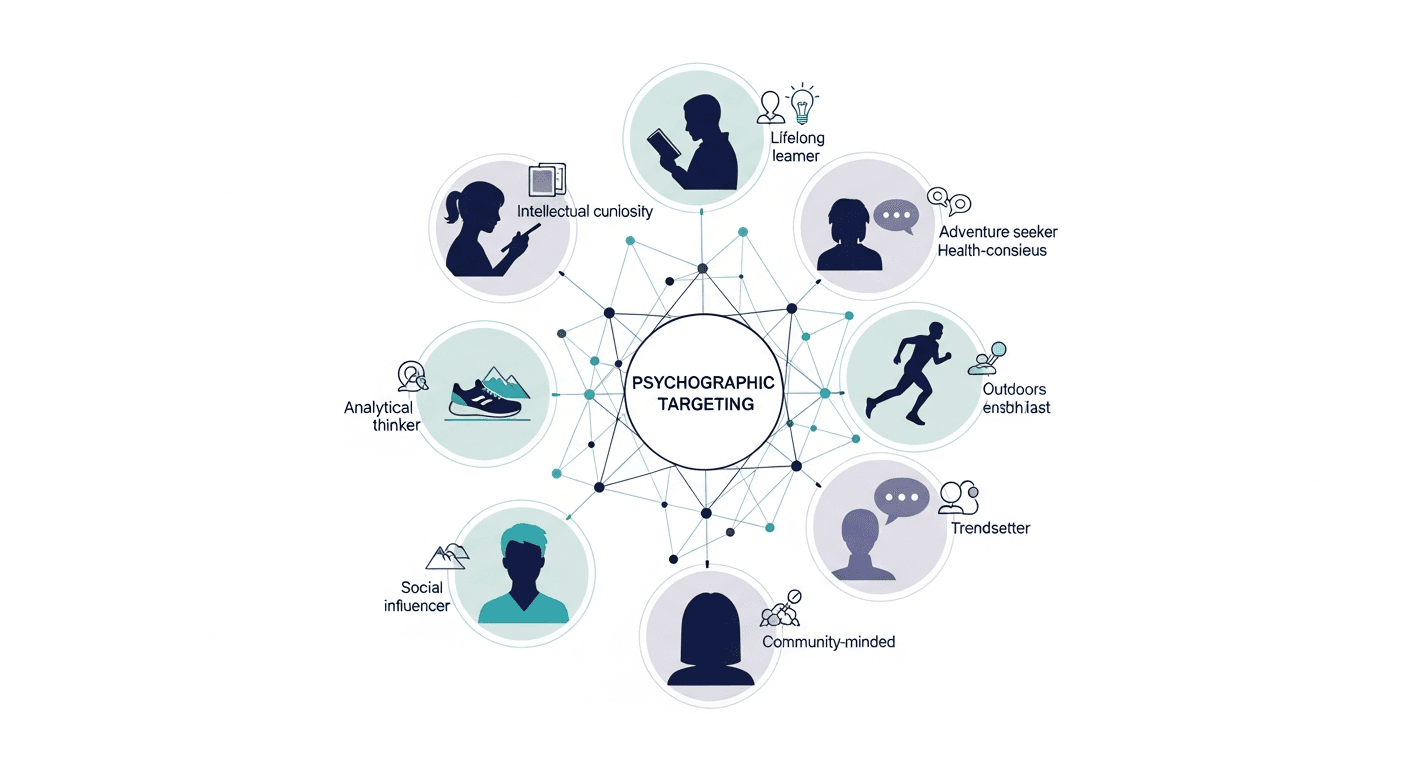
Use clustering techniques to group similar psychographic profiles. You might discover segments like “value-driven professionals,” “lifestyle-focused adventurers,” “pragmatic budget-conscious consumers,” or “status-seeking luxury enthusiasts.” The specific segments depend on your industry, product, and collected data.
Create detailed psychographic personas for each segment. Go beyond basic demographics. Describe their values, what they read, who they follow, their career aspirations, their lifestyle choices, their pain points, and their aspirations. The more detailed, the better your targeting becomes.
Validate your segments through additional research. Do these psychographic profiles actually exist in your market? Can you reach them effectively? Are they large enough to justify targeted campaigns? Do they have distinct needs relative to other segments?
Tools that leverage AI, like Hovers, can help accelerate this analysis. AI algorithms can identify patterns in psychographic data that humans might miss, creating more sophisticated and actionable segmentation.

Step 4: Create Targeted Marketing Campaigns
With psychographic segments defined, create targeted campaigns that speak specifically to each segment’s values and psychology.
Messaging is paramount. Different psychographic segments need different messaging angles. A value-driven segment might respond to sustainability and social impact messaging, while an achievement-oriented segment might respond to success and performance messaging. Don’t use the same copy for different psychographic segments.
Channel selection matters too. Different psychographic segments consume media differently. A wellness-focused segment might be active on Instagram and engaged with wellness podcasts, while a professional segment might prefer LinkedIn and industry publications. Target your audience where they actually are.
Content creation should feel tailored. Instead of one generic piece of content, create variations that speak to different psychographic profiles. A single product might be positioned as sustainable and ethical for one segment, as innovative and cutting-edge for another, and as reliable and trustworthy for a third.
Campaign testing is essential. Test messaging, creative approaches, and channels with each psychographic segment. Measure which approaches resonate most strongly. Use these learnings to refine future campaigns.
Real-World Examples of Psychographic Targeting
Case Study: Successful Brands Using Psychographic Segmentation
Patagonia represents psychographic targeting excellence. The company targets environmentally and socially conscious consumers, weaving sustainability into every marketing message. Their psychographic targeting goes beyond environmental values. It encompasses a lifestyle of outdoor adventure, a willingness to invest in quality over quantity, and political/social activism. Every campaign, from their “Don’t Buy This Jacket” initiative to their environmental advocacy, speaks directly to this psychographic profile.
The result? A fiercely loyal customer base that views Patagonia as more than a clothing company. They’re buying alignment with their values. Competitors might offer similar performance at lower prices, but they can’t offer the same psychographic resonance.
Apple represents another masterclass. Apple targets psychographically distinct segments differently. The “think different” creative appeals to innovative, design-conscious consumers who see themselves as creative rebels. The same product gets marketed through different psychographic lenses: aspiration, creativity, innovation, and lifestyle. This multifaceted approach reaches different psychological profiles with the same product.
Nike uses psychographic targeting to build communities around lifestyle and aspiration. They target aspiring athletes, active lifestyle enthusiasts, and people who view themselves as driven and determined. The famous “Just Do It” campaign isn’t about shoes; it’s about psychology. It appeals to people who see themselves as capable of overcoming challenges.
Warby Parker reaches psychographically distinct segments. For one segment, the appeal is affordable accessibility and democratizing luxury. For another, it’s sustainability and social responsibility. For another, it’s style and self-expression. Same product, radically different positioning based on psychographic profiles.
Industry-Specific Applications
In the fitness industry, psychographic targeting segments beyond age and income. One segment values community and social fitness, responding to group class messaging. Another values personal achievement and tracking metrics, responding to performance messaging. A third values wellness and holistic health, responding to mind-body integration messaging.
Financial services use psychographic targeting extensively. Someone with $500,000 might be psychographically conservative and risk-averse (emphasize security and stability) or psychographically aggressive and growth-focused (emphasize returns and opportunity). Same income level, completely different psychology, completely different marketing approach.
In the luxury market, psychographic targeting determines positioning. One segment buys luxury for status and exclusivity messaging. Another buys for craftsmanship and heritage. Another buys for innovation and cutting-edge design. Luxury brands typically target all three segments simultaneously but with completely different messaging.
Tech companies use psychographic targeting to reach different user types. Early adopters are psychographically different from pragmatic users who are different from risk-averse users. Messaging that excites early adopters (“revolutionary,” “cutting-edge”) might alienate pragmatic users who want proven reliability.
The travel industry segments psychographically across adventure seekers, luxury comfort seekers, cultural explorers, and family-focused travelers. Same destination, completely different positioning and messaging based on psychographic profiles.
Common Questions About Psychographic Targeting
Why Do Marketers Use Psychographic Segmentation?
Marketers use psychographic segmentation because it works. The fundamental reason is simple: psychographic targeting increases relevance, which increases engagement, which increases conversions.
Beyond the mechanics, marketers use psychographic segmentation because consumer behavior demands it. Modern consumers expect personalized experiences. They expect brands to understand them at a deeper level. Generic mass marketing feels increasingly inappropriate in an era where personalization is technically possible.
Psychographic segmentation also addresses a critical business challenge: standing out. In commoditized markets where products are similar, psychographic differentiation becomes the key competitive advantage. You can’t win on product features alone, so you win by understanding and speaking to customer psychology better than competitors.
Finally, psychographic segmentation enables efficiency. By targeting right and speaking relevant to psychographically aligned audiences, you reduce marketing waste and improve ROI. In an increasingly cost-conscious environment, this efficiency matters.
Does Psychographic Targeting Really Matter?
Skeptics question whether psychographic targeting delivers meaningful returns. Fair question. The honest answer: yes, but with caveats.
Psychographic targeting matters when implemented well. Poor implementation delivers minimal returns. Generic psychographic segments that don’t meaningfully differ in values or behavior won’t improve marketing performance. Psychographic insights that don’t translate into distinct messaging won’t drive engagement improvements.
Psychographic targeting matters most in certain contexts. For premium or lifestyle products with emotional decision factors, psychographic targeting generates substantial returns. For commodity products with purely rational purchasing drivers, psychographic targeting matters less.
The maturity of your data infrastructure affects whether psychographic targeting matters. If you can collect, analyze, and activate psychographic insights efficiently, they matter significantly. If implementing psychographic targeting requires months of manual work, the ROI might not justify the effort.
However, the trend is clear: psychographic targeting is becoming table stakes. Brands that excel at it gain competitive advantages. Brands that ignore it increasingly lose relevance. In the long term, psychographic targeting doesn’t just matter; it’s fundamental to marketing effectiveness.

Recent Trends in Psychographic Targeting
AI and Psychographic Segmentation
Artificial intelligence is transforming psychographic targeting. Historically, psychographic segmentation required extensive manual analysis and intuition. AI enables rapid, sophisticated analysis of massive psychographic datasets.
Machine learning algorithms identify psychographic patterns humans would miss. They process social media data, behavioral data, survey responses, and third-party data to reveal nuanced psychological profiles. They segment audiences based on complex combinations of values, interests, and behaviors that traditional methods couldn’t identify.
Natural language processing analyzes customer feedback, social media posts, and reviews to extract psychographic insights at scale. Instead of reading 100 customer reviews manually, AI processes 10,000, identifying patterns in language that reveal values and motivations.
Predictive analytics use psychographic data to anticipate future behavior. By understanding someone’s psychological profile, AI predicts which products they’ll buy, which messaging will resonate, and when they’re likely to churn. These predictions enable proactive, personalized interventions.
Platforms like Hovers leverage AI to help marketers implement psychographic targeting at scale. AI-powered content creation can generate variations tailored to different psychographic segments. Automated analysis reveals psychographic insights from customer data. This democratizes sophisticated psychographic targeting capabilities previously available only to large enterprises.
Future of Psychographic Targeting in Marketing
Psychographic targeting will become increasingly sophisticated and personalized. As data collection, AI capabilities, and privacy-compliant tracking methods evolve, brands will understand customer psychology with increasing precision.
Real-time psychographic targeting will emerge. Instead of static psychographic profiles that last months or quarters, future systems will continuously update profiles as new behavioral and preference data arrives. Marketing messages will adapt in real time based on evolving psychographic understanding.
Privacy-first psychographic targeting will grow in importance. As third-party cookies disappear and privacy regulations expand, brands will rely more on first-party data and privacy-compliant psychographic insights. This shift actually strengthens psychographic targeting because it forces deeper customer understanding and direct relationship building.
Hyper-personalized experiences based on psychographic understanding will become the norm. Instead of reaching customers with segment-level messaging, future marketing will create individualized experiences reflecting each person’s unique psychological profile. This goes beyond “Hi, John” personalization to genuinely customized experiences.
Cross-channel psychographic activation will increase. Psychographic understanding will flow across all marketing channels: email, social media, web experiences, paid advertising, and customer service interactions. Every touchpoint will reflect understanding of customer psychology.
The competitive advantage of psychographic targeting will diminish as more brands implement it effectively. This doesn’t mean it will become less important; it means it will become foundational. Brands that haven’t mastered psychographic targeting will increasingly lose competitive relevance.
The convergence of psychographic and behavioral targeting will continue. The distinction between these approaches is blurring as behavioral data reveals psychological motivations and psychological profiles predict behavior. Future marketing will integrate both seamlessly.
To stay ahead of these trends and implement sophisticated psychographic targeting effectively, consider exploring Hovers. Our AI-powered platform helps automate content creation tailored to different psychographic segments, enabling you to reach audiences on a deeper level at scale. Start using psychographic targeting to enhance your marketing strategy today and watch your engagement, loyalty, and ROI improve meaningfully.
Article created using Hovers.ai