Understanding Content Mapping
What is Content Mapping?
Content mapping is the strategic process of aligning your marketing materials with specific stages of the buyer’s journey. Think of it as creating a roadmap that guides your potential customers from their first awareness of a problem all the way through to making a purchase decision. Rather than randomly publishing content and hoping it resonates, content mapping ensures every piece you create serves a specific purpose at a specific moment in your customer’s buying process.
At its core, content mapping involves three critical activities: identifying your target audience segments (personas), understanding the journey these personas take from problem recognition to purchase, and then strategically positioning content to address their needs at each stage. It’s not rocket science, but it is a discipline that separates companies winning deals from those constantly wondering why their marketing efforts fall flat.
The beauty of content mapping lies in its specificity. Instead of creating generic “about us” or “features” content that appeals to everyone and no one, you’re building a targeted content strategy that speaks directly to where your prospects are in their decision-making process. A prospect in the awareness stage has completely different content needs than someone actively evaluating vendors. Content mapping ensures you’re not trying to sell a solution to someone who doesn’t even know they have a problem yet.
Importance of Content Mapping in Sales
Here’s where the rubber meets the road: content mapping directly impacts your revenue. According to research from Content Marketing Institute, companies that align sales and marketing around mapped content experience 36% higher customer retention rates and 27% higher win rates. Those aren’t marginal improvements; they’re game-changing numbers.
The challenge most B2B organizations face is the disconnect between what marketing produces and what sales actually needs. Marketing teams operate in a vacuum, creating content they think prospects want. Meanwhile, sales teams are in trenches having real conversations with prospects, learning exactly what information would move deals forward. Content mapping bridges this gap by creating a collaborative framework where both teams contribute to a unified strategy.
When sales can confidently hand a prospect specific content that directly addresses their current concern, conversion rates skyrocket. That’s because you’re reducing friction in the buying process. Instead of prospects searching for answers themselves (and potentially finding your competitor’s content), you’re proactively providing exactly what they need when they need it.
Key Benefits of Mapping Content to the Buyer’s Journey
Beyond improved win rates, content mapping delivers tangible benefits across multiple dimensions. First, it improves your content marketing metrics dramatically. When content is strategically positioned, engagement rates increase because you’re reaching the right person with the right message at the right time. Open rates improve. Click-through rates improve. Because you’re not wasting energy on irrelevant audiences.
Second, content mapping makes your team more efficient. Instead of creating random blog posts and hoping they drive pipeline, your team works from a clear roadmap. Every piece of content has a defined purpose and target audience. This clarity reduces waste and eliminates the “what should we write about” paralysis that kills productivity.
Third, it accelerates sales cycles. When prospects have access to the exact information they need when they need it, they move faster through their evaluation process. You’re removing obstacles and providing clarity. Sales teams report spending less time on education and more time on closing, which is where they add real value.

The Buyer’s Journey Explained
Stages of the Buyer’s Journey
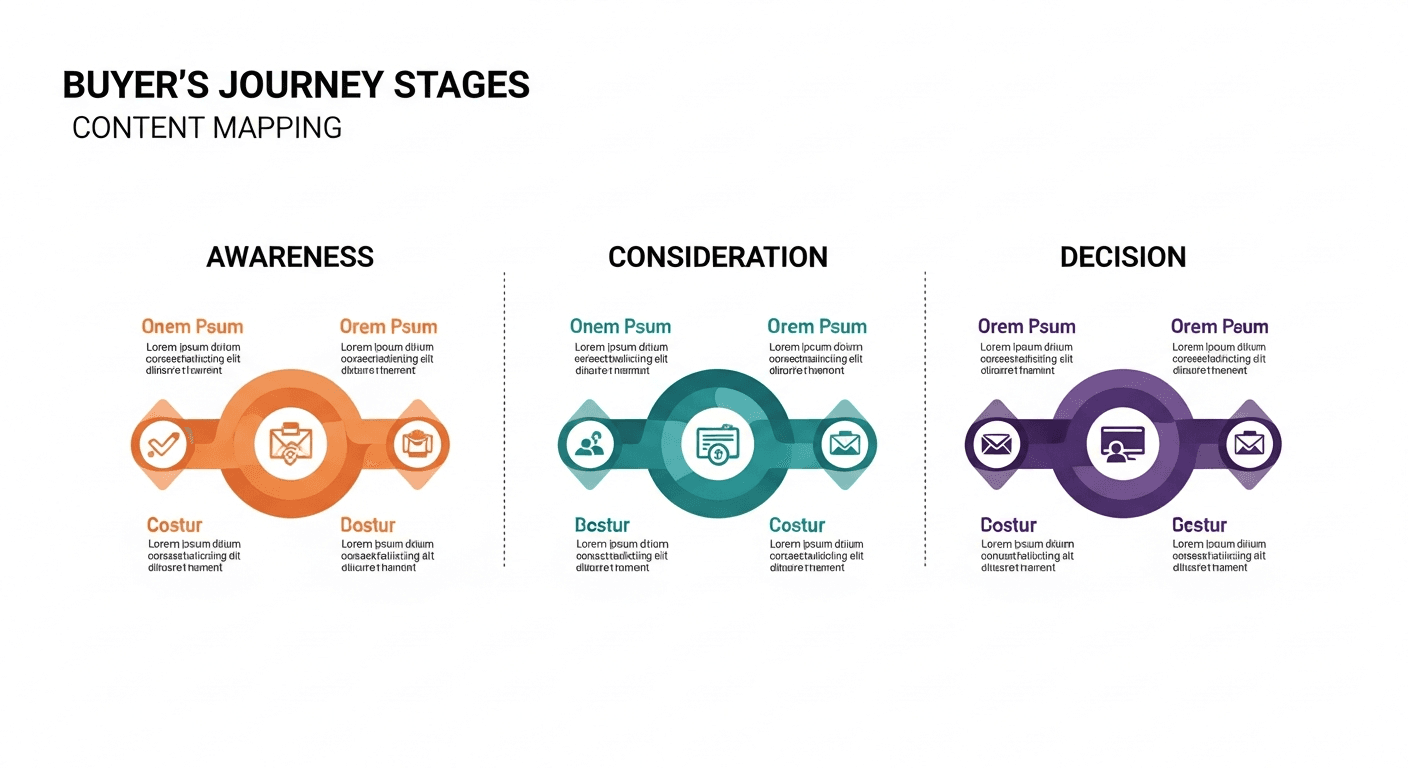
The buyer’s journey typically unfolds across three distinct stages, each with its own characteristics, buyer mindset, and content requirements.
The awareness stage is where it all begins. A prospect recognizes they have a problem or opportunity, but they haven’t yet committed to solving it. They’re in research mode, exploring the landscape, trying to understand what options exist. During this stage, prospects are searching for educational content: blog posts, guides, videos, and resources that help them understand their problem better. They’re not ready to hear a sales pitch. They’re not even convinced they need to take action. Your job in the awareness stage is to become a trusted educational resource.
The consideration stage is where prospects have clearly defined their problem and are now actively evaluating potential solutions. They understand what they need to fix, and they’re comparing different approaches or vendors. During this stage, content takes on a more specific focus. Prospects want comparison guides, case studies, webinars, and detailed product information. They want to understand the pros and cons of different solutions and see how other companies have addressed similar challenges. This is where persona development really matters, because different buyer personas within the same company might have different priorities.
The decision stage is the home stretch. Prospects have narrowed their choices and are ready to make a purchase decision. They want final validation that they’re making the right choice. Content here includes customer testimonials, pricing information, contract details, and implementation guidance. Sales cycles can accelerate dramatically if you have the right content at this stage, because you’re removing the final objections and concerns that might otherwise stall the deal.

Identifying Buyer Personas
You cannot effectively map content to the buyer’s journey without first understanding exactly who you’re mapping for. This is where buyer personas enter the picture. A persona is a semi-fictional representation of your ideal customer, built on real data about your existing customer base, market research, and conversations with prospects and customers.
Effective personas include demographic information (job title, industry, company size), psychographic details (goals, frustrations, values), and behavioral patterns (how they research, what content they consume, what influences their decisions). The goal isn’t to create a perfect, encyclopedic profile of every possible customer. The goal is to identify the 3 to 5 primary personas that represent the vast majority of your revenue.
Consider a B2B SaaS company selling marketing automation software. One primary persona might be the Marketing Manager, focused on campaign efficiency and team productivity. Another might be the VP of Marketing, concerned primarily with revenue impact and ROI. Another might be the CMO, focused on strategy and competitive differentiation. Each of these personas has different concerns, different buying criteria, and different content preferences. Content that resonates with the Marketing Manager might completely miss the mark for the CMO.
The most effective way to develop personas is through primary research. Conduct interviews with current customers who match your ideal profile. Talk to prospects who didn’t buy from you and ask why. Analyze your sales team’s conversation notes. Look at behavioral data from your website and marketing tools. Combine all of this information into clear, detailed personas that your entire team can reference.
Aligning Content with Buyer Needs
Once you understand your buyer personas and the stages they move through, the next step is identifying the specific questions, concerns, and information needs at each intersection.
Let’s use a practical example. Suppose your persona is a marketing director at a mid-sized SaaS company, and you’re selling a content marketing platform. During the awareness stage, this prospect might be searching for answers to questions like “What is content marketing?” or “How do we reduce our customer acquisition cost?” They’re not aware that your solution exists; they’re trying to understand if content marketing is even the right strategy for their company.
During the consideration stage, the same prospect might be searching for “Best content marketing platforms” or “How to choose a content marketing tool” or “Content marketing platform comparison.” Now they’re actively evaluating whether a solution is worth implementing, and comparing vendors.
During the decision stage, they might be looking for “Pricing comparison of content marketing tools” or “Implementation process and support” or customer reviews and case studies from companies similar to theirs.
The content you create must directly address these needs at each stage. Generic content about your company or your platform’s features might have a place somewhere, but it’s not going to drive the results you want at most stages of the journey. You need targeted, specific content that answers the exact questions your buyer is asking.
Steps to Map Content to the Buyer’s Journey
Step 1: Define Your Buyer Personas
Start by clearly defining 3 to 5 primary buyer personas. For each persona, document the following:
Basic demographics including job title, industry, company size, years of experience, and key responsibilities. This helps you understand who you’re talking to and what perspective they bring to purchase decisions.
Pain points and challenges specific to their role. What keeps them up at night? What problems they’re trying to solve? What opportunities they’re trying to capitalize on? Be specific. “Wants to improve marketing” is too vague. “Struggling to generate qualified leads with current outbound strategy and needs a solution that integrates with existing CRM” is specific enough to write to.
Goals and success metrics. What are they trying to achieve in their role? How do they measure success? Understanding this helps you position content around outcomes rather than features.
Buying criteria and decision drivers. What factors matter most when they’re evaluating solutions? Is it price? Ease of implementation? Vendor reputation? Integration capabilities? Different personas weight these differently.
Content preferences and consumption habits. Where do they spend time? Do they prefer video content or written guides? Do they engage with webinars or prefer to research independently? What publications or websites do they trust?
Once you’ve documented all of this, validate it with your sales team. Do your customer-facing team members recognize these personas from their daily conversations? If not, refine the personas until they ring true.
Step 2: Outline the Buyer’s Journey Stages
Map out the buyer’s journey specific to your business. For most B2B companies, the three-stage model works fine: awareness, consideration, decision. Some companies add additional stages like “post-purchase” for onboarding and expansion content. Some companies insert additional stages between consideration and decision if their sales cycles are particularly complex.
The key is that the stages you identify should match how your actual prospects move through a buying cycle. If you sell enterprise software with 6-month sales cycles, your buyer’s journey might look different than a company selling self-service SaaS that people sign up for in minutes.
For each stage, document the buyer’s mindset and focus. What are they thinking about? What information would be most valuable to them? What objections might they have? What actions do you want them to take at this stage?
Step 3: Identify Content Needs at Each Stage
Now comes the strategic thinking. For each combination of persona and journey stage, identify the specific content that would serve their needs. Create a matrix with personas down the left side and journey stages across the top. Then fill in the cells with content ideas.
For example, using our marketing director persona and a content marketing platform:
Awareness stage content needs might include “What is content marketing,” “ROI of content marketing,” “Content marketing vs. other marketing strategies,” “How to measure content marketing effectiveness.”
Consideration stage content needs might include “Content marketing platform comparison,” “Features to look for in a content marketing tool,” “Implementation best practices,” “Case studies from mid-market SaaS companies.”
Decision stage content needs might include “Pricing and plan details,” “Integration guide with our CRM system,” “Onboarding timeline,” “Customer testimonials and reviews.”
The goal is to identify 5 to 10 pieces of content for each persona-stage combination. This doesn’t mean you need to create all of this content immediately. It means you have a clear roadmap for what to prioritize. Platforms like Hovers can accelerate this process by helping you generate content ideas and optimize them for specific buyer journey stages, though you’ll still need to do the strategic thinking about your specific personas and their needs.
Step 4: Create a Content Map Template
Translate your strategic thinking into a usable content map that your team can reference and work from. The template should include the following columns:
Content Title: What is this piece of content called?
Persona: Which buyer persona is this for?
Journey Stage: Is this awareness, consideration, or decision stage?
Content Type: Is this a blog post, case study, video, webinar, whitepaper, comparison guide?
Estimated Length: How long should this content be?
Primary Keywords: What search terms should this content target?
SEO Objective: Why are we creating this content from an SEO perspective?
Content Format: Will this be a long-form blog post, short social media content, interactive tool?
Publishing Timeline: When should this go live?
Assigned Owner: Who is responsible for creating this?
The specific columns you include matter less than having a centralized document that makes your content strategy visible and actionable. This template becomes the source of truth for your content team, preventing duplicative work and ensuring alignment with your overall strategy.

Step 5: Evaluate and Optimize Your Content
Content mapping isn’t a one-time exercise; it’s an ongoing process. Once you’ve mapped out your content and started publishing, regularly evaluate how that content is performing against your objectives.
Look at your content marketing metrics for each piece. Is the awareness stage blog post getting search traffic? Are consideration stage resources generating leads? Are decision stage pieces being shared by your sales team, and are they actually helping close deals?
Use tools to track how your content is performing. Google Analytics tells you traffic and engagement. Your marketing automation platform tells you how many leads each piece generates. Your CRM tells you if sales is using the content and if it’s contributing to closed deals. When you have this data, you can optimize.
Content that’s underperforming should be investigated and improved. Maybe the keyword targeting is wrong. Maybe the content doesn’t adequately address buyer needs. Maybe it’s positioned for the wrong persona or journey stage. Use performance data to continuously refine your content map.
At the same time, look for gaps. Are there persona-stage combinations where you have no content? Are there questions your prospects keep asking that your current content doesn’t address? Use these gaps to identify the next round of content priorities. You can also use insights from guides like How to identify content gaps with effective gap analysis formats to strengthen this process.
Tools and Resources for Content Mapping
Recommended Tools for Content Mapping
Several tools can make the content mapping process significantly more efficient and effective. Spreadsheet tools like Google Sheets or Excel are the bare minimum. You can build a functional content map with just a spreadsheet, and many teams do. The advantage is simplicity and accessibility. Every team member can access and edit the document.
But purpose-built content planning tools offer more functionality. Asana, Monday.com, and Notion are work management platforms that help teams organize, track, and collaborate on content projects. You can set up custom workflows, assign ownership, track progress, and maintain a single source of truth for your content calendar.
Content intelligence platforms like Hovers take content mapping a step further by combining content planning with AI-powered content generation and optimization. These platforms can help you identify content gaps, generate content ideas aligned with specific buyer journey stages, create SEO-optimized articles with proper structure and citations, and in some cases, even publish directly to your CMS. For teams that need to produce high volumes of quality content efficiently, these tools can be transformative.
SEO research tools like Ahrefs, SEMrush, and Moz help you understand what your target audience is searching for, which directly informs your content map. You can see the actual search volume for different keywords and buyer journey stages, helping you prioritize which content to create first. You may also find inspiration from resources like the Hovers Blog.
Templates for Effective Content Mapping
While custom templates work best for your specific situation, starting with a proven framework accelerates the process. A basic content map template should have columns for content title, target persona, buyer journey stage, content type, estimated length, primary keywords, and publishing timeline.
An advanced template might add columns for estimated resource requirements, SEO difficulty, competitive landscape, internal links, external sources to cite, and content status (planned, in progress, draft, published, updated). The more detail you include, the more actionable your map becomes.
Many content marketing platforms provide template libraries. HubSpot offers free content mapping templates. Content Marketing Institute provides research-backed frameworks. Starting with a proven template and customizing it for your business is much faster than building from scratch. You can also reference tools like the Free Outline Generator to streamline this step.
Best Practices for Using Content Mapping Tools
First, ensure your entire team understands and uses the same content map. This means sales, marketing, and product all need visibility and buy-in. Regular team meetings to review the content map, discuss progress, and identify changes ensure the document stays current and relevant.
Second, update your content map regularly. As you learn more about your buyers, as market conditions change, and as performance data comes in, your map will evolve. Quarterly reviews are a good cadence for larger strategic updates. Weekly or bi-weekly reviews of content status and progress keep execution on track.
Third, use your content map to guide decision-making. When someone suggests creating new content, ask whether it’s in the map and addresses an identified buyer need. This discipline prevents random content creation and keeps your team focused on high-impact work. To improve SEO alignment during this process, explore resources like the Essential Technical Guide to SEO Content Writing Tools.
Common Challenges in Content Mapping
Identifying Gaps in Existing Content
Most organizations already have content scattered across their website, blog, videos, resources section, and sales collateral. One of the first challenges in content mapping is taking inventory of what already exists and identifying gaps.
The tedious but necessary first step is to catalog your existing content. Go through every piece of content your company has published and document it in a spreadsheet. Include the title, topic, content type, and stage of the buyer’s journey it addresses. Once you have everything cataloged, map it to your personas and journey stages.
You’ll quickly see where you have content clusters and where you have gaps. You might discover that you have extensive content for the awareness stage but nothing for the decision stage. You might find that you have lots of content for one persona but nothing for another. These gaps become your content creation priorities.
The second-order challenge is that some of your existing content might not cleanly fit into your personas and journey stages. Content was probably created before you had a clear mapping strategy. It might address multiple personas or multiple stages. This is fine; content can serve multiple purposes. Just document how each piece of existing content contributes to your overall strategy.
Aligning Teams on Content Strategy
Content mapping requires cross-functional alignment, and that’s where many initiatives derail. Marketing has one perspective on what content should be created. Sales has a different perspective based on what prospects actually ask for. Product teams worry that marketing doesn’t adequately represent their differentiation. Leadership is concerned about resource allocation.
Getting all these stakeholders aligned is challenging but essential. The most effective approach is to involve them in the mapping process itself. Include sales, marketing, product, and at least one customer-facing executive in the persona development process. Have them contribute to identifying content needs at each stage. When stakeholders contribute to the strategy, they’re more likely to support its execution.
Ongoing communication about the content map and performance is also critical. Monthly meetings where you share which content performed well, which underperformed, and what’s coming next keep everyone informed and invested. When your sales team sees that marketing is actually publishing the content they requested, and that it’s helping close deals, skepticism turns to enthusiasm.
Measuring the Effectiveness of Your Content Map
This is perhaps the most nuanced challenge. How do you know if your content map is actually working? The challenge is that content’s impact on revenue isn’t always direct or immediate. An awareness stage blog post might not directly generate a lead. But it might have helped a prospect become aware of the problem, which eventually leads them to seek a solution weeks or months later.
Here’s a framework for measuring content map effectiveness:
For awareness stage content, track organic traffic, keyword rankings, and brand search volume. If your awareness stage content is working, you should see increasing traffic from your target keywords and increasing brand searches over time. These are leading indicators that your content is making prospects aware of the problem and your brand.
For consideration stage content, track lead generation and engagement rates. How many people are downloading your comparison guides or signing up for webinars? Are they qualified leads? Are they moving into sales conversations?
For decision stage content, track whether your sales team is actually using this content and whether it’s correlated with deal closing. Talk to your sales team directly. Ask them if the content is helping. Set up a process where sales logs which content they share with prospects.
The most compelling measure is the impact on pipeline and revenue. Are the content sources aligned with content map stages generating qualified pipeline? Are they influencing deal outcomes? These are the ultimate measures of effectiveness.

Conclusion and Actionable Takeaways
Recap of Key Points
Content mapping transforms how organizations approach marketing and sales alignment. Rather than creating content randomly, you strategically align every piece with specific personas and journey stages. This discipline improves content marketing metrics across every dimension: traffic, engagement, lead quality, and ultimately, revenue impact.
Effective content mapping starts with clear buyer persona development. You need to understand not just who your customers are demographically, but what problems they’re trying to solve, how they make decisions, and what information would be most valuable to them at different points in their buying journey.
The buyer’s journey in most B2B contexts breaks down into awareness, consideration, and decision stages. Each stage has distinct buyer mindsets and information needs. Your content strategy must address these specific needs rather than trying to create one-size-fits-all content.
The actual process of mapping content involves five key steps: defining your personas, outlining journey stages, identifying content needs at each intersection, creating a usable content map template, and then continuously evaluating and optimizing based on performance data. This isn’t a one-time project; it’s an ongoing discipline that evolves as your business and market evolve.
Next Steps for Implementing Content Mapping
Start immediately with audience research. Set up interviews with 5 to 10 of your best customers and 5 to 10 prospects who considered but didn’t buy from you. Ask them about their buying process, what information was most important, where they struggled, and what would have made the decision easier. This will give you real data to build your personas and content strategy around.
Then create your first-pass content map. Get your team together, document 3 to 5 personas, map out your buyer’s journey, and identify 5 to 10 content pieces for each persona-stage combination. This doesn’t need to be perfect; it just needs to be a starting point that your team can reference and refine.
Start creating content according to your map. Focus first on the biggest gaps: the persona-stage combinations where you have no content and where demand is highest. Use the content map as your editorial calendar. Every piece of content should be tied back to a specific persona and journey stage.
Tools can accelerate this process significantly. Platforms like Hovers help teams generate SEO-optimized content at scale, which is especially valuable once you’ve identified what content to create. But the strategic work of understanding your personas, mapping their journey, and identifying content needs is something you and your team need to do.
Encouragement to Experiment and Adapt
Content mapping won’t be perfect on your first attempt. You’ll learn more about your buyers as you go. Market conditions will shift. Your product will evolve. Your content strategy will need to evolve with it. That’s not a failure; that’s a sign that you’re paying attention and adapting.
The real discipline is consistency. Continue publishing content according to your map. Keep measuring performance. Refine your personas and journey stages as you learn more. Celebrate the content that performs and learn from the content that doesn’t. Over time, this discipline compounds into significant competitive advantage.
The companies winning in competitive markets aren’t the ones creating the most content. They’re the ones creating the right content for the right audience at the right time. Content mapping is how you achieve that alignment. Start today with our free template, build your personas, map your content, and watch your deal flow improve.
Ready to put your content strategy into action? Join our newsletter for more insights on content strategy, AI-powered content creation, and building effective go-to-market strategies. We share practical frameworks and proven approaches every week to help you win more deals.
Article created using Hovers.ai