Facebook Ads Strategy: Combine Paid and Organic Content for Results
Understanding Facebook Ads Strategy
What is a Facebook Ads Strategy?
A Facebook Ads strategy is your roadmap for turning casual scrollers into paying customers. It’s not just about throwing money at ads and hoping something sticks. Instead, it’s a deliberate, data-driven approach to reaching the right people with the right message at the right time. Your strategy encompasses everything from campaign objectives and audience targeting to creative development and performance measurement.
Think of it this way: without a strategy, you’re essentially playing marketing roulette. With one, you’re making calculated decisions based on your business goals, audience insights, and real performance data. A solid Facebook Ads strategy defines what you want to achieve, who you want to reach, what you’ll show them, how much you’ll spend, and how you’ll measure success. It’s the difference between a random campaign that costs you money and a strategic initiative that generates ROI.
The beauty of Facebook advertising is its precision. Unlike traditional advertising where you hope your target audience sees your message, Facebook lets you define your audience with surgical accuracy. You can target by age, location, interests, behaviors, job titles, and even purchase history. You can reach people who’ve visited your website, engaged with your content, or match the profile of your best customers. This targeting capability makes Facebook an incredibly powerful platform for businesses of all sizes.
But here’s the thing: precision targeting only works when you pair it with compelling content and a clear value proposition. That’s where most businesses stumble. They nail the targeting but fail on the creative or messaging side. A successful Facebook Ads strategy acknowledges this reality and treats both elements as equally important.
Importance of Combining Paid and Organic Content
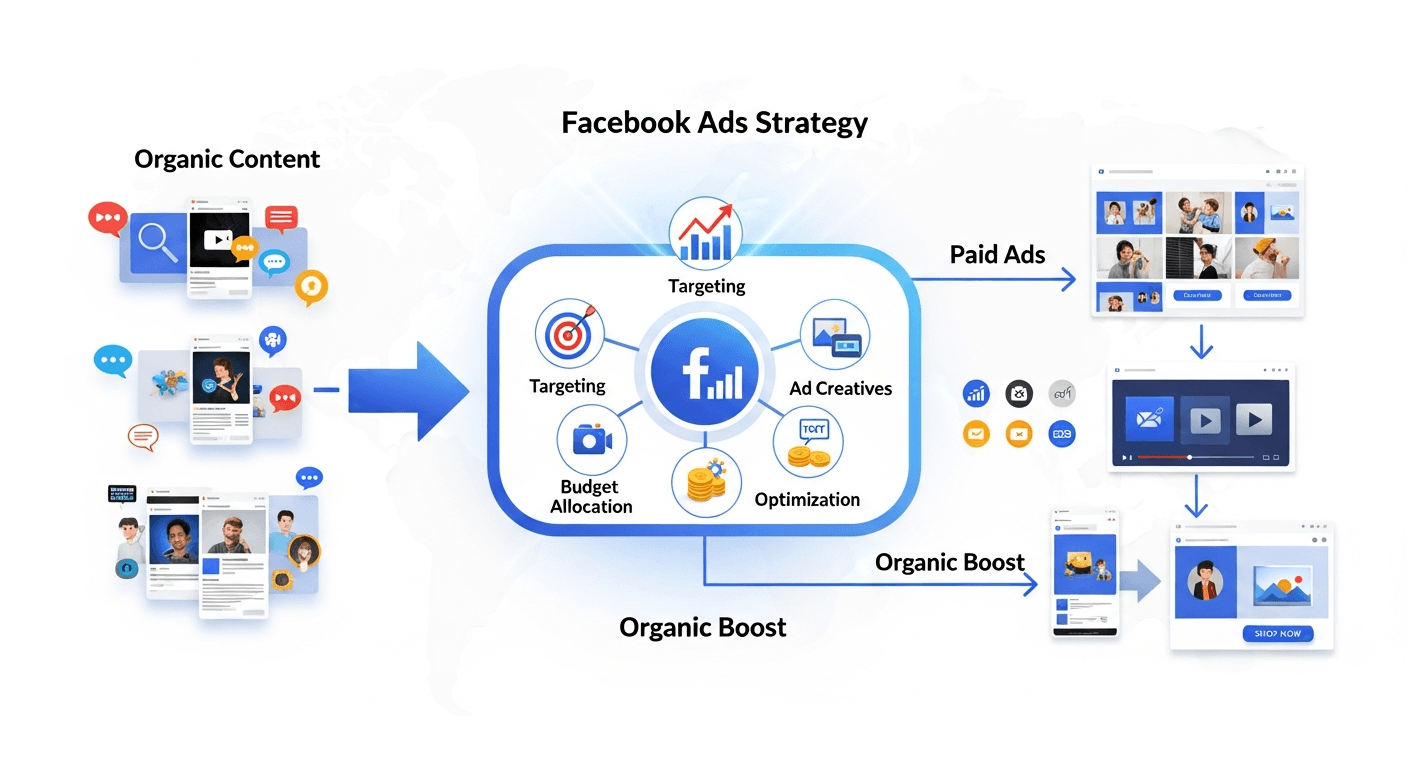
This is where the real magic happens. Combining paid and organic content isn’t just smart marketing; it’s essential if you want to maximize your return on ad spend and build genuine brand loyalty. Here’s why this approach works so well:
Organic content serves as the foundation for your brand’s credibility and authority. When your audience discovers your Facebook page and sees years of valuable, consistent content, they’re far more likely to trust your paid ads. Conversely, paid ads drive visibility and get your best organic content in front of new audiences who might never find it otherwise. It’s a virtuous cycle.
Consider the customer journey. Most people don’t convert on their first interaction with your brand. They need multiple touchpoints across different channels before making a purchase decision. Organic content provides those early-stage touchpoints. Your followers see your posts, read your insights, and gradually warm up to your brand. When they eventually see your paid ads, they’re already familiar with you, which dramatically increases conversion rates.
Additionally, organic content provides the raw material for your paid campaigns. Your best-performing organic posts often make the best ad creatives. They’ve already proven they resonate with your audience. By promoting these proven winners through paid ads, you’re leveraging social proof and authentic engagement to drive results. Hovers.ai recognizes this synergy by enabling creators to produce consistent, high-quality organic content that naturally supports paid advertising efforts.
The data backs this up. According to recent marketing studies, brands that use both organic and paid social strategies see engagement rates that are 30-50% higher than those relying on just one approach. Moreover, combining strategies allows you to test messaging and creative on organic channels before investing significant ad spend, reducing wasted budget and improving overall campaign efficiency.

Key Components of a Successful Facebook Ads Strategy
Setting Clear Objectives
You can’t hit a target you haven’t defined. Before you create a single ad, you need to articulate what success looks like for your campaign. Facebook offers several objective options, and choosing the right one is foundational.
Are you trying to build brand awareness? Drive traffic to your website? Generate leads? Increase app installs? Drive conversions? Each objective optimizes your ads differently and attracts different audiences. Facebook’s algorithm works backward from your objective, so selecting the wrong one means your ads will be shown to the wrong people, regardless of how brilliant your creative is.
Here’s a practical framework: start with your overarching business goal. If you’re a SaaS company, your ultimate objective is probably customers. But your Facebook Ads objective might be lead generation or traffic, depending on your sales process. If you run an e-commerce business, it’s likely conversions. If you’re a content creator, it might be engagement or video views.
Once you’ve selected your objective, set specific, measurable targets. Instead of “increase sales,” aim for “achieve a 3:1 return on ad spend on product ads targeting cart abandoners.” Instead of “get more newsletter signups,” target “generate 500 qualified leads at a cost per lead not exceeding $5.” These specific targets give you clarity and make it easier to evaluate performance.
Different objectives also carry different costs. Generally, brand awareness campaigns are cheapest per impression, while conversion campaigns are most expensive per action. This matters for budget planning. A campaign costing $2 per click isn’t expensive if it converts at 20%, but it’s wasteful if your conversion rate is 2%.
Identifying Your Target Audience
Facebook’s targeting capabilities are simultaneously impressive and overwhelming. You can get incredibly granular with your audience selection, but more options don’t always mean better results.
Start broad: identify the core demographics of your ideal customer. Age range, location, and basic interests. Then layer in behavioral data. What do these people do online? What problems are they trying to solve? What are they currently interested in? What stage of the buying journey are they in?
Facebook’s Lookalike Audience feature is a game-changer here. If you have a list of your best customers, Facebook can find people with similar characteristics and behaviors. These lookalike audiences often perform better than manually targeted audiences because they’re based on real customer data rather than assumptions about who your audience might be.
Custom Audiences are equally powerful. You can upload your customer email list, and Facebook will match those people to accounts. You can then create ads specifically for these known customers, whether that’s promoting upsells, re-engagement campaigns, or exclusive offers.
The key to effective targeting is testing. Don’t assume you know exactly who your audience is. Create multiple audience segments and let the data tell you which ones convert best. A segment that seemed promising might underperform, while an unexpected audience might become your star performer.
Creating Engaging Content
No targeting sophistication can save a bad ad. Your creative makes or breaks your campaign. This is where organic and paid strategies intersect most directly.
Your ad creative should do several things: it should stop the scroll, communicate a clear benefit, and compel action. On Facebook, you’re competing for attention with posts from friends, family, and thousands of other advertisers. You have about one-second to convince someone your ad is worth their time.
The most effective Facebook ads typically share certain characteristics. They lead with strong visuals or video. Text is minimal and benefit-focused. There’s a clear call-to-action. They speak directly to the viewer’s pain point or desire. And critically, they feel native to the platform rather than like interruptive advertising.
User-generated content and testimonials consistently outperform polished, corporate creative. People trust other people more than they trust brands. A photo of a real customer using your product typically generates higher engagement and conversion rates than a professional product photo.
This is where your organic content becomes invaluable. Posts that generated strong organic engagement often make excellent ad creative. They’ve already proven they resonate with your audience. You’re essentially scaling what you know works.

Integrating Organic Content with Paid Ads
Benefits of Organic Content in Paid Campaigns
Organic content provides several strategic advantages when integrated into your paid advertising efforts. First, it builds trust. When someone sees an ad from your brand, they’re more likely to engage if they’ve previously seen organic content from you. That familiarity breeds confidence.
Second, organic content provides creative ideas and proven winning angles. Rather than guessing what messaging will resonate, you can see what your audience actually engages with organically and amplify those themes through paid campaigns. This dramatically reduces creative risk and improves ROI.
Third, organic content extends your reach efficiently. Some of your best customers might never see a specific ad, but they might see an organic post and convert directly. By maintaining a consistent organic presence alongside paid efforts, you’re capturing demand through multiple channels.
Fourth, organic engagement improves ad performance. When your ads run on posts that already have comments and likes, they appear more credible and trustworthy. This social proof element significantly impacts click-through rates and conversion rates. A post with 50 comments appears more popular than one with zero, even if the same audience sees both.
Finally, organic content allows you to test and iterate before investing significant ad spend. You can publish an organic post, gauge the response, refine the messaging, and then promote a perfected version through paid ads. This testing-and-refinement approach leads to smarter ad spend and better results.
For teams juggling multiple content responsibilities, solutions like Hovers.ai streamline this process with automated content creation. The platform automatically generates 30-day content calendars with SEO-optimized articles, complete with images and citations, that can be published directly to your website or social platforms. This means you have a consistent stream of quality organic content to draw from when developing paid campaigns.
How to Leverage User-Generated Content
User-generated content (UGC) is content created by your customers, followers, and community members rather than by your brand. It’s marketing gold because it’s authentic, credible, and typically outperforms branded content.
The most effective way to leverage UGC is to encourage customers to create it. This might involve running contests or challenges where participants share photos or videos using your product. It might involve creating branded hashtags and asking followers to tag their content. It might involve directly reaching out to satisfied customers and asking them to share their experience.
Once you’ve collected UGC, the next step is amplification. Share these pieces of content on your organic channels, crediting the creator. Then, take your best UGC pieces and use them as paid ad creative. People respond differently to content created by other users versus content created by the brand itself.
There’s an important distinction here: you need permission before using someone’s content in ads. Always credit the creator and compensate them if your terms require it. This protects you legally and builds goodwill. Many creators feel honored to see their content featured in brand ads, especially if they’re compensated or credited prominently.
The performance difference is striking. According to data from social advertising platforms, ads featuring user-generated content see conversion rates 5-10 times higher than ads featuring branded content. Why? Because people trust other people. A customer testimonial or product review from a real user carries more weight than any claim your brand makes about itself.
Case Studies of Successful Integrations
Let’s ground this in reality with specific examples of brands successfully combining organic and paid strategies.
A fitness apparel company ran an organic campaign encouraging customers to share their workout photos with a branded hashtag. They received hundreds of submissions, selected the best ones, and created a series of paid ads featuring these customer photos. The organic content served multiple purposes: it engaged their existing community, generated user-generated content, and provided creative assets for paid campaigns. The resulting paid campaigns achieved a 4.2:1 return on ad spend because the imagery was authentic and the community felt represented.
An e-commerce beauty brand took a different approach. They identified their top-performing organic posts based on engagement metrics. These were typically educational content pieces (tutorials, product comparisons, ingredient breakdowns) that their audience found valuable. They then promoted these posts through paid ads targeted at cold audiences, creating a funnel where awareness-stage audiences discovered valuable content and warm audiences saw conversion-focused ads. By matching creative to audience stage, they improved overall campaign efficiency by 35%.
A B2B software company maintained a consistent organic content calendar focused on industry insights, case studies, and thought leadership. This organic presence established authority. When they launched paid campaigns promoting free trials, the ads performed better because the target audience already had some familiarity with the brand through organic content. The combination of organic authority-building and paid conversion-driving created a powerful synergy.
These aren’t outliers. Brands consistently see 20-40% improvements in campaign performance when they intentionally integrate organic and paid strategies. The mechanism is clear: organic builds trust and awareness, paid accelerates results and reaches new audiences, and together they create a compounding effect that neither strategy could achieve alone.

Best Practices for Facebook Ads
Utilizing Facebook Pixel for Tracking
Facebook Pixel is a small piece of code that you place on your website. It tracks user behavior, allowing you to understand what people do after clicking your ads. Without Pixel, you’re flying blind.
Pixel tracks several important actions: page views, lead submissions, purchases, add-to-cart actions, and custom events. This tracking data serves multiple purposes. First, it measures campaign performance. You can see not just how many people clicked your ad, but how many actually purchased, signed up, or completed your desired action.
Second, Pixel data fuels Facebook’s optimization algorithm. When you set a conversion objective and implement Pixel properly, Facebook learns which of your audience members are most likely to convert. The algorithm then prioritizes showing your ads to similar people. Over time, this creates increasingly efficient campaigns as the algorithm refines its understanding.
Third, Pixel enables retargeting. You can create audiences of people who visited your website but didn’t convert. You can then show them different ads designed to overcome their objection or remind them of the value you offer. This is among the highest-ROI advertising you can do because you’re targeting warm audiences who already showed purchase intent.
The implementation matters. You need to ensure Pixel is firing correctly on all relevant pages. You need to track the right conversions. If you’re an e-commerce business, tracking purchases is critical. If you’re a service provider, tracking lead submissions matters most. Set up custom events if standard actions don’t capture your specific business model.
A/B Testing Your Ads
A/B testing, also called split testing, means running multiple versions of your ad simultaneously and comparing results. This is how you identify what actually works with your specific audience rather than relying on general best practices.
Good A/B tests isolate a single variable. You might test different headlines while keeping images and copy identical. You might test different images with identical headlines. You might test different calls-to-action. By changing one element at a time, you can definitively attribute performance differences to that specific change.
The results often surprise people. An image you think is perfect might underperform. A headline you assumed would resonate might flop. Meanwhile, something unexpected might become your best performer. This is exactly why testing matters. Your assumptions, no matter how educated, aren’t as reliable as actual performance data.
Effective testing requires adequate sample sizes and duration. Don’t judge a test after 24 hours with minimal impressions. Give tests at least 3-5 days and several thousand impressions before drawing conclusions. This allows statistical significance and reduces the impact of daily variations.
Run multiple tests simultaneously but sequentially analyze results. Start with broad tests (different images, different headlines) to identify winning directions. Once you’ve found a strong performer, conduct more granular tests on that version (minor copy tweaks, different CTAs) to squeeze out additional performance improvements.
Optimizing Ad Spend
Budget optimization is where many advertisers leave money on the table. They set their daily budget and let it run without adjustment, assuming Facebook’s algorithm handles everything.
Reality is more nuanced. Facebook’s algorithm works within the parameters you set. If you have multiple campaigns running simultaneously, Facebook allocates your budget across them. If you set campaign budgets too low, campaigns might not accumulate sufficient data for the algorithm to optimize effectively.
Dynamic budget allocation, also called campaign budget optimization (CBO), is Facebook’s solution. Instead of setting budgets at the ad set level, you set a total budget at the campaign level, and Facebook automatically distributes that budget to the best-performing ad sets. This typically outperforms manual allocation because it adapts in real-time based on performance.
Another optimization tactic is progressive budget scaling. Start campaigns with modest budgets. Let them run for 3-7 days while you accumulate performance data. If they’re performing well (generating conversions at your target cost per action), gradually increase the budget. If they’re underperforming, pause them or redirect budget to stronger campaigns. This approach reduces waste while scaling winners.
Pay attention to frequency. Frequency measures how many times the same person sees your ad. Too low frequency, and you’re not reaching people enough to convert. Too high frequency, and you’re wasting budget on people who’ve already made a decision about your offer. Generally, aim for frequency between 1.5 and 3. If frequency exceeds 4 with dropping performance, consider refreshing your creative.
Common Questions About Facebook Ads Strategy
What are the most effective strategies for running Facebook Ads?
The most effective Facebook Ads strategies share several common characteristics. First, they start with clear objectives. They define success precisely, measure religiously, and optimize continuously based on data.
Second, they integrate organic and paid efforts. Rather than running ads in isolation, they leverage organic content to build awareness and trust, then use paid ads to accelerate conversions. This creates synergy that multiplies results.
Third, they invest in creative quality. The best-performing ads lead with compelling visuals or video, communicate clear benefits, and speak directly to the viewer’s situation. They feel native to the platform and often use user-generated content or customer testimonials.
Fourth, they target with precision. Rather than broad audience selections, they segment their audience into meaningful groups and tailor messaging to each segment. They test new audiences systematically and double down on top performers.
Fifth, they optimize continuously. They A/B test creative elements, monitor performance daily, adjust budgets based on results, and pause underperforming campaigns quickly. They understand that optimization is ongoing, not something you do once and forget.
Lastly, the most effective strategies align Facebook advertising with broader marketing initiatives. If you’re running content marketing, email marketing, and SEO simultaneously, your Facebook Ads should complement and amplify those efforts rather than operating in isolation. Platforms like Hovers.ai help create cohesive strategies by ensuring your organic content and paid efforts reinforce each other across channels.
How can I measure the success of my Facebook Ads?
Success measurement depends on your objectives, but several key metrics apply universally. Cost per click (CPC) tells you how much you’re spending for each click on your ad. Cost per lead (CPL) shows your expense per lead generated. Return on ad spend (ROAS) indicates your revenue relative to spending. Cost per acquisition (CPA) shows how much each customer costs to acquire.
These metrics matter, but context matters more. A $5 CPC is expensive for some businesses and cheap for others. A $20 CPA is profitable if your average customer value is $100 but disastrous if it’s $30.
Align your metrics to your actual business objectives. For awareness campaigns, measure reach and frequency. For lead generation, focus on CPL and lead quality. For e-commerce, ROAS and CPA are critical. For content promotion, engagement rates and traffic matter most.
Track metrics across the entire customer journey, not just immediate ad metrics. Someone might click your ad, not convert immediately, then return later and purchase. Facebook’s attribution model should account for this, but it’s worth understanding how Facebook allocates credit and potentially cross-checking with your own analytics.
Set baseline metrics before your campaigns launch. These allow you to measure improvement. If your baseline conversion rate from cold traffic is 1%, an improvement to 1.5% is meaningful, not just incremental.
Finally, measure incrementally over time. Some performance fluctuations are random. Looking at weekly or monthly trends reveals true performance shifts better than daily figures.
Recent Trends in Facebook Advertising
Emerging Tools and Technologies
Facebook’s advertising platform continuously evolves, introducing new tools and capabilities. Advantage+ Shopping Campaigns use AI to automatically optimize product ads across placements, requiring minimal human input. These work well for e-commerce but aren’t suitable for all business types.
Reels have become the dominant content format, and ads running on Reels see significantly higher engagement than feed ads. Short-form video content, similar to TikTok, performs exceptionally well. If you’re not creating Reels content, you’re missing opportunities.
Generative AI within Facebook’s Ads Manager can create ad variations automatically. You provide core messaging and assets, and AI generates multiple versions. This accelerates testing but requires human judgment to ensure quality and brand alignment.
Broader Instagram integration means your Facebook Ads Manager controls Instagram advertising more seamlessly. This is strategically important because Instagram often shows better performance for visual products and aesthetically-focused brands.
Changes in Facebook’s Advertising Policies
Apple’s iOS privacy changes fundamentally altered Facebook’s targeting and measurement capabilities. Third-party data used for targeting became less reliable. First-party data and contextual targeting became more important.
Changes to ad approval processes have become stricter. Ads with certain claims, testimonials, or imagery face increased scrutiny. Staying current with policy updates prevents campaign disapprovals and wasted spend.
Privacy regulations like GDPR and CCPA require explicit consent for certain data usage. Ensuring your pixel implementation respects these regulations protects your business legally.

Conclusion and Actionable Takeaways
Summary of Key Points
Your Facebook Ads strategy should never exist in isolation. The most successful campaigns integrate organic content creation with paid advertising, creating synergy that multiplies results. Organic content builds trust and provides creative assets. Paid ads amplify proven winners and reach new audiences. Together, they’re significantly more powerful than either strategy alone.
Success requires clarity on objectives, precision in targeting, quality in creative, and discipline in measurement. You need to know exactly what you’re trying to achieve, who you’re trying to reach, what compelling offer you’re making them, and how you’ll know if you succeeded. Without these foundations, you’re essentially guessing.
Testing and optimization are continuous. The marketplace changes, your audience evolves, and new opportunities emerge. Your Facebook Ads strategy should reflect this dynamism. What worked last month might not work next month. But by testing systematically and adjusting based on data, you’ll stay ahead of curve.
Finally, your Facebook Ads strategy should connect to your broader marketing ecosystem. If you’re building an audience through content marketing, email, and SEO, your Facebook Ads should amplify those efforts. If you’re generating leads through your website, Facebook Ads should drive qualified traffic. Alignment across channels creates compounding advantages that isolated efforts can’t achieve.
Next Steps for Implementing Your Strategy
Start today by defining your specific objectives. What does success look like for your business? What’s the one metric that matters most? Get clear on this before creating anything else.
Next, audit your current audience. Who are your best customers? What characteristics do they share? Use this understanding to inform your targeting.
Then, assess your content situation. Do you have sufficient quality content to build organic presence and source creative assets? If not, this is a critical gap. You need consistent organic content to fuel effective paid campaigns. Consider tools like Hovers.ai that automate content creation and calendaring, ensuring you have a steady stream of SEO-optimized organic content ready to amplify through paid efforts.
Start small with testing. Launch a modest campaign with 2-3 audience segments and 2-3 creative variations. Collect data over 5-7 days. Analyze results. Double down on winners and pause underperformers.
Implement Facebook Pixel if you haven’t already. Ensure it’s tracking the right conversions for your business.
Commit to A/B testing as an ongoing practice. Make it part of your monthly rhythm to test at least one significant variable per campaign.
Finally, measure consistently. Set up reporting that shows you the metrics that matter. Review performance weekly. Adjust budgets, pause underperformers, and scale winners based on data.
Start optimizing your Facebook Ads strategy today. Explore our AI-powered content tools for better marketing results. The combination of strategic advertising with consistent, quality content creation is how modern businesses build sustainable growth.
Article created using Hovers.ai