Understanding Social Media Automation
Definition and Core Components
Let’s cut through the noise: social media automation isn’t about replacing you with robots (though that would be pretty efficient). It’s about using software and tools to handle repetitive, time-consuming tasks so you can focus on what actually matters: strategy, creativity, and building genuine relationships with your audience.
Social media automation leverges tools or software to manage repetitive tasks like posting content, scheduling updates, handling customer service replies, generating analytics reports, monitoring brand mentions, and managing ad campaigns without manual labor. Think of it as your personal social media assistant that works 24/7 without complaining about overtime.

The core components of a solid automation system typically include:
- Content scheduling: Pre-plan and publish posts at optimal times across multiple platforms
- Engagement automation: Auto-respond to common customer inquiries and moderate comments
- Analytics and reporting: Collect data on performance metrics without manual compilation
- Social listening: Monitor brand mentions, competitor activity, and industry trends in real-time
- Ad management: Automate bidding strategies and audience targeting for paid campaigns
- Team workflows: Approval processes and cross-team collaboration within a unified dashboard
These components work together to create a streamlined system that keeps your social presence active and data-informed, even when you’re focused elsewhere.
How Social Media Automation Works
The mechanics are straightforward: you set up rules, schedules, and triggers within a platform (like Hovers, which takes this concept further by automating entire content calendars with AI-generated, rank-ready articles for multi-channel distribution). The tool then executes those actions automatically across your chosen social channels.
Here’s the practical flow: First, you input your content, audience data, and posting preferences into the automation platform. Second, the software applies your rules and schedules to trigger actions at specific times or based on defined conditions. Third, it publishes, engages, or reports on these actions in real-time, often logging everything in a central dashboard for your review.
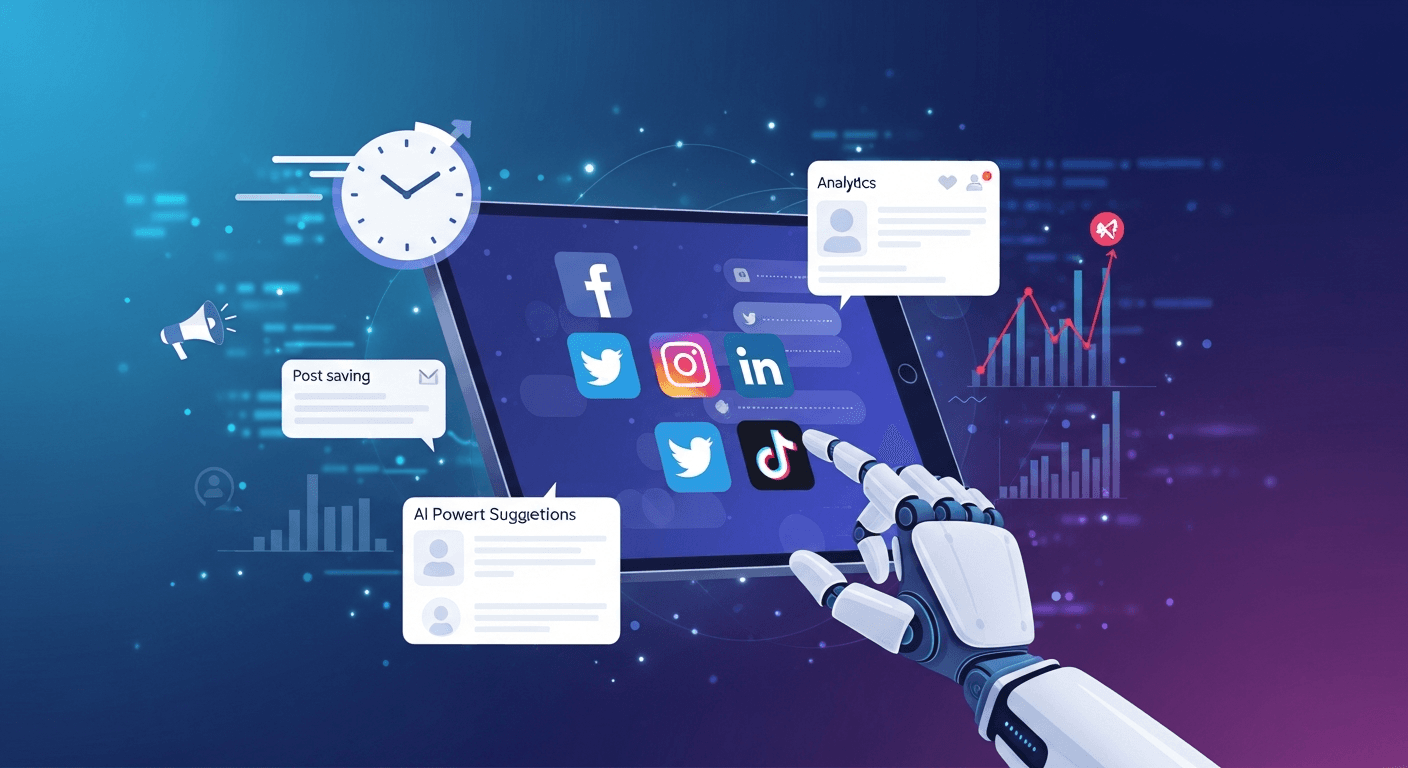
Modern automation platforms go beyond basic scheduling. They integrate with your CMS, email systems, and analytics tools to create a cohesive ecosystem. AI-powered features can now optimize post timing, suggest content adjustments, and even predict which audience segments will respond best to specific messages. This level of integration means less context-switching and more strategic control over your entire content distribution network.
Tasks You Can Automate
Scheduling Posts
Post scheduling is the bread-and-butter of social media automation, and frankly, if you’re manually posting at different times each day, you’re leaving reach on the table. Automation tools let you batch-create content and schedule it for weeks or months ahead, ensuring consistent visibility even when you’re offline.
The data backs this up: proper scheduling based on audience research significantly increases reach and engagement. Instead of guessing when your audience is online, you can use platform analytics to identify peak activity times, then schedule posts for those windows automatically. Imagine planning your entire month’s content strategy in a single sitting and having the system handle publication timing. That’s the efficiency we’re talking about.
Beyond basic timing, advanced platforms let you schedule different versions of the same message for different segments, test posting times across time zones, and automatically reschedule underperforming content for a second push later.
Engagement and Customer Service
Quick response times drive engagement, and automation excels here. Chatbots and auto-response systems can handle frequently asked questions, direct customers to relevant resources (like your FAQ), and flag urgent inquiries for human review.
Consider the scenario: a customer asks “What are your hours?” or “How do I reset my password?” These questions repeat constantly. Automation handles them instantly, freeing your team to focus on complex issues that require genuine human insight. AI rule engines can be configured to monitor sentiment, trigger alerts if someone expresses frustration, and route those conversations to your best team members.
The result? Faster response times, happier customers, and your team spending less time on repetitive work. One expert noted that automation can save 20 minutes per user per day on engagement tasks alone.
Analytics and Reporting
Manually compiling social media metrics is like organizing files with a stone tool. Automation platforms pull data from all your connected accounts, calculate KPIs, and generate comprehensive reports without human intervention.

Instead of spending hours in Excel, you get real-time dashboards showing what’s working. Modern platforms go beyond vanity metrics (likes and comments) to track actual business impact: conversions, revenue attribution, and customer retention. Roughly 58% of companies have seen higher retention rates when using data-driven insights from automation tools.
Automation also enables competitive benchmarking, so you see not just your performance but how you stack up against competitors. That’s intelligence you can act on immediately.
Social Listening
Social listening automation monitors brand mentions, competitor activity, and industry conversations across the web automatically. Instead of manually searching for your brand name every morning, tools do it continuously and alert you to spikes in sentiment, emerging trends, or PR-worthy moments.
AI-powered rule engines can flag when your sentiment drops below a defined threshold or when a competitor launches a major campaign. This real-time intelligence lets you respond to opportunities or issues before they become crises.
Benefits of Social Media Automation
Time Savings and Efficiency
Let’s talk numbers: 74% of marketers report significant time savings after implementing automation. That’s not a rounding error. That’s nearly three-quarters of professionals reclaiming hours each week.
On a practical level, batch scheduling content that once took hours now takes minutes. Analytics reporting that required manual compilation now generates with one click. Customer service replies that needed individual crafting now come from templates and AI-powered suggestions.
Consider this breakdown: if you manage three social platforms manually and spend 30 minutes daily on each (posting, responding, checking metrics), that’s 2.5 hours per day or 12.5 hours weekly. Automation can reduce that to roughly 5-7 hours weekly, freeing up significant time for strategy, content creation, or growth initiatives.
For small and medium-sized businesses, this matters even more. 47% of SMBs rely on automation for multi-platform management, with 33% gaining 30+ minutes weekly through AI-powered features. When you’re bootstrapped, every minute counts.
Consistency Across Platforms
Maintaining consistent messaging, posting frequency, and brand voice across multiple platforms is genuinely difficult without automation. You’d need to adapt content for each channel, post at optimal times for each one, and monitor engagement separately. That’s multiplied complexity.
Automation solves this with unified dashboards. You can publish once and automatically distribute to Twitter, LinkedIn, Instagram, and Facebook with platform-specific formatting. You can maintain a posting schedule that guarantees consistent presence without burnout.
This consistency builds audience trust and reinforces your brand message. People who follow you across platforms see a cohesive presence, not scattered attention.
Improved Engagement and Insights
Faster response times mean more engaged audiences. Automated monitoring means you catch conversations happening around your brand. AI-driven personalization means your messages are tailored to specific audience segments, not generic broadcasts.
Real-time insights let you see what resonates before the week ends, allowing mid-course corrections. Instead of waiting for monthly reports, you act on data continuously.
Popular Tools and Platforms
Overview of Leading Tools
The automation landscape includes heavy hitters like Hootsuite, SproutSocial, and Sprinklr, each bringing different strengths:
Hootsuite positions itself as essential for 2025 businesses, emphasizing time savings and consistency. It’s robust for medium-sized teams managing multiple platforms and offers strong integration with third-party apps.
SproutSocial excels in analytics depth, offering competitive benchmarking and advanced ROI tracking. It’s particularly strong for mid-to-large enterprises focused on data-driven decision-making.
Sprinklr targets enterprise-scale operations and highlights benefits like 20 minutes daily savings per user and 10% ad spend reduction through AI optimization. Their rule engines and sentiment monitoring are particularly sophisticated.
Later emphasizes visual content scheduling and content calendar management, making it excellent for Instagram-heavy brands.
Beyond these, newer platforms are emerging with AI integration as a core differentiator, generating not just scheduling but actual content recommendations and optimizations.
Key Features to Look For
When evaluating automation platforms, prioritize these capabilities:
- Unified dashboard: Manage all platforms from one place, reducing platform-switching
- AI-powered optimization: Automatic post timing, content suggestions, and performance predictions
- Rule engines and alerts: Set conditions (sentiment drops, competitor moves) that trigger automated actions
- Analytics depth: Track not just engagement but business impact (conversions, revenue)
- Team workflows: Approval processes, content calendars, and cross-team collaboration
- Integration ecosystem: Connect with your CMS, email tools, and other systems
- Compliance and approval: Multi-market approval workflows for enterprises managing global campaigns

Don’t just chase the feature list. Pick tools that align with your actual workflow. A small brand might prioritize beautiful scheduling and basic analytics. An enterprise might need sophisticated compliance features and custom rule engines.
Best Practices for Implementation
Getting Started with Automation Tools
Starting with automation doesn’t require a big bang rollout. Here’s a sensible approach:
Step one: Audit repetitive tasks. Identify what’s eating your time. Is it scheduling posts? Responding to FAQs? Pulling analytics? Be specific.
Step two: Start with scheduling. This is the least risky place to begin. Pick one platform, schedule a week of content, and observe. Does it work as intended? Are posts going out at the right times?
Step three: Add engagement automation carefully. Introduce chatbots or auto-responses for the most common questions first. Review their responses regularly, especially in the first two weeks.
Step four: Layer in analytics. Once you’re comfortable with publishing automation, let the platform handle data collection and reporting. You’ll quickly see patterns you’d have missed with manual tracking.
Step five: Expand thoughtfully. As you gain confidence, add social listening, sentiment monitoring, and advanced segmentation.
This phased approach prevents overwhelm and lets you catch problems before they scale. You’re building systems, not just automating randomly.
One practical tip: batch your content creation weekly. Spend a few hours on Monday creating content for the entire week, then let automation handle distribution. This rhythm saves time daily and improves content quality through batching psychology (you’re in “creation mode,” not context-switching).
Maintaining Authenticity in Automation
Here’s where the sassy-but-solid advice gets critical: automation can feel robotic if you let it. The tools that work best balance efficiency with human oversight.
Automate the mechanical stuff (scheduling, FAQs, metrics compilation). Never automate away the human elements that build relationships.
Your followers aren’t robots. They want to feel seen and understood. A perfectly timed automated post is fine. An automated response that feels generic is not. Here’s the rule: auto-responses should address common needs efficiently, but complex or emotional interactions need human nuance.
Best practice: let automation handle initial triage and routing. It flags a customer concern, suggests a response, and routes it to the right team member, who then replies authentically. The customer still gets speed and accuracy, but the interaction feels human because the final touch is.
Authentic brands using automation report better retention and loyalty. The tools amplify your genuine care; they don’t replace it.
Risks and Limitations
Over-Automation and Inauthenticity
The biggest risk is assuming automation is a substitute for strategy and genuine engagement. Brands that post consistently but never respond to comments, use only automation for customer service, or fill their feeds with recycled content often lose audience trust.
Over-automation looks like:
- Robotic responses that don’t address specific customer concerns
- Scheduled posts that ignore real-time events or crises (a funny meme scheduled during a disaster)
- Abandoning community management entirely in favor of bots
- Using automation to spray the same generic message across every platform
Audiences can sense this. And they don’t like it. Automation should free up time for better engagement, not replace it with silence.
The fix is intentional balance. Use automation where it improves efficiency without sacrificing authenticity. Review automated responses regularly. Jump into conversations that matter. Show up as a human being, not just a distribution machine.
Compliance and Legal Considerations
Here’s something often glossed over: platform policies. Most social networks have rules about what can and can’t be automated. Violating them can get your account suspended, and that kills your reach permanently.
For example, many platforms prohibit:
- Automated engagement (liking or commenting en masse without context)
- Bot-driven messaging that violates privacy policies
- Scheduled posts that obscure authentic publication timing
- Automated actions that mimic spam behavior
Multi-market compliance adds another layer. Global teams need approval workflows that account for regional regulations (GDPR in Europe, CCPA in California, etc.) and cultural norms. What’s acceptable to schedule in one market might violate policy in another.
Best practice: read your platform’s automation policy directly. Set up approval workflows that route content through compliance review before automation pushes it live. Document your automation rules for regulatory audits.
This isn’t boring legal stuff. It’s the foundation of sustainable social media automation that doesn’t collapse from a policy violation.
Recent Developments in Social Media Automation
AI Integration and Advanced Features
2025 is the year automation stops being dumb scheduling and becomes genuinely intelligent. AI-powered features now include:
- Auto-optimization: Systems that adjust posting times, content format, and targeting based on real-time performance
- Sentiment analysis: Rule engines that alert you instantly if brand sentiment drops or a crisis is brewing
- Predictive analytics: AI that forecasts content performance before you publish, suggesting edits to improve reach
- Personalized recommendations: Systems that suggest which audience segments to target based on historical response patterns
- Content generation integration: Platforms that don’t just schedule content but generate it
This matters because intelligence compounds over time. The more data your automation system processes, the smarter its suggestions become.
Platforms like Hovers exemplify this trend by automating 30-day content calendars with AI-generated articles and one-click publishing to social platforms, essentially automating the entire content-to-distribution pipeline with minimal human input while maintaining quality and SEO optimization.

Trends for 2025 and Beyond
The trajectory is clear:
- Unified dashboards evolve. Instead of separate tools for publishing, listening, engagement, and analytics, expect integrated platforms where all activities happen in one place
- AI becomes the default. Rather than basic scheduling, expect every action to include AI suggestions for optimization
- Privacy-first automation. As regulations tighten, tools that handle compliance automatically (geo-targeting, consent management) will become essential
- Video and rich media focus. Automation for video scheduling and visual content curation will expand significantly
- Cross-channel intelligence. Automation that connects social insights with email, website behavior, and offline data will provide richer audience understanding
The brands winning in 2025 aren’t those with the most social accounts. They’re the ones using automation intelligently to deliver consistent, personalized, authentic experiences across channels.
Actionable Takeaways
Identifying Repetitive Tasks
Grab a notebook (digital or paper) and track your social media work for a full week. Write down every task, how long it took, and whether you did it the same way each time.
You’ll probably find:
- Scheduling posts follows a predictable pattern
- You answer the same questions repeatedly
- Analytics gathering involves the same steps weekly
- Platform monitoring is vigilant but repetitive
These are your automation targets. Automate them ruthlessly.
Using Analytics for Improvement
Once automation is pulling your data, don’t ignore it. Review analytics weekly, looking for patterns:
- Which content types drive engagement?
- When do your audience members appear online?
- Which segments show highest conversion rates?
- What topics spark conversation?
Use these insights to refine your strategy. The goal isn’t just to automate current work but to get smarter about future work based on data you couldn’t access before.
Balancing Automation with Human Interaction
Create a rule for your team: automation handles logistics and triage. Humans handle relationships.
Practically, this means:
- Schedule posts, but reserve time weekly for real engagement
- Use chatbots for FAQs, but monitor for escalations
- Pull analytics automatically, but have someone review them
- Monitor mentions automatically, but respond personally to high-value ones
- Set approval workflows so humans review risky or important content before it goes live
This balance is where the magic happens. You get the efficiency of automation with the authenticity that builds loyal audiences.
The Bottom Line
Social media automation isn’t a cheat code. It’s a force multiplier. Used well, it amplifies your team’s effectiveness, consistency, and insights. Used poorly, it creates robotic brands that audiences ignore.
The brands dominating social in 2025 are those that leverage automation to eliminate busywork, then redirect that freed-up time toward genuine strategy and engagement. They use AI insights to inform decisions, not replace them.
Start small. Identify your biggest time drains. Implement automation deliberately. Review regularly. Adjust based on results. Over time, you’ll build a system that runs smoothly in the background while your team focuses on what makes you unique: your voice, creativity, and genuine connection with your audience.
That’s how you save hours while actually boosting your reach.
Article created using Hovers • Explore more on our Blog or generate ideas with our Free Blog Ideas Tool