Introduction
For US agencies, a semantic seo content framework is the difference between publishing isolated posts and building a searchable topic system that compounds. If you already understand semantic SEO at the pillar level, this guide shows how to turn that strategy into an agency workflow grounded in content strategy and, where helpful, topic modeling—so writers, editors, and SEO leads can actually execute. It is built for teams that need repeatable briefs, cleaner internal linking, and measurable outcomes for client work, not just theory. For teams looking to operationalize this faster, Hovers can help automate topic research, content planning, and link planning from a single keyword.
The main challenge is not understanding semantic SEO. The challenge is operationalizing it across clients so every page has a clear role, a defined entity scope, and a linking function. This article walks through the framework step by step, then shows how to validate coverage, avoid common agency mistakes, and ship pages with confidence.

Implementation Workflow: From Semantic Topic Maps to Publishable Briefs
A useful semantic SEO brief starts with five inputs: the topic model, the entity list, SERP intent signals, internal link targets, and draft success metrics. Those inputs turn a vague content request into something a strategist can assign, a writer can execute, and an editor can QA. Without all five, agencies tend to produce briefs that are polished but not operational.
Inputs and roles (SEO, content strategist, writer, editor, web/analytics)
The SEO strategist owns the topic model and intent read. The content strategist translates that model into a brief with section goals, entity targets, and links. Writers need clear coverage requirements, editors verify accuracy and completeness, and web or analytics teams confirm that the page is tracked properly once it goes live.
A simple agency handoff can look like this:
| Stage | Deliverable | Owner | Sign-off rule |
|---|---|---|---|
| Discovery | Topic map and intent cluster | SEO strategist | Search intent is mapped correctly |
| Briefing | Semantic SEO brief | Content strategist | Required entities and questions are included |
| Drafting | Writing doc | Writer | Each section satisfies its purpose |
| QA | Validation checklist | Editor | Coverage and links pass the gate |
| Launch | Publishing notes | Web or PM | Tracking and links are confirmed |
Step-by-step cycle (discover → model → brief → write → link → publish → measure)
The most reliable agency workflow is linear, even if the work is iterative. First, discover the keyword set and cluster the intent. Next, model the entities and relationships. Then brief the page, write the draft, plan links, publish, and measure whether the page is earning the right impressions and supporting the right cluster.
A practical version of the cycle looks like this:
- Discover queries, competitors, and SERP patterns.
- Model the primary entity, supporting entities, and related questions.
- Brief the page with section-level coverage requirements.
- Write the draft against the brief, not against memory.
- Attach internal links before publishing.
- Publish with QA notes and tracking.
- Measure query coverage, links, and engagement.
Operationalizing semantic entities into briefing fields (entity targets, supporting concepts, intent constraints)
Use the briefing structure defined in the Inputs and roles table (briefing deliverable + required entities/questions + QA sign-off) as the baseline for your entity-to-field mapping. At this stage, the goal is to ensure each semantic entity and constraint is actionable inside the brief—so the writer knows what to include and the editor has something objective to validate.
Only add guidance beyond the table to strengthen purpose and testing. For every field you include, verify it passes a “so what?” test:
- Does the field directly change a writing decision (what to write, how to frame it, or where it must appear)?
- Can you validate it during QA without guesswork?
- If the field were removed, would the brief become ambiguous or the page outcomes become harder to measure?
That structure prevents thin coverage because every required entity has a job. If a field has no purpose, remove it. If a required entity cannot be tied to a section, the brief is probably too broad.
Turn topic model outputs into an editorial calendar and assignment queue
Once the map is complete, convert it into work units. The best agency editorial calendars do not list only titles. They list page type, cluster role, owner, target publish date, and prerequisite pages. That makes scheduling much easier because the team can see dependencies before production starts.
For example, a pillar may need three support pages before launch, or a landing page may need one prerequisite explainer article to establish context. When you queue work this way, the calendar becomes an execution system instead of a publishing list.
How to translate content into measurable on-page + internal-linking outcomes
Every brief should define what success looks like on-page and in the link graph. On-page outcomes include required entities present, intent match, and answer completeness. Internal-linking outcomes include the number of hub links, the direction of support links, and whether the page sits in the correct cluster.
Use a clear measurement plan, not a vague goal like “improve SEO.” A better target is, “The page must cover all required entities, link to the hub, and support two downstream cluster pages.” For measurement, tie reporting to the search console and analytics. The value of a framework like this platform is that it helps turn those requirements into a repeatable process instead of a one-off checklist.
Best Practices & Standards: Entity Mapping, Consistency, and On-Page Structure
A semantic SEO framework breaks down when entity mapping is inconsistent. The fix is to standardize how your agency names entities, chooses primaries, and structures pages so the same logic works across clients. That consistency matters more than clever copy because it keeps your topic graph usable as the account grows.
Entity mapping rules (canonical entity names, variants, attributes, disambiguation)
Pick one canonical entity name per concept and use it everywhere in planning. Variants are allowed, but they should map back to the canonical label in the taxonomy. If a term has multiple meanings, disambiguate it early so the team does not mix intents.
For example, “optimization” can mean conversion optimization, search optimization, or technical tuning depending on the client. Your taxonomy should specify which one applies, which modifiers are acceptable, and which adjacent terms are out of scope. That prevents writers from drifting into a different search job.
Topic-to-intent mapping (primary vs secondary intent constraints)
Every page should have one primary intent and, at most, a small set of secondary intents. The primary intent determines the page type and structure. Secondary intents are only useful if they support the same user job-to-be-done.
The rule is simple: if a supporting entity changes the page’s purpose, it belongs elsewhere. A page can explain a framework, compare approaches, or capture a question, but it should not try to do all three at full depth. That is how pages become unfocused.
On-page semantic structure (headings, sections, Q&A blocks, entity placement)
A strong semantic page usually follows the same internal logic:
- Intro that frames the intent
- Entity-context section that defines the main concept in use
- Comparative or alternatives block when readers need choice-making support
- Question coverage that resolves common uncertainties
- Internal links that connect the page to the rest of the cluster
This structure keeps the page readable while making entity coverage visible. It also helps writers know where each required concept belongs, which reduces fluffy filler. For guidance on page intent and internal link logic, Google’s own Search Central documentation is a useful reference.

To keep those structure decisions working the same way across accounts, you also need consistency standards—because if different clients treat the same entities and labels differently, the “right” page structure stops mapping to the same taxonomy logic.
Consistency standards across clients (taxonomy, naming conventions, QA gates)
Agency scale creates drift unless the team uses one shared taxonomy doc and one QA system. The taxonomy should define canonical entity names, approved synonyms, disallowed terms, and page-type rules. The QA checklist should be reused across clients so the review process is stable.
A good consistency standard is boring by design. If each account invents its own logic, the team will spend more time interpreting briefs than producing content. Standardization reduces rework and makes onboarding new writers much easier.
How to keep writers aligned on coverage requirements without adding fluff
Coverage without fluff means every required entity must earn its place. Tell writers what each section must answer or establish, not just which keywords to include. That shift turns content from keyword placement into topic completion.
A useful rule is this: if the section cannot explain the entity’s role in the user journey, cut or rewrite it. Writers should not be asked to “mention” entities. They should be asked to prove something with them.
Content Types That Fit the Framework (Pillars, Supporting Articles, FAQs, Landing Pages)
Not every page in a semantic graph has the same job. Agencies need content-type rules so pages do not compete with each other or duplicate the same explanation in different formats. The framework works best when each page type has a clear role in the cluster.
Pillar guides as topical hubs (what to include, how to structure internal links)
A pillar guide is the hub for the topic graph. Its job is to define the central entity, orient the reader, and distribute traffic to supporting pages. It should include the minimum semantic sections needed to make the cluster intelligible.
That usually means:
- Definition and scope of the core entity
- Why the entity matters to the user job
- Key supporting entities and attributes
- A comparison or navigation section
- Questions that connect to downstream support content
- Hub links to related cluster pages
If the pillar does not point outward, it is not functioning as a hub. It is just a long article.
Supporting articles as entity/value amplifiers (how to set boundaries)
Supporting articles should go narrower than the pillar. Their purpose is to explain one entity, one attribute set, or one related use case in more depth. They should not re-create the pillar’s full map.
The boundary test is simple. If the support article can be summarized as a sub-question or a single entity slice, it is probably scoped well. If it needs the whole cluster to make sense, it is too broad and should be split.
FAQs as intent expansion (how to map questions to entities and use cases)
FAQ pages and FAQ blocks are useful when they are tied to questions already discovered in the semantic map. Do not add generic questions just to increase coverage. Each question should map to an entity, an attribute, or a known intent gap.
This is especially useful when the SERP shows mixed intent. If users are asking “how,” “what,” and “which tool” around the same theme, FAQs can capture those variations without diluting the main page. They also support snippet eligibility when the answers are direct and specific.
Landing pages as conversion endpoints (how to keep semantic relevance while optimizing for intent)
Landing pages are not content hubs, but they still need semantic depth. In the semantic graph, treat them as decision nodes that reinforce the pillar’s core entity and connect specific intent to the right supporting proof. The goal is to keep topical consistency without recreating the pillar’s entire explanatory layer.
A strong landing page should:
- Reinforce the primary entity and decision context (the exact service/product meaning, scope, target user, and the “why this now” rationale that matches the cluster)
- Map to the semantic variants already covered in the pillar/supporting content by referencing the same key attributes and entity relationships (without restating every definition)
- Use proof elements that correspond to downstream entity slices (e.g., outcomes/benefits tied to attributes discussed in supporting articles, or comparisons already covered elsewhere)
- Include a clear internal link path:
- Link up to the most relevant pillar guide section (for terminology or broader framing)
- Link out to supporting articles that validate specific attributes, use cases, or implementation details
- Avoid linking to unrelated cluster topics that would pull relevance away from the conversion intent
- Support intent through direct on-page answers to the highest-priority decision questions surfaced by the FAQ layer (even if the landing page does not host full FAQ content)
The safest pattern is to include a concise entity explanation, use-case proof, differentiators, and links to supporting educational content. For agencies, this is often where semantic SEO and CRO meet. The page should convert, but it should also sit cleanly inside the topic graph by acting as the destination for a specific intent slice that the pillar and supporting pages have already defined.
Validation: How to Verify Semantic Coverage and Entity Relevance (Before & After Publishing)
Validation should be deterministic. If the page passes, publish. If it fails, fix the specific gate. Agencies lose time when validation is subjective, so the goal is to create a clear decision system that every reviewer can use the same way.
Pre-publish checks (topic model alignment, entity coverage thresholds, intent match)
Before publishing, confirm three things: the page matches the topic model, the required entities are present, and the intent is aligned with the target SERP. If any of those fail, the page is not ready.
A practical pre-publish checklist includes:
- Primary entity appears in the right context
- Required supporting entities are covered
- Required questions are answered
- Intent matches the page type
- Internal links point to the right hub and support pages
- No section is carrying unrelated intent
On-page semantic QA (section completeness, entity placement logic, answer coverage)
A semantic QA pass should test whether each section earns its place. The introduction should frame the intent. The body should cover the required entities in logical sequence. The conclusion should resolve the page’s promise without introducing a new topic.
A simple scorecard helps:
| Check | Pass condition |
|---|---|
| Entity presence | All required entities are included |
| Attribute completeness | Core attributes are explained, not implied |
| Question coverage | Required questions are answered clearly |
| Intent fit | Page type matches search intent |
| Section purpose | Every section does a specific job |
Internal linking sanity checks (directionality, hub/satellite relationships, anchor relevance)
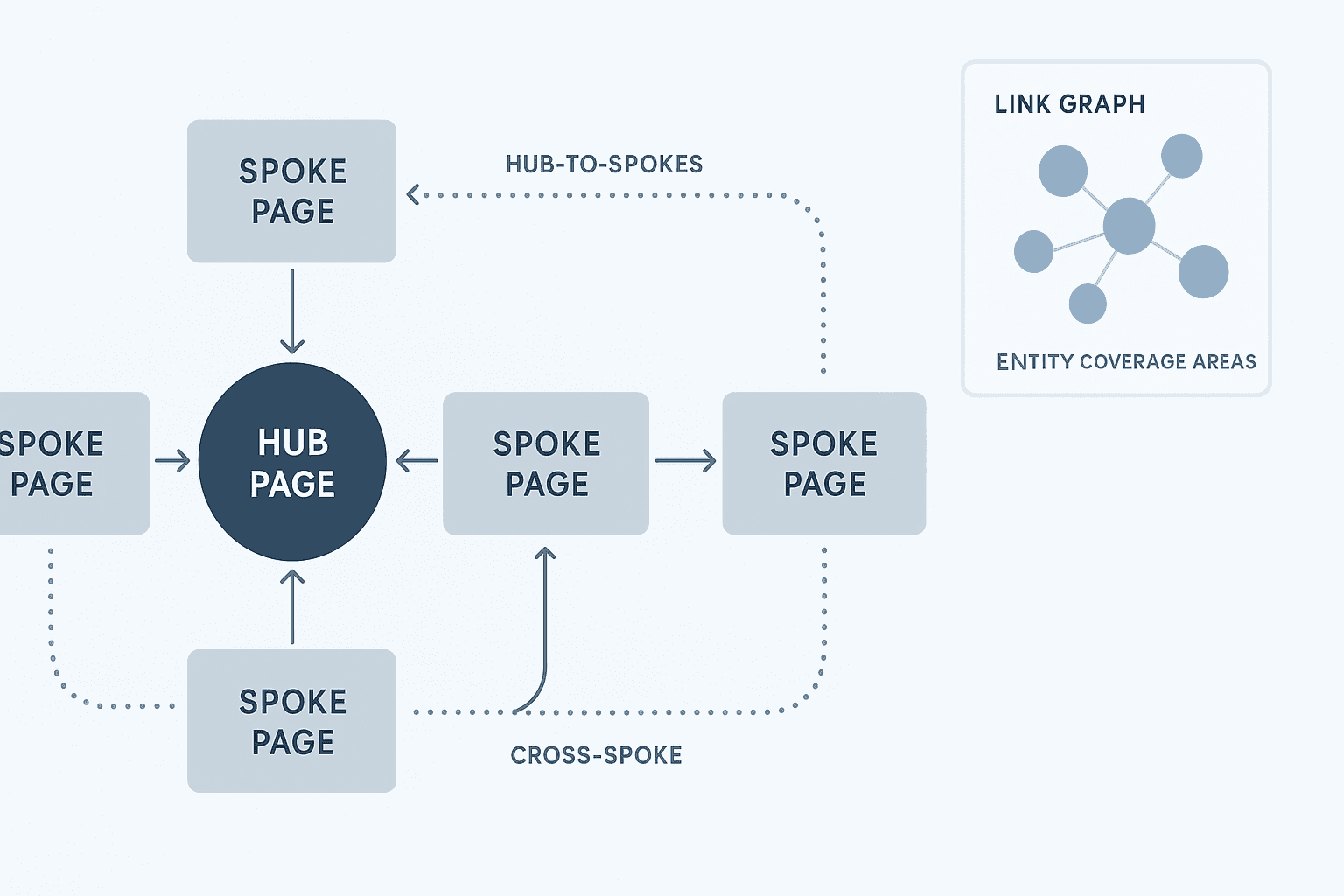
Internal linking should be validated like a system, not a set of one-off links. Hub pages should link to satellites, and satellites should point back to the hub. Anchor text should describe the destination page’s meaning, not just repeat a keyword.
Also check for orphans. If a page has no meaningful inbound link from its cluster, it is easier for both users and crawlers to miss. Moz’s overview of internal links is a helpful reference point for why link structure matters in SEO: Moz Beginner’s Guide to SEO.
Post-publish measurement (what to track in GSC/analytics and how to interpret)
After publishing, measure whether the page is being understood. In Google Search Console, look for impressions from intent-related queries, not just the head term. In analytics, watch engagement and assisted conversions if the page supports a larger journey.
The best signal is cluster behavior. If the pillar and supporting pages begin to rank together for related queries, the framework is working. If one page gets isolated impressions without downstream cluster lift, the map may be off.
Exception handling (when a page should be reworked vs merged vs deindexed/redirected)
Use the validation results to choose the remedy. If the page is close but incomplete, update it. If it overlaps heavily with another page, merge it. If it is fundamentally the wrong intent, re-brief it. If it has no strategic value and no clean place in the graph, deindexing or redirecting may be the right call.
That decision rule keeps the content system healthy. It also prevents agencies from protecting weak pages just because they already exist.
Common Mistakes in Semantic SEO Frameworks (and How to Fix Them)
Most agency failures are predictable. The problem is not lack of effort. It is usually one of a few repeatable mistakes that show up when semantic planning meets production reality.
Mis-mapped topics (wrong intent or wrong audience job-to-be-done)
| Symptom | Likely mistake | Fix |
|---|---|---|
| Rankings are flat for related intents | Topic was mapped to the wrong job | Rebuild the intent cluster and adjust page type |
| Traffic comes from irrelevant queries | Entity scope is too broad | Narrow the primary entity and move side topics out |
| Conversions are low on a service page | The page answers research intent, not buying intent | Re-brief for a conversion endpoint |
The early warning sign is SERP pattern mismatch. If the results are mostly comparisons and your brief is educational, the mapping is wrong. Query clustering should confirm whether users want explanation, selection, or action before the brief is written.
Thin entity coverage (missing attributes/relationships)
Thin coverage usually happens when a page names the entity but does not explain its attributes or relationships. The remedy is not to add more paragraphs at random. It is to attach each required attribute to a section purpose.
If an entity matters, ask what the reader needs to know about it, how it relates to the primary topic, and what would make the page more useful. Add only those details. The goal is depth, not length.
Incorrect internal linking patterns (orphan pages, overlinking, irrelevant anchors)
Orphan pages have no useful path from the cluster. Reciprocal overlinking creates loops that do not clarify hierarchy. Anchor stuffing makes links look repetitive and can confuse the page’s meaning.
The corrected pattern is simple: hub to satellite, satellite to hub, and anchors that describe intent rather than exact-match repetition. If a link does not help a reader understand where they are in the system, it probably should not be there.
Briefs that don’t translate (writers can’t execute semantic requirements)
A brief fails when it lists goals but not instructions. Writers need clear entity targets, section purposes, and examples of what counts as coverage. If they must infer the structure, the brief is too vague.
The fix is to rewrite the brief as a production document. It should tell the writer what each section must establish, which entities matter, and which pages to link to. That is how you turn strategy into output.
Inconsistent taxonomy across clients and time (drift and rework costs)
Taxonomy drift happens when agencies rename the same concept differently across accounts or over time. The result is broken reporting, inconsistent briefs, and extra editorial work. A shared entity dictionary prevents that drift.
Use one canonical source of truth, then add QA gates that force the team to check it before every publish. That is much easier than repairing three months of mixed terminology later.
Examples: Semantic Topic Map → Agency Content Brief → Outline + Internal Linking Pattern
A working example makes the framework easier to adopt. The goal here is not to show a perfect topic. It is to show how the parts fit together from map to brief to page structure and links.
Sample topic map (entities, relationships, intent clusters)
| Field | Example |
|---|---|
| Primary entity | Semantic SEO content framework |
| Supporting entities | topic map, entity dictionary, internal linking plan, content brief |
| Attributes | page role, section purpose, validation gate, link direction |
| Question set | How do I brief it? How do I validate it? How do I link it? |
| Intent cluster labels | implementation, evaluation, optimization |
Sample content brief (fields: entities, attributes, questions, constraints, linking targets)
A concise agency brief might read like this:
- Page goal: teach agencies how to operationalize semantic SEO into a repeatable production workflow
- Primary intent: implementation
- Required entities: semantic topic map, content brief, internal linking plan, validation checklist
- Required attributes: canonical naming, intent match, link direction, section purpose
- Required questions: what to include, how to validate, how to avoid drift
- Constraints: do not re-explain foundational semantic SEO concepts
- Link targets: pillar hub, related support article, FAQ resource
That brief works because it gives the writer a system, not just a topic.
Sample outline aligned to entities and intent constraints
A writer-facing outline should make coverage visible section by section. For example:
- Introduction, frame the workflow and the implementation use case.
- Workflow section, explain discovery, modeling, briefing, writing, linking, publishing, and measurement.
- Standards section, define canonical entity rules and page structure.
- Content types section, separate pillar, support, FAQ, and landing page roles.
- Validation section, define pass or fail criteria before and after publish.
- Common mistakes section, show how to diagnose and fix the system.
- Getting started section, assign roles and launch the first cycle.
Sample internal linking plan (hub→satellite and satellite→hub directions)
A clean cluster might link like this:
- Pillar hub: links to all supporting articles and the FAQ page
- Support article 1: links back to the pillar and to the validation guide
- Support article 2: links back to the pillar and to the briefing template page
- FAQ page: links to the pillar and the most relevant support article
- Landing page: links to the pillar and one or two educational support pages
Anchor meaning rules matter here. The anchor should reflect the destination’s role, such as “semantic topic map,” “validation checklist,” or “content brief template.” Avoid vague anchors that do not tell the reader what comes next.
How the example brief passes validation gates (what to check and what success looks like)
This example passes when the draft includes all required entities, the intent is clearly implementation-focused, and every section has a job. It also passes when the hub points outward, the satellites point back, and the links make the cluster easy to navigate.
Success looks like a page that can stand alone and still contribute to the topic graph. That is the standard agencies should use before they scale production.
Getting Started for Agencies: Roles, First Client Cycle, and Required Inputs
A framework becomes useful when the team knows who owns what. Agency implementation should start small, with one cluster, one workflow, and one shared checklist. That makes it easier to tune the system before it reaches multiple accounts.
Team roles & responsibilities (RACI-style assignment)
A practical role split looks like this:
- SEO strategist: owns the topic model and validation criteria
- Content strategist: writes the brief and manages section logic
- Writer: executes the brief and covers the required entities
- Editor: checks coverage, clarity, and consistency
- Analyst: tracks performance after publish
- Project manager: keeps the cycle moving and records decisions
Each role should have one clear approval point. That prevents missed handoffs and makes accountability easier.
First-cycle onboarding plan (weeks 1–4)
A simple onboarding plan works well for new US clients:
- Week 1, model the first cluster and confirm the taxonomy.
- Week 2, build the brief and linking plan.
- Week 3, write, edit, and QA the pages.
- Week 4, publish, measure, and review the results.
Before week 1 begins, prepare the entity dictionary, taxonomy, brief template, and validation checklist and store them in a single shared location so the first cycle can run consistently.
Measurable outcomes for weeks 1–4 (what “success” looks like):
- Taxonomy readiness (end of week 1):
- 100% of target topics have a defined parent/child relationship in the taxonomy
- Validation checklist coverage reaches ≥ 95% for required attributes (no critical fields left blank)
- Brief quality (end of week 2):
- ≥ 90% of briefs pass validation on the first review (no major rework required)
- Linking plan includes explicit rules for internal link targets (measured as 100% of required link destinations specified)
- On-page execution + QA (end of week 3):
- ≥ 95% of required entities appear in the correct sections (based on the entity dictionary)
- 0 “critical” QA issues escape to publish (missed entities, broken required sections, or inconsistent headings)
- Pilot publishing + early performance signals (end of week 4):
- 100% of pages are published with correct metadata and internal linking applied per the plan
- QA-to-publish turnaround time: median cycle time ≤ 5 business days from “brief approved” to “page published”
- Internal link adherence: ≥ 90% of expected links are present (spot-checked against the linking rules)
- First-week indexation rate: ≥ 90% of newly published URLs indexed (per Search Console or your index checker)
The goal is not scale. The goal is to establish a clean operating rhythm that the team can repeat.
How to run the first pilot on one client/topic cluster
Start with one pillar and three support pages. That gives the team enough structure to test the workflow without creating too much complexity. Run the validation gates after drafting and again after publishing.
Use the pilot to adjust thresholds. If writers keep missing a certain attribute, the brief is too vague. If links are inconsistent, the linking rules need to be stricter. Pilot data should improve the system before you expand it.
Governance: how to iterate the framework over time without chaos
Governance is what keeps the framework from breaking as accounts grow. Set a recurring taxonomy review, version the brief template, and hold a retro after each cycle. Those reviews should capture what changed, what failed, and what the team should standardize next.
This is also a good place to revisit the workflow with Hovers if you want a faster way to generate topic maps, briefs, and link plans from the same input. The point is not to remove editorial judgment. The point is to make the process repeatable.
Quality Gates: A deterministic checklist agencies can apply every publish
A deterministic checklist makes the framework operational. If the page fails a gate, it does not publish until the issue is resolved. If it passes, the team moves on without debate.
Use this every time:
- The page has one primary entity and a defined intent.
- Required supporting entities are covered in the correct sections.
- Each section has a clear purpose.
- The intro frames the user job-to-be-done.
- The page includes the required questions or explanations.
- Internal links point to the correct hub, satellite, or prerequisite page.
- Anchor text matches destination meaning.
- There are no orphaned cluster pages.
- The taxonomy terms match the shared dictionary.
- The draft is ready for measurement after launch.
If a page fails one gate, fix that gate first. If it fails multiple gates, re-brief it rather than patching it in place. That rule saves time and keeps the content system coherent.
Frequently Asked Questions
How do I estimate entity coverage requirements for a new client topic cluster?
Start with the SERP and the user job-to-be-done, then list the entities that appear in the strongest competing pages. Mark each as required or optional based on whether the page can satisfy intent without it. If the answer is no, it is required.
What tools can help agencies build semantic topic maps and entity dictionaries?
Agencies often use a mix of research tools, spreadsheets, and content planning platforms. The important part is not the tool brand. It is whether the system can store canonical entities, intent notes, link targets, and validation rules in one place.
How should we handle cannibalization when multiple pages target overlapping entities and intents?
First, check whether the pages actually serve different user jobs. If they do not, merge them or re-scope one page. If they do, tighten the entity boundaries and make the internal links explain the difference so the cluster is easier to read.
How do we structure a semantic SEO brief for highly competitive US markets with multiple SERP intents?
Lead with the primary intent, then explicitly constrain the page to that intent. Add a comparison or decision section only if the SERP shows mixed evaluation behavior. In competitive markets, the brief must tell writers what not to cover as clearly as what to include.
What’s the difference between semantic SEO and topic clustering, and when should an agency use each?
Topic clustering is the organizing method. Semantic SEO is the broader strategy that includes entities, intent, page roles, and internal links. Agencies should use clustering to build the structure and semantic SEO to make sure each page in that structure serves a distinct purpose.
How do we validate internal linking if the website structure is changing during a redesign?
Validate at the cluster level, not just the URL level. Map hubs, satellites, and prerequisite pages before launch, then confirm that the new site structure still preserves those relationships. If the redesign breaks the hierarchy, rebuild the link plan before publishing.
How do semantic SEO frameworks differ for local US SEO services vs national service pages?
Local pages usually need stronger location and service entity alignment, while national pages need broader topical authority and clearer solution framing. The framework is the same, but the entity dictionary and intent constraints change to match the market scope.
Conclusion
A semantic SEO content framework gives US agencies a practical way to turn topic research into publishable briefs, structured pages, and measurable internal links. The real value is not in the concept itself. It is in the repeatable operating system: map the entities, brief the page, validate the coverage, and connect the cluster with intention.
If your current process still relies on vague briefs or inconsistent linking, the next step is to run one pilot cluster and apply the validation gates before scaling. That is the fastest way to see where the framework is strong and where it needs tuning. If you want help operationalizing that workflow, explore Hovers resources or request a demo to see how a brief template and internal linking plan can speed up your next client cycle.