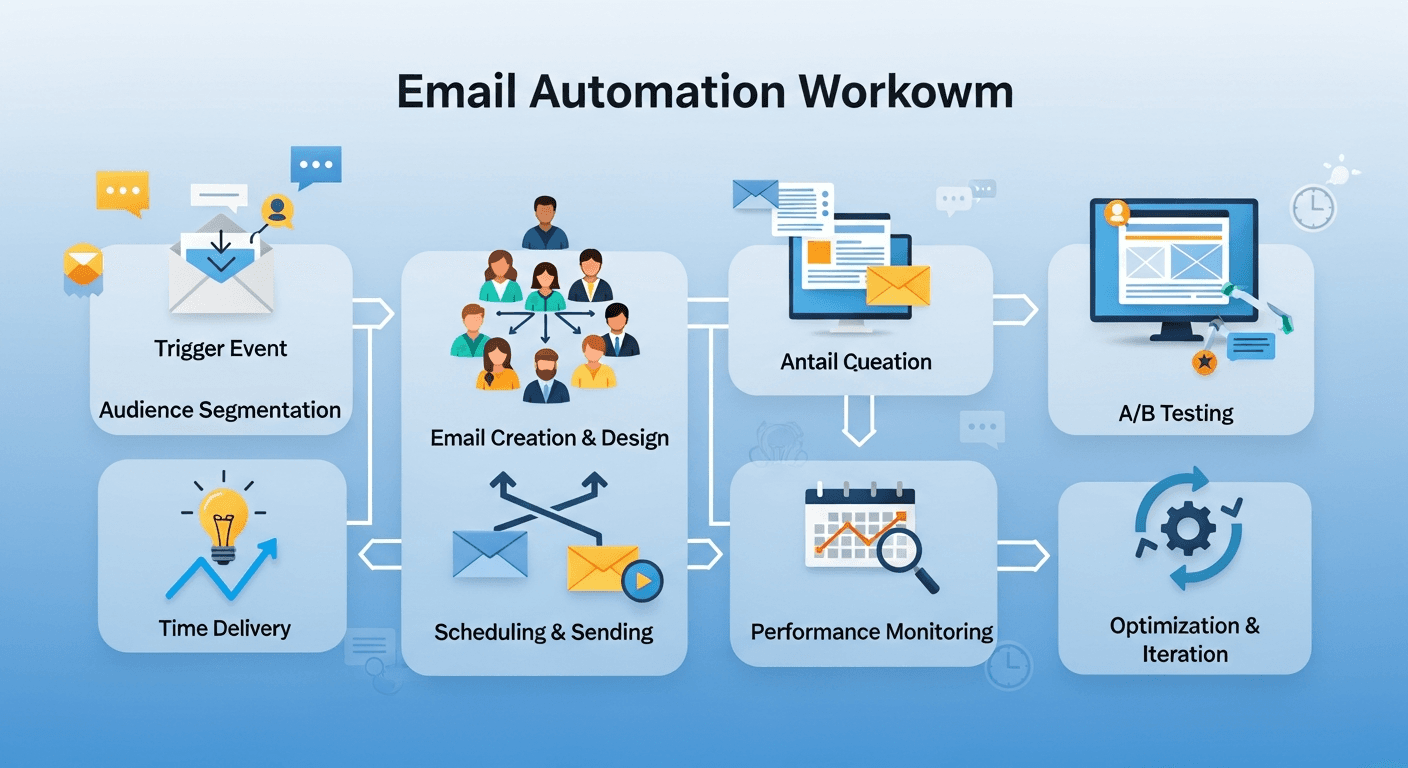
Understanding Email Automation
What is Email Automation?
Email automation is the process of sending targeted, predetermined messages to subscribers based on specific triggers or actions they take. Instead of manually crafting and sending individual emails, you set up a series of messages that deploy automatically when conditions are met. Think of it as your marketing team working 24/7 without requiring coffee breaks.
When a subscriber joins your email list, abandons their shopping cart, or reaches a milestone with your brand, automated workflows kick into action. These aren’t generic batch-and-blast messages either. Modern email automation delivers personalized content that responds to real user behavior, making subscribers feel like you’re speaking directly to them (because you are).
The beauty of email automation lies in its efficiency. You spend time upfront designing workflows, then those workflows generate results continuously. A welcome series can nurture new subscribers for months. A cart abandonment sequence can recover lost sales automatically. A re-engagement campaign can win back inactive customers without lifting a finger.
But here’s where many marketers stumble: they confuse email automation with email spray-and-pray tactics. Real email automation requires strategy. It demands understanding your audience, mapping their customer journey, and crafting messages that provide genuine value. It’s not about bombarding inboxes. It’s about meeting people where they are with information they actually want.

Benefits of Email Automation for Businesses
The statistics speak for themselves. According to Campaign Monitor, automated emails generate 50% higher click-through rates compared to traditional email campaigns. That’s not a marginal improvement. That’s a fundamental shift in how your audience engages with your content.
Consider the time savings. A business sending 100 manual emails per week saves roughly 5 hours weekly by automating that process. Over a year, that’s 260 hours redirected toward strategy, creative work, and relationship building. Your team becomes force multipliers rather than email factories.
Revenue impact matters most to business leaders. Automated email campaigns generate 3 to 5 times more revenue per email compared to non-automated campaigns. The reason is straightforward: when messages align with user intent and timing, conversion rates skyrocket.
Beyond revenue, email automation delivers consistency. Your brand voice remains constant across all customer touchpoints. New team members don’t need to learn your email communication style because the system enforces it. Messaging remains on-brand 100% of the time, reducing errors and maintaining professionalism.
Perhaps most importantly, email automation builds relationships at scale. You can nurture hundreds or thousands of prospects simultaneously with personalized experiences. This scalability means you’re not choosing between growing your audience and maintaining relationships. You’re doing both.
Key Components of Effective Email Automation
Segmentation and Targeting
Imagine sending the same email to a software developer and a fashion retailer. It won’t land. Segmentation ensures your message reaches the right person with the right content at the right time.
Segmentation divides your email list into distinct groups based on shared characteristics. These characteristics can be demographic (location, company size, job title), behavioral (purchase history, email engagement, website activity), or psychographic (interests, pain points, goals). Each segment receives targeted messages that speak to their specific situation.
The power of segmentation emerges in the numbers. HubSpot reports that segmented email campaigns achieve 14.31% higher open rates and 100% higher click-through rates compared to non-segmented campaigns. These aren’t tiny improvements. These are transformative metrics.
Effective segmentation starts with understanding your data. Collect information about subscribers through signup forms, surveys, and website behavior tracking. The more you know about your audience, the more precisely you can segment them. A B2B SaaS company might segment by industry, company size, and use case. An e-commerce store might segment by purchase frequency, average order value, and product category preference.
Progressive segmentation works even better. Rather than creating static segments once, progressive segmentation evolves as you gather new data. When a subscriber clicks a link about a specific product, they automatically move into a product-interest segment. When they make a purchase, they shift to a customer segment. Your segments stay fresh and relevant.
Personalization Techniques
Generic feels lazy. Personalized feels intentional. Personalization goes far beyond slapping a first name into your subject line (though that’s a starting point).
True personalization delivers content tailored to individual preferences and behavior. A subscriber interested in social media management receives different automation sequences than one interested in email marketing. Someone who abandoned their cart sees product recommendations for items they viewed. A long-time customer gets VIP offers before they’re offered to the general audience.
The implementation can range from simple to sophisticated. Simple personalization includes dynamic content blocks that change based on segment. Subject line personalization increases open rates by 26%, according to Campaign Monitor. Behavioral personalization (showing products based on browsing history) drives 8 times more conversions than non-personalized messaging.
Advanced personalization uses AI and machine learning to predict what content each individual subscriber wants. Predictive analytics can identify which subscribers are most likely to convert, which are at risk of churning, and which are primed for upsells. This intelligence allows you to send the right message at the precise moment someone is most receptive.
Dynamic content blocks represent a practical personalization technique available in most modern email platforms. These blocks change their content based on subscriber data. A financial services company might show different investment products based on account type. A SaaS company might highlight different features based on company size. The same email template serves multiple purposes through intelligent personalization.

Progressive Profiling for Better Engagement
Progressive profiling builds customer profiles gradually over time rather than demanding everything upfront. Instead of a lengthy signup form asking 15 questions, you ask 2 or 3. With each email interaction, you learn a bit more.
This approach dramatically improves signup conversion rates. Shorter forms convert 50% to 75% better than longer ones. By asking progressively, you reduce friction while building comprehensive profiles. Win-win.
Progressive profiling works through strategic form field additions over time. Your first signup form asks for name and email. A few weeks later, a form asks about company size. Another month in, a survey embedded in an email asks about primary pain points. Within six months, you’ve built rich profiles without overwhelming anyone.
The beauty of progressive profiling is its balance of data collection and user experience. You get the behavioral insights that matter while respecting subscribers’ time. They don’t feel interrogated. They feel understood as you gradually personalize their experience based on collected information.
Implementation requires intentionality. Plan what information you need at each stage of the customer journey. Determine when each question matters most. A question about budget is meaningless for someone who just joined your list, but it’s essential after they’ve engaged with content about your pricing tier. Timing and sequencing transform progressive profiling from pushy to elegant.
Setting Up Your Email Automation
Choosing the Right Email Automation Tool
Selecting an email automation platform is consequential. The right tool amplifies your efforts. The wrong tool creates friction.
Start by assessing your needs. What’s your subscriber count? What automation complexity do you envision? Do you need advanced segmentation? Do you want AI-powered recommendations? How much are you willing to invest? These questions narrow your options significantly.
Popular email automation platforms include ConvertKit (creator-focused), ActiveCampaign (mid-market, highly featured), Klaviyo (e-commerce specialists), and HubSpot (all-in-one platform). Each excels in different scenarios. ConvertKit appeals to creators and digital product sellers. Klaviyo dominates in e-commerce because of its product integration capabilities. ActiveCampaign serves B2B companies with complex workflows. HubSpot attracts businesses wanting everything in one platform.
Integration capabilities matter enormously. Your email platform should connect with your CRM, your shopping cart, your analytics tools, and your website. These integrations create the data flow that powers effective automation. A platform that exists in isolation will frustrate you within weeks.
User experience shouldn’t be overlooked. A platform with incredible features but a confusing interface will cost you time and money. You’ll spend more hours fighting the tool than using it strategically. Test the platform with your actual use case before committing. Most platforms offer free trials specifically for this purpose.
Pricing structures vary widely. Some charge per subscriber, others charge per contact, still others use monthly flat rates. Calculate total cost of ownership including setup, training, integrations, and ongoing usage. The cheapest option often isn’t the best value.
Creating Your First Automated Campaign
Your first automation should be simple and high-impact. A welcome series works beautifully for first-time automation. It has clear purpose, straightforward triggers (someone joins your list), and measurable results.
Start by mapping the customer journey for this specific automation. When does the trigger occur? What’s the subscriber’s mindset at that moment? What do they need to know? What action do you want them to take? This mapping informs your email sequence structure.
A typical welcome series runs three to five emails over two weeks. The first email deploys immediately, confirming subscription and setting expectations. The second email, arriving 2 to 3 days later, provides your strongest value proposition or core resource. The third email, arriving 5 to 7 days later, tells your brand story and why you exist. The fourth email, arriving 10 to 14 days later, presents a clear call-to-action aligned with your business goals.
Each email should serve a distinct purpose. Don’t repeat yourself. Don’t hard-sell in the first email. Don’t make the sequence feel like an obnoxious parade of promotional messages. Each email builds on the previous ones, gradually earning trust and relevance.
Write subject lines that generate curiosity without being manipulative. Test variations to see what resonates with your audience. Monitor open rates but don’t obsess over them. A 20% open rate for a welcome series is solid. A 30% open rate for a third email in a series is excellent.

Design emails for mobile devices first. Over 50% of email opens occur on mobile devices. If your email looks broken on iPhone, you’re losing conversions immediately. Keep it simple, scannable, and button-click friendly.
Best Practices for Email Automation Setup
Respect frequency boundaries. Automation can tempt you to over-communicate. Just because you can send five emails per week doesn’t mean you should. Frequency tolerance varies by audience and industry. B2B audiences often accept 1 to 3 emails per week. E-commerce audiences might tolerate more. Start conservative, monitor unsubscribe rates, and adjust accordingly.
Segment your automations from day one. Don’t send cart abandonment sequences to people who never had carts. Don’t send upgrade upsell emails to enterprise customers already on your highest tier. Irrelevant automation destroys engagement faster than silence.
Build in logical exit conditions. If someone purchases the product your welcome series is promoting, they should exit that sequence. If someone opens your email and clicks through to your website, maybe they’re ready for a different message. Automation should respond to changing behavior, not bulldoze forward obliviously.
Test before you launch. Send your automation to yourself and trusted team members. Check that links work. Verify that dynamic content displays correctly. Ensure images load properly. A single broken link in your automation multiplies its damage across thousands of sends.
Monitor deliverability carefully. Authentication standards like SPF, DKIM, and DMARC matter. Your sender reputation matters. ISPs track how many of your emails get marked as spam. A single poorly constructed campaign can damage your reputation for months. When setting up automation, treat deliverability as a foundational pillar, not an afterthought.
Examples of Successful Email Automation
Case Studies of High-Converting Email Campaigns
Online education platform Skillshare uses email automation brilliantly. When someone visits without enrolling, a welcome sequence begins immediately. The first email arrives within an hour, offering a discount code specific to the course they viewed. This early intervention capitalizes on active interest. Their automation sequences achieve 35% to 40% click-through rates because they’re timely and relevant.
E-commerce brand Grailed implements post-purchase automation that drives repeat sales. After someone completes their first purchase, they receive a series of styling tips featuring products that complement their original purchase. This cross-selling approach within an automated sequence generates 20% to 25% additional revenue per customer within 90 days. The automation feels helpful rather than pushy because it recommends products based on actual purchase behavior.
SaaS company Notion uses onboarding automation to guide new users toward “aha moments.” When someone signs up, they receive a structured email sequence introducing core features in digestible pieces. By day 7, they’ve learned enough to experience real value. This automation dramatically improves activation rates compared to users left to figure Notion out alone.
B2B marketing agency HubSpot employs lead scoring automation that routes prospects to sales teams based on engagement level. When someone downloads a resource, attends a webinar, and visits pricing pages, they’re automatically flagged as sales-ready. This automation ensures hot prospects don’t fall through cracks while cold prospects don’t get pestered by sales reps. The result is shorter sales cycles and higher conversion rates.
These case studies share common threads: they’re timely, they’re relevant, they’re behavioral, and they respect subscriber preferences. They solve problems rather than create them.
Common Mistakes to Avoid in Email Automation
One mistake stands above all others: setting automation and forgetting it. Email automation isn’t a one-and-done setup. Content becomes stale. Market conditions change. Customer needs evolve. Automation sequences need regular auditing and updating. That welcome series written two years ago might reference outdated products or feature prices that changed last quarter.
Another pervasive mistake is over-automation. Sending too many sequences to overlapping segments creates message fatigue. Someone might receive emails from your welcome series, your product tutorial series, your promotional series, and your newsletter simultaneously. That’s not nurturing. That’s harassment. Every subscriber should have clear rules about how many emails they receive weekly and why.
Poor segmentation creates third major mistake. Sending irrelevant messages because you didn’t segment properly destroys engagement metrics and tanks sender reputation. If you’re not sending intentionally targeted messages, you’re wasting both your time and your subscribers’ time.
Unclear value propositions doom plenty of otherwise solid automation sequences. Each email in your automation should answer one simple question: “Why should I care?” If the answer isn’t immediately obvious, your automation has failed.
Many marketers underestimate the importance of the unsubscribe experience. Make it easy to unsubscribe. Make it easy to manage preferences. Complicated unsubscribe processes violate spam laws in many jurisdictions (hello, CAN-SPAM Act and GDPR) and breed resentment. When someone wants out, let them out gracefully.
The final common mistake is ignoring data. You’re sitting on a goldmine of information about what resonates with your audience. Open rates, click rates, conversion rates, unsubscribe patterns. These metrics reveal what’s working and what’s falling flat. Yet many marketers set automation and ignore the data entirely. This is leaving money on the table.
Measuring the Success of Your Email Automation
Key Metrics to Track
Open rate reveals whether your subject lines are compelling. A 15% to 25% open rate is generally healthy, though this varies by industry and audience. Falling open rates suggest your subject lines are losing relevance or you’re sending too frequently.
Click-through rate is more meaningful than open rate. Opening an email is passive. Clicking is active engagement. A 2% to 5% click-through rate is solid. If your click-through rate is 0.5%, your content isn’t compelling enough or your call-to-action is unclear.
Conversion rate is what actually matters to your business. Did the email lead to a signup, a purchase, a webinar registration? Conversion rates vary enormously by industry and automation type. A welcome series might convert at 5% to 10%. A product recommendation email might convert at 3% to 8%. Cart abandonment sequences often convert at 10% to 25%. Track conversions tied directly to your business goals.
Unsubscribe rate indicates whether people are unhappy with your frequency or relevance. More than 0.5% unsubscribe rate suggests problems. Less than 0.1% suggests you’re not sending enough or aren’t reaching people who aren’t interested. You want some unsubscribes. Zero unsubscribes often means you’re not mailing frequently enough.
List growth rate shows whether your automation is acquiring more subscribers than you’re losing to unsubscribes and bounces. Healthy lists grow 1% to 2% monthly organically. Stagnant or declining lists indicate acquisition problems or engagement problems.
Return on investment ties everything together. How much revenue is your email automation generating relative to your costs? Hovers helps businesses streamline content creation for email marketing automation by generating high-quality, SEO-optimized articles that can be repurposed as email content, but proper measurement ensures you’re investing in the right channels.
A/B Testing for Continuous Improvement
A/B testing transforms email automation from guesswork into science. Test one variable at a time to isolate what drives results.
Subject line testing reveals what language generates opens. Test curiosity-driven subjects against benefit-driven subjects. Test personalized subjects against generic ones. Subject line testing often yields 10% to 30% lift in open rates.
Send time testing determines when your audience is most receptive. Your first intuition might be wrong. Test morning delivery against evening delivery against weekend delivery. Tracking which time generates best open rates and click rates informs all future sends.
Content testing asks fundamental questions. Does storytelling outperform data? Does long-form email outperform short-form? Does a personal tone outperform a professional tone? The answers vary by audience. Only testing on your specific audience reveals truth.
Call-to-action testing optimizes your conversion rate. Test button copy. Test button placement. Test single CTAs against multiple CTAs. Test different value propositions. Even small CTA improvements can dramatically impact conversion rates.
Segmentation testing validates whether your segments actually behave differently. Do they? Or are you over-segmenting? Proper segmentation should show distinct open rates, click rates, and conversion rates between segments. If segments show identical metrics, they’re not actually different enough to warrant separate messaging.
Test rigorously but systematically. Running twenty tests simultaneously creates noise. Run one test, document results, implement learning, move to next test. Over months, these marginal improvements compound into significant performance gains.
Recent Trends in Email Automation
Emerging Technologies in Email Marketing
Artificial intelligence increasingly powers email automation. Machine learning algorithms now predict optimal send times for individual subscribers. Instead of sending to everyone at 9 a.m. Tuesday, AI determines that subscriber A opens best at 8 a.m. Monday while subscriber B opens best at 2 p.m. Thursday. This personalization of timing increases open rates by 15% to 20%.
Predictive analytics identify which subscribers are most likely to convert, most likely to churn, and most likely to spend significant money. Armed with these predictions, you can adjust messaging accordingly. High-churn-risk subscribers receive re-engagement sequences. High-value prospects receive premium offers. This intelligence-driven approach beats guessing every time.
Dynamic content blocks now include AI-generated recommendations. Instead of humans manually selecting which products to recommend, AI learns patterns in purchase behavior and browsing history to generate personalized product recommendations automatically. This scales personalization to levels previously impossible.
Interactive email elements transform passive reading into active engagement. Embedded surveys let subscribers vote directly in email without leaving inbox. Countdown timers create urgency. Product carousels let subscribers browse without navigating to website. These interactive elements increase click-through rates by up to 150% compared to static email.
Deliverability tools monitor your sender reputation in real time. They predict whether your emails will hit inbox or spam folder. They identify domain reputation issues before they tank your deliverability. This proactive monitoring prevents the catastrophic sender reputation damage that can take months to repair.
The Future of Email Automation
Conversational email will grow significantly. Instead of one-way messaging, subscribers will respond to emails directly in their inbox, triggering follow-up messages based on their responses. Email becomes a dialogue instead of a broadcast. This transforms customer service, lead qualification, and feedback collection.
Privacy-first strategies will become essential. Third-party cookies are disappearing. Email remains one of the few channels where you own direct customer relationships without reliance on third-party data. This advantage means email automation investment will increase across industries.
Hyperpersonalization will intensify. Automation that considers not just purchase history and browsing behavior but also context like weather, location, time of day, and real-time sentiment analysis will emerge. Email will feel increasingly tailored to individual circumstances rather than generic to segments.
Integration with other marketing channels will deepen. Email automation won’t exist in isolation. It will coordinate with SMS, push notifications, in-app messaging, and social media. Omnichannel automation will provide seamless experiences across touchpoints.
Regulatory requirements will continue tightening. GDPR, CAN-SPAM, CASL, and emerging regulations worldwide will require more explicit consent, clearer unsubscribe options, and stronger data protection. Automation systems that built compliance into workflows from the beginning will thrive while others scramble.

Conclusion and Next Steps
Recap of Key Takeaways
Email automation transforms marketing from a time-consuming manual process into an intelligent, scalable system. The fundamentals remain consistent: segment your audience, personalize your messaging, time your sends strategically, and measure everything.
Progressive profiling balances data collection with user experience. Build customer profiles gradually while respecting subscriber time. This approach generates richer insights while maintaining engagement.
Lead nurturing automation nurtures prospects systematically at scale. Welcome series, educational sequences, product recommendations, and re-engagement campaigns work collectively to move prospects closer to conversion.
Measurement drives improvement. Track opens, clicks, conversions, and ROI. A/B test systematically. Let data guide optimization rather than assumption or instinct.
The platforms available today provide sophisticated capabilities at accessible price points. Modern email automation isn’t just for enterprise organizations anymore. Small teams can implement enterprise-grade automation.
Call to Action: Start Your Email Automation Journey
You now understand email automation fundamentals and best practices. The next step is implementation. Choose a platform aligned with your needs. Identify your first automation opportunity (welcome series is ideal for beginners). Map your subscriber journey. Write your emails. Test thoroughly. Launch with confidence.
Start simple with one automation sequence. Measure results rigorously. Let early wins inform your next automation projects. Within a few months, you’ll have multiple sequences working in parallel, steadily moving subscribers through your funnel.
For content creators and small teams looking to streamline their email marketing strategy with high-quality material, consider how Hovers can support your content calendar. The platform generates SEO-optimized articles that work beautifully repurposed as email content, helping you maintain consistent, valuable communication with your audience while saving time on content creation.
Email automation success isn’t about complexity. It’s about consistency, relevance, and respect. Respect your subscribers’ time and inbox. Deliver relevant value consistently. Automate the routine work so you can focus on strategic thinking. Done right, email automation becomes your most profitable marketing channel.
Start your email automation journey today. Your future self (and your conversion rates) will thank you.
Article created using Hovers.ai