Understanding Efficiency Optimization
Definition of Efficiency Optimization
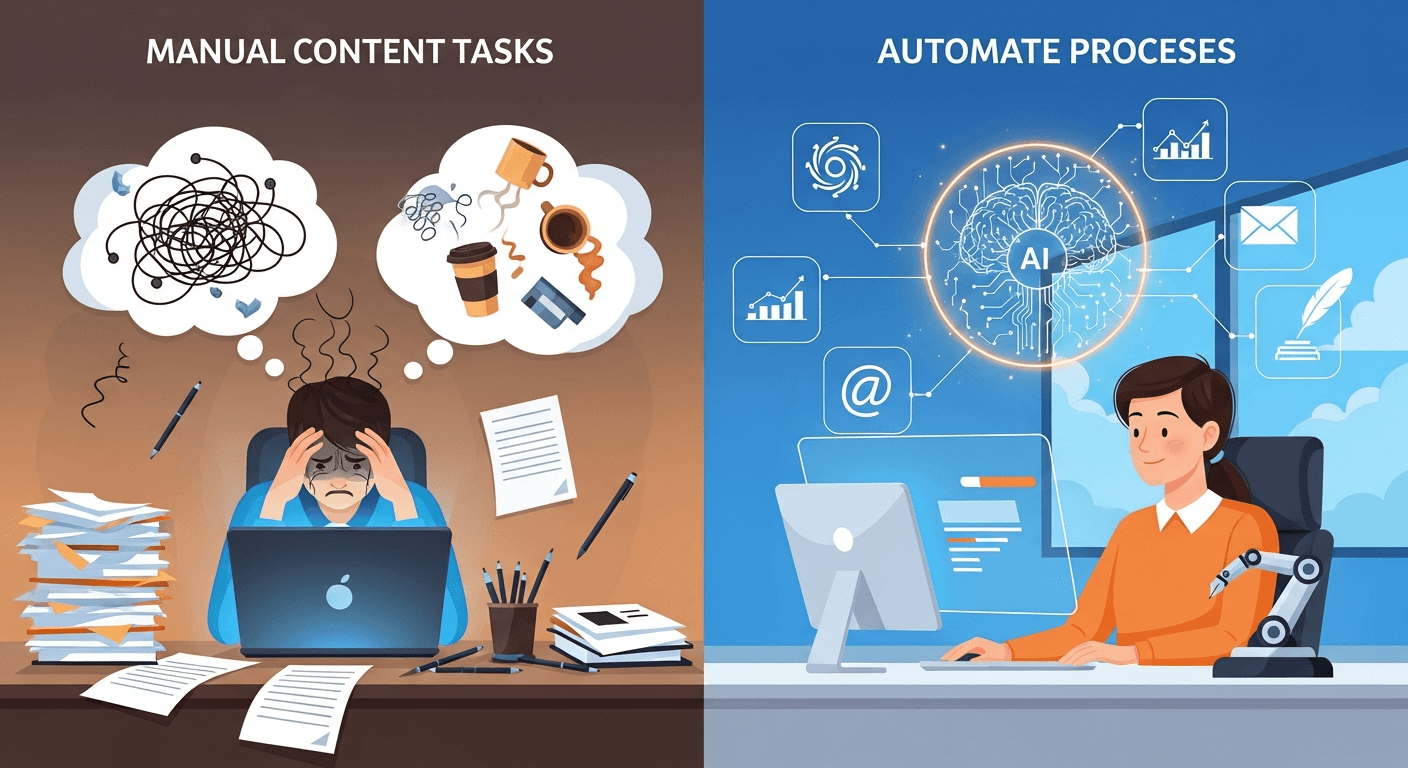
Let’s cut through the noise: efficiency optimization isn’t about working harder or grinding yourself to dust. It’s about working smarter by systematically eliminating waste from your workflow and maximizing output with minimal effort. Think of it as the art of doing more with less, without sacrificing quality.
In the context of process automation and content creation, efficiency optimization means identifying repetitive, time-consuming tasks and replacing them with streamlined workflows powered by intelligent automation tools. It’s the difference between spending eight hours manually creating a content calendar and having one generated automatically in minutes.
The core principle is straightforward: every minute spent on a task that could be automated is a minute stolen from strategic work. When you optimize for efficiency, you’re essentially creating a system where machines handle the mechanical work while humans focus on creativity, strategy, and decision-making.
This isn’t theoretical. Studies show that knowledge workers waste approximately 30% of their time on administrative tasks that could be automated. For content creators and small teams managing multiple projects, that’s nearly a full workday each week spent on busywork instead of actual content strategy.
Importance of Efficiency in Content Creation
Content creation is a multi-step process that historically has been labor-intensive. You need to research topics, plan your content calendar, write articles, source images, add citations, optimize for SEO, and publish across multiple platforms. When each step is done manually, the entire process becomes a bottleneck that limits your output.
Here’s the business reality: time is your most finite resource. Whether you’re a founder bootstrapping your business or a small team wearing multiple hats, your hours are limited. Efficiency optimization directly translates to competitive advantage. Teams that automate routine content tasks can publish more frequently, maintain consistency, and respond faster to market trends.
Beyond productivity metrics, efficiency optimization also impacts quality. When creators aren’t exhausted from manual administrative work, they have mental bandwidth for strategic thinking. You write better content when you’re not burned out managing spreadsheets and scheduling posts.

Common Manual Content Tasks That Waste Time
Identifying Time-Consuming Tasks
If you’re managing content in 2024, you’re probably drowning in tasks that sound simple but collectively consume your entire week. Let’s identify the usual suspects.
Content calendar creation tops the list. Most teams manually build spreadsheets mapping out topics, keywords, publish dates, and platform assignments. A 30-day calendar with 20 articles? That’s 2-3 hours of planning, reorganizing, and cross-referencing before you write a single word. For inspiration, see our 30 Day Content Calendar for Content Management Systems.
Research and keyword analysis is another massive time sink. Creators jump between keyword research tools, search engines, competitor sites, and analytics platforms to understand what topics matter and how to optimize around keywords. This fragmented process burns hours that could be spent on actual creation. Our guide on how to identify content gaps may help streamline this step.
Article writing with SEO optimization used to be a purely manual affair. Writers would craft content, then go back multiple times to weave in keywords, optimize heading structure, ensure proper keyword density, and adjust readability. A single article could require 3-4 revision passes just for SEO alignment. You can also explore our article on SEO content writing tools.
Image sourcing and optimization is deceptively time-consuming. Finding relevant images, resizing them, adding alt text, compressing for web performance, and licensing properly could add 30 minutes to each article. Multiply that by a content calendar, and you’re looking at days of work.
Publishing and distribution involves logging into different platforms, formatting content for each channel, scheduling posts, adding metadata, and monitoring uploads. What should take minutes per post takes 10-15 minutes when done across multiple platforms.
Citation management and source verification requires creators to track sources, verify accuracy, format citations properly, and add links. It’s detail-oriented work that’s essential but repetitive and error-prone when done manually.
Impact of Manual Processes on Productivity
The cumulative effect of these manual tasks is devastating to productivity metrics. Consider a content team publishing three articles per week. Here’s a realistic time breakdown:
Content planning and calendar creation: 5 hours per week. Research and keyword analysis: 6 hours per week. Writing and editing: 9 hours per week. SEO optimization and revisions: 4 hours per week. Image sourcing and optimization: 3 hours per week. Publishing and distribution: 2 hours per week. Citation verification and linking: 2 hours per week.
That’s 31 hours of work per week for a team of two people. Now factor in meetings, revisions from stakeholders, and unexpected issues. You’re looking at a full-time person dedicated almost entirely to operational tasks with minimal capacity for strategy.
The productivity drain extends beyond hours logged. Context switching between tasks degrades focus and increases error rates. Manual processes introduce inconsistencies in quality and formatting. Delays in one step cascade through the entire workflow. And perhaps worst of all, repetitive administrative work demoralizes teams and contributes to burnout.
This is where most small teams plateau. They can’t grow output without hiring more people, but hiring creates overhead and complexity. The solution isn’t more people. It’s smarter processes.

Introduction to Process Automation
What is Process Automation?
Process automation sounds technical, but it’s essentially instructing software to handle tasks that humans currently do manually. Instead of your team following a repetitive workflow, software follows the workflow for you.
There are different levels of automation sophistication. Basic automation might involve scheduled email workflows or simple task triggers. More advanced automation, sometimes called intelligent automation, combines rule-based processes with artificial intelligence to handle complex, multi-step workflows that require decision-making and adaptation.
For content creation, intelligent automation means systems that understand context, can generate original content, optimize for multiple parameters simultaneously, and integrate seamlessly across tools. A modern intelligent automation platform can analyze your target keywords, research trending topics, generate SEO-optimized articles with images and citations, then publish directly to your CMS. What once required 15 hours of manual work happens in minutes.
The magic isn’t in any single technology. It’s in the integration of multiple tools working in concert. Automation platforms connect your keyword research tools, content management systems, publishing platforms, and analytics tools into a unified workflow. Data flows between systems automatically, eliminating manual data entry and reducing error.
Benefits of Automating Content Tasks
The benefits of process automation extend far beyond time savings, though that’s certainly significant.
Speed to market is the most obvious benefit. With automation, you can generate a month-long content calendar in minutes instead of hours. You can publish content at optimal times without manually scheduling each post. You can respond to trending topics in days instead of weeks because you’re not bottlenecked by manual creation processes. Learn more in our article on automated content creation.
Consistency and quality control improve dramatically with intelligent automation. When systems follow standardized templates and optimization rules, every piece of content meets baseline quality standards. SEO optimization isn’t inconsistently applied. Image usage is standardized. Citation formats are correct. There’s no degradation in quality during the production rush.
Scalability becomes feasible for small teams. Automation lets you publish 3x more content with the same team size because machines are doing the repetitive work. You can expand into new content areas, tackle multiple topics simultaneously, and maintain publishing frequency even during busy periods.
Cost efficiency is substantial. Intelligent automation reduces the need for specialists and contractors. A small team can accomplish what previously required twice the headcount. For bootstrapped founders and growing companies, that’s the difference between viability and burnout.
Team morale and retention improve when people aren’t doing repetitive busywork. Your team spends time on creative and strategic work, which is actually engaging. This reduces burnout and improves retention, which is far cheaper than constant hiring and training.
Data quality and insights improve because automation eliminates manual data entry errors. Your analytics are more reliable. Your performance metrics are consistent. You can actually trust your numbers and make decisions based on accurate data.
Flexibility and adaptability paradoxically improve with automation. Ironically, automated systems allow for quicker pivots. When you change strategy, you update rules and templates in your automation platform, and the entire workflow adapts. Manual processes require retraining humans and rebuilding systems across multiple tools.
Intelligent Automation Tools for Content Creation
Overview of Popular Tools
The automation tool landscape is crowded, which is good for choice but overwhelming for selection. Let’s break down the main categories and some notable players.
Standalone AI writing tools like ChatGPT and Claude excel at generating text but require manual integration into your workflow. You write prompts, copy outputs, paste into your CMS. They’re useful but not truly automating your process.
SEO and content planning platforms like Semrush and Ahrefs provide research capabilities and competitive analysis. They help you plan content, but you still manually create the calendar and write the articles.
AI-powered content generation platforms like Jasper and Copy.ai focus on producing written content at scale. They reduce writing time significantly but don’t handle the full workflow from planning through publishing.
All-in-one automation platforms combine multiple capabilities into unified workflows. These integrate keyword research, content generation, image sourcing, SEO optimization, and direct CMS publishing. Hovers exemplifies this approach, automatically generating 30-day SEO-optimized content calendars with full articles including images and citations, with seamless publishing to WordPress, Shopify, and other CMS platforms.
Workflow automation tools like Zapier and Make (formerly Integromat) connect different applications and create custom workflows. They’re powerful but require technical setup and ongoing maintenance.
Comparative Analysis of Features
Let’s analyze what actually matters when comparing intelligent automation tools for content creation.
End-to-end workflow coverage is essential. Tools that only handle one part of the process (like writing) create fragmented workflows. The best tools handle planning, generation, optimization, and publishing in one integrated system.
SEO optimization depth varies significantly. Some tools understand SEO at a surface level. Others integrate comprehensive keyword analysis, internal linking suggestions, readability optimization, and search intent alignment. For content creators, SEO capability directly impacts ranking potential.
Image sourcing and integration separate adequate platforms from excellent ones. Does the tool find relevant images automatically? Does it optimize images for web performance? Does it handle licensing and attribution? Manual image sourcing completely negates automation benefits.
Citation and source management distinguishes platforms that produce publishable content from those that produce content requiring significant cleanup. Do citations auto-populate? Are sources verified? Can the system generate proper citations in multiple formats?
CMS integration breadth determines whether you’re automating publishing or just generating content you still need to manually publish. WordPress, Shopify, and Framer integration matter if you use those platforms. Limited CMS support means continued manual publishing.
Customization and control balance user-friendliness with professional flexibility. Can you customize templates and styling? Can you set specific requirements for word count, keyword targets, and tone? Can you review and approve content before publishing, or is it fully hands-off?

Quality and accuracy of generated content is non-negotiable. Are articles original or regurgitated? Are facts verified? Does the writing read naturally or feel robotic? This requires testing with real content generation.
Learning curve and support matter for implementation. Some platforms are intuitive enough for non-technical users. Others require developer involvement. For small teams, ease of use is critical.
Pricing and scalability determine long-term viability. Can the tool grow with your publishing volume? Does pricing scale proportionally, or do costs explode at higher volumes? For bootstrapped teams, this is make-or-break. For comparison, explore our pricing.
| Feature | Standalone AI Writers | SEO Platforms | AI Content Generators | Integrated Automation | Workflow Tools |
|---|---|---|---|---|---|
| Content Planning | No | Limited | No | Yes | Custom |
| AI Article Generation | Yes | Limited | Yes | Yes | Custom |
| Image Sourcing | No | No | Limited | Yes | Custom |
| SEO Optimization | Limited | Comprehensive | Basic | Comprehensive | Custom |
| Citation Management | No | Limited | No | Yes | Custom |
| CMS Integration | Limited | Limited | Limited | Comprehensive | Extensive |
| Ease of Use | High | Medium | High | High | Low |
| Learning Curve | Minimal | Moderate | Minimal | Minimal | Significant |
The table clearly shows the advantage of integrated platforms like Hovers. Instead of juggling multiple tools and manually connecting outputs, you get a unified system handling the entire workflow from planning through publishing.
Strategies for Implementing Efficiency Optimization
Step-by-Step Guide to Automating Content Tasks
Implementing automation successfully requires strategy, not just tool adoption. Here’s a proven framework.
Step 1: Audit your current workflow. Document everything you do to create and publish a piece of content. Track time spent on each task. Identify which tasks are repetitive, which are bottlenecks, and which require specialized skills. You need data to make prioritization decisions.
Step 2: Prioritize automation opportunities. Focus first on high-time, low-complexity tasks. Content calendar creation and image sourcing are perfect starting points. Avoid automating tasks that require deep expertise or creative judgment initially. Low-hanging fruit builds momentum and shows ROI quickly.
Step 3: Select tools aligned with your workflow. Don’t choose tools based on features alone. Choose tools that integrate together and cover your actual workflow. If you publish primarily to WordPress, prioritize tools with robust WordPress integration. If SEO optimization is your weakness, prioritize comprehensive SEO capabilities.
Step 4: Implement gradually, not all at once. Start with one or two automated processes. Get comfortable with the workflow. Measure impact. Then expand. Trying to automate everything simultaneously creates chaos and guarantees failure.
Step 5: Establish quality checkpoints. Automation doesn’t mean zero human oversight. Build in review and approval steps, especially initially. As you trust the system and quality remains consistent, you can reduce oversight. But maintain approval gates for critical decisions.
Step 6: Document new workflows. Once automated processes are working, document them clearly. Include decision rules, approval processes, and troubleshooting steps. This prevents knowledge from living only in someone’s head.
Step 7: Measure results against baselines. Compare time spent and output quality before and after automation. Track publishing frequency, article quality scores, SEO rankings, and team satisfaction. Real metrics guide optimization decisions.
Best Practices for Maximizing Efficiency
Beyond implementation steps, certain practices dramatically improve automation outcomes.
Standardize before automating. If your current process is chaotic and inconsistent, automation will amplify that chaos. Before automating, establish standards for article structure, keyword targets, image usage, and formatting. Automation works best when it has clear rules to follow.
Set realistic expectations. Automation accelerates your process, but it doesn’t create genius-level content from mediocre templates. The quality ceiling is set by your instructions and templates. Invest in developing excellent automation inputs, and outputs will be excellent.
Review and refine regularly. Automation isn’t set-and-forget. Review outputs monthly. Are articles hitting keyword targets? Are they ranking? Are readers engaging? Adjust rules, templates, and parameters based on performance data.
Balance automation with personalization. Fully automated content sometimes lacks personality. Consider automating bulk generation but adding personal touches or specialized insights for high-priority pieces. Hybrid approaches often outperform pure automation or pure manual creation.
Involve your team in implementation. If people feel automation is being imposed on them, they’ll resist and sabotage. Involve team members in tool selection and process design. Make them architects of automation, not just users. You’ll get better buy-in and better processes.
Plan for edge cases. Automation handles standard cases beautifully. But your workflow probably has exceptions and special situations. Build in escape routes and override options so people can handle edge cases without breaking the system.
Track automation performance metrics. Time saved per article, cost per piece of content, articles published per week, SEO ranking improvements, reader engagement metrics. Know your numbers. They guide optimization decisions and justify continued investment.

Addressing Common Concerns and Misconceptions
The Paradox of Efficiency Optimization
Here’s a counterintuitive truth that trips up most people attempting efficiency optimization: focusing too hard on optimizing every tiny task can paradoxically reduce overall efficiency.
This is the optimization paradox. You spend so much time perfecting your process that you never actually execute it. You’re endlessly tweaking and optimizing but not producing content. The mental cost of decision-making and perfectionism exceeds the productivity gain.
The solution is pragmatic imperfection. Your automation system doesn’t need to be perfect. It needs to work better than your current manual process. An 80% automated workflow that produces content consistently beats a 99% optimized workflow that’s still being designed.
Another paradox: automating everything can backfire. Fully hands-off automation removes human judgment and flexibility. When something unexpected happens (and it will), the system might generate nonsensical content or miss important context. The best approach is intentional automation with strategic human oversight.
Smart teams automate the mechanical parts (scheduling, image sourcing, basic optimization) while maintaining human oversight for strategic decisions (topic selection, brand voice, fact verification, final approval).
Planning for Efficiency vs. Premature Optimization
Many teams fall into the premature optimization trap. They spend months designing the perfect automation system before publishing a single automated article. Meanwhile, their competitors publish content manually and capture market share.
Premature optimization kills momentum. You need to start generating efficiency gains immediately, not in six months. The fastest path to efficiency isn’t perfection on day one. It’s imperfect implementation today that you iterate on continuously.
Here’s the practical approach: identify your biggest bottleneck (probably content calendar creation or article writing). Find a tool that addresses it (like Hovers for integrated content generation and publishing). Implement it in your workflow even if it’s not perfect. Start generating content automatically. Measure results. Optimize based on real data.
You’ll learn more in one week of implementation than in six months of theoretical planning. Real-world usage reveals problems that planning sessions never anticipate. You’ll discover which features matter and which don’t. You’ll develop better templates and instructions. You’ll identify workflow gaps.
Most importantly, you start seeing ROI immediately instead of hoping it materializes someday.
The decision framework is simple: Does your current manual process work acceptably but slowly? Automate it now with a 70% solution. Does your process create problems (inconsistency, errors, bottlenecks)? Standardize it before automating. Is your process unique and specialized? Automate the standard parts and maintain human control over specialized parts.
Perfect is the enemy of good. And good is the enemy of nonexistent (which is where your automated content currently is).

Conclusion and Actionable Takeaways
Summary of Key Points
Efficiency optimization in content creation isn’t about working harder. It’s about systematically eliminating manual tasks that don’t require human judgment and redirecting your team’s energy toward creative and strategic work.
The reality is stark: manual content processes consume 30+ hours per week for small teams publishing just three articles weekly. That’s a full-time employee spent entirely on operational busywork. Process automation eliminates this waste.
Intelligent automation tools have evolved from simple writing assistants to comprehensive platforms that handle planning, generation, optimization, and publishing in integrated workflows. The difference between using multiple disconnected tools and using an integrated platform is the difference between slight efficiency gains and transformative productivity improvements.
Implementation doesn’t require perfection. It requires pragmatic decisions about which tasks to automate (mechanical, repetitive, high-time tasks), which tools to use (integrated solutions covering your full workflow), and how to maintain quality (strategic human oversight at critical points).
The biggest mistake teams make is overthinking the implementation. Premature optimization delays results. Better to implement an 80% solution today and iterate continuously than design a 99% solution for six months while manually creating content.
Next Steps for Implementing Automation
Your path to efficiency optimization starts with clear action items.
First, audit your current content workflow. Document every task from topic selection through publishing. Note time spent and pain points. This gives you the baseline for measuring improvement.
Second, identify your biggest bottleneck. Where does time disappear? Most teams will find content calendar creation or article writing is the biggest drag. That’s your starting point.
Third, investigate integrated automation solutions. Look for platforms that handle your specific bottleneck plus the steps before and after it. An integrated platform like Hovers that generates 30-day content calendars, produces SEO-optimized articles with images and citations, and publishes directly to your CMS (WordPress, Shopify, Framer) can compress weeks of work into days.
Fourth, run a pilot. Use the tool to automate one month of content production. Review outputs. Measure time saved and quality maintained. Gather team feedback. Let the pilot data guide decisions about scaling.
Fifth, optimize based on real results. Don’t tweak endlessly before launching. Launch, measure, optimize based on actual performance data. Your first iteration won’t be perfect, but it will be better than manual processes. Your second iteration will be better still.
Sixth, document your new workflow. Once you’ve found what works, capture it in standard procedures. This enables consistency and allows team changes without losing institutional knowledge.
The bottom line is simple: stop wasting time on manual content tasks. The technology to automate your workflow exists today. The platforms are sophisticated enough for professional use. The ROI is measurable and usually positive within the first month.
You can continue spending 30+ hours weekly on administrative work while watching competitors publish more frequently and capture market share. Or you can invest in automation today and free your team to focus on what actually builds your business: strategy, creativity, and growth.
Start automating your content tasks today. Explore Hovers for a platform that generates SEO-optimized content calendars, produces articles with images and citations automatically, and publishes directly to your CMS. See firsthand how efficiency optimization transforms your content operation from a bottleneck into a competitive advantage.
The choice is yours. Keep grinding through manual processes, or start working smarter. The teams that choose automation are already pulling ahead.