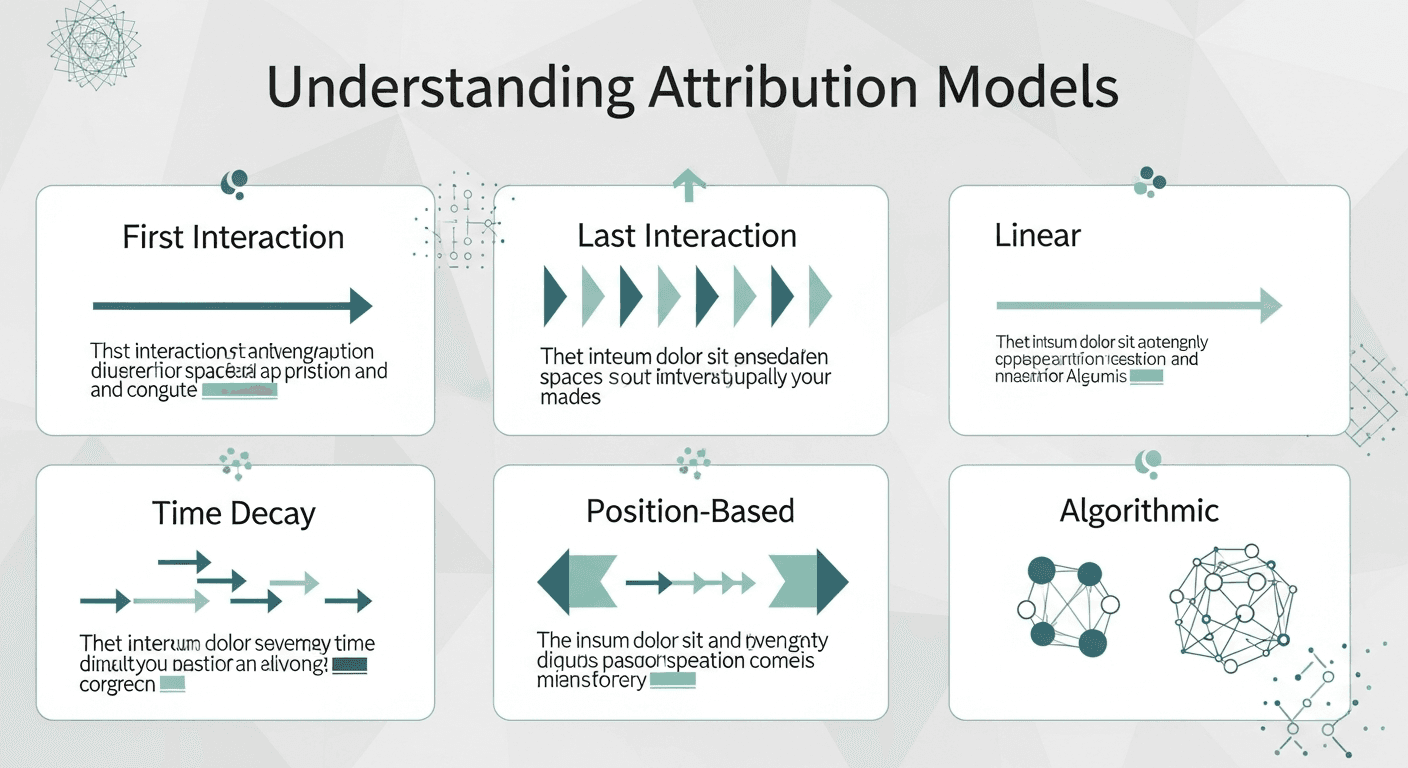
What is Attribution Modeling?
Attribution modeling is the framework that answers one of marketing’s most pressing questions: which touchpoint actually deserves credit for a conversion? It’s the difference between knowing someone bought your product and understanding the full journey that got them there.
Think of it this way. A potential customer discovers your blog post through organic search, reads it, leaves, scrolls through your social media ads three days later, clicks an email campaign, visits your website directly, and finally converts. So which channel deserves the credit? First-click? Last-click? All of them equally? That’s where attribution modeling steps in to cut through the ambiguity.
Definition and Importance
Attribution modeling is a methodology for assigning credit to marketing touchpoints along a customer’s conversion path. It provides a structured way to understand which channels, campaigns, and content pieces drive actual business results. Rather than guessing which efforts matter most, attribution models transform customer journey data into actionable insights.
The importance of attribution modeling cannot be overstated. Most businesses rely on flawed metrics like last-click attribution, which credits only the final interaction before conversion. This approach systematically undervalues the awareness and consideration stages that actually build decision-making momentum. When you don’t accurately understand which touchpoints drive conversions, you’re essentially making budget allocation decisions in the dark.
Consider this: according to recent marketing analytics data, companies using comprehensive attribution models increase marketing ROI by an average of 15-25% compared to those using single-touch attribution. Why? Because they finally understand where to invest their resources based on actual contribution to conversions, not just guesswork.
For content marketers specifically, attribution modeling reveals which content pieces actually influence purchasing decisions. A top-of-funnel blog post might not convert immediately, but it plants the seed that eventually leads to a customer paying for your solution. Attribution modeling captures this often-invisible contribution.
How Attribution Models Work
Attribution models operate on a fundamental principle: collect data about every touchpoint in a customer’s journey, then apply a mathematical formula to assign conversion credit accordingly. The mechanics vary significantly depending on which model you choose.
Most attribution models work by tracking customer interactions across channels using cookies, pixels, and cross-domain tracking. When someone converts, the model looks back at their complete journey and distributes credit based on its underlying logic. Some models credit only one touchpoint, others distribute credit across multiple touchpoints using different weighting strategies.
The process typically follows these steps. First, data collection captures all interactions (website visits, email opens, ad clicks, content downloads, etc.). Second, the model identifies the conversion event. Third, the attribution logic traces back through the journey. Fourth, the model calculates credit distribution based on its specific formula. Finally, marketers can aggregate results to understand channel performance, campaign effectiveness, and content impact.
Modern attribution platforms automate this process, pulling data from various marketing tools and applying your chosen model in real time. This automation is crucial because manual attribution across multiple channels quickly becomes unmanageable.

Types of Attribution Models
The attribution modeling landscape offers numerous approaches, each with distinct strengths and limitations. Understanding these models is essential for choosing one that aligns with your business structure and marketing objectives.
First-Click Attribution
First-click attribution assigns 100% of conversion credit to the first touchpoint in a customer’s journey. This model operates on the assumption that awareness is everything. The channel that first introduces a prospect to your brand gets all the credit, regardless of what happens afterward.
When is first-click attribution valuable? It excels at identifying which channels are most effective at driving brand awareness and capturing new audiences. If you’re launching a new product and want to understand which channels successfully reach previously unaware prospects, first-click attribution provides clear answers.
However, first-click attribution has significant limitations. It completely ignores the nurturing process that converts awareness into action. A blog post that teaches someone about a problem they didn’t know existed gets credit, but the sales email that convinced them to buy your solution gets none. This model systematically undervalues consideration and decision-stage content.
First-click works best for organizations primarily interested in top-of-funnel metrics and brand awareness campaigns, not for those focused on revenue optimization.
Last-Click Attribution
Last-click attribution is the default model for most marketing tools. It awards 100% of conversion credit to the final touchpoint before conversion, based on the logic that the last interaction is most influential on the final decision.
This model dominates the industry because it’s simple and aligns with many marketers’ intuitions about consumer behavior. The email that prompted immediate purchase action seems most directly responsible for the conversion. Many default analytics implementations use last-click attribution, so it requires no additional setup.
The problem? Last-click attribution ignores everything that built to that final moment. It systematically overvalues lower-funnel channels (typically paid search and retargeting) while undervalues awareness and consideration channels (typically organic search, content, and social media). Organizations relying solely on last-click attribution typically slash investment in content and awareness channels, then wonder why their top-of-funnel withers.
Last-click attribution can blind you to the true drivers of revenue by creating a false narrative about which channels matter most. Use it as one data point, never as your only attribution model.
Multi-Touch Attribution
Multi-touch attribution is the antidote to single-touch models. Rather than crediting only one touchpoint, multi-touch models distribute conversion credit across all touchpoints in a customer’s journey using various weighting strategies.
The fundamental insight is simple but powerful: conversions result from multiple influences. A customer’s journey typically involves 5-7 meaningful touchpoints before conversion. Each touchpoint plays some role in advancing the prospect toward purchase. Multi-touch attribution attempts to quantify that role.
Why is multi-touch attribution gaining traction? Because it produces more realistic revenue attribution. When you analyze actual customer journeys, you discover that awareness content, consideration content, and direct response all contribute to conversions. Multi-touch models reflect this reality.
The challenge with multi-touch attribution is determining the right weighting strategy. Different multi-touch models weight touchpoints differently, leading to different conclusions about channel effectiveness. The choice of weighting strategy significantly impacts results, so selecting the right approach matters enormously.
Linear Attribution
Linear attribution divides conversion credit equally across all touchpoints in a customer’s journey. If a prospect had five touchpoints before converting, each receives 20% of the credit.
Linear attribution appeals to marketers who believe all touchpoints contribute meaningfully and want an approach that avoids making assumptions about which touchpoints matter most. It’s intellectually honest in acknowledging that multiple channels influence decisions without pretending to know exactly how much each contributes.
The limitation is obvious: not all touchpoints are equally important. A random brand awareness impression shouldn’t receive equal credit to a targeted sales email. Linear attribution oversimplifies the customer journey by treating all interactions as equally valuable.
Linear attribution works best when your customer journeys are relatively consistent in structure and length. It falls short when journey length varies dramatically or when certain touchpoints clearly matter more than others.
Time-Decay Attribution
Time-decay attribution weights touchpoints based on proximity to conversion. Recent touchpoints receive more credit than older touchpoints. The logic is straightforward: interactions closer to purchase decisions are more influential on final behavior.
Most time-decay models use exponential formulas where credit grows increasingly concentrated toward the conversion event. A touchpoint one day before conversion might receive 40% of credit, while a touchpoint one week before receives 10%.
Time-decay attribution acknowledges an important truth about consumer behavior: recency matters. Your last email before purchase is genuinely more influential than a blog post someone read six weeks ago. This model captures that insight mathematically.
However, time-decay models can undervalue the foundational awareness and education that makes prospects receptive to final sales messages. If everyone sees your sales email, but only engaged readers respond, time-decay attribution credits the email while ignoring the content that educated readers beforehand.

U-Shaped Attribution
U-shaped attribution (also called position-based attribution) allocates 40% credit to the first touchpoint, 40% to the last touchpoint, and distributes the remaining 20% equally across middle touchpoints. The U-shape represents the significance of first impressions and final conversions.
This model reflects a practical reality: both awareness and decision-stage touchpoints matter critically. The content that first educates someone about a problem or solution is crucial. The final message that triggers purchase action is equally crucial. Middle touchpoints matter but somewhat less.
U-shaped attribution balances multiple perspectives without overly weighting any single touchpoint. It acknowledges that customer journeys have structure: awareness, consideration, and decision stages each play meaningful roles.
The tradeoff is that U-shaped attribution makes specific assumptions about which touchpoints matter most. If your actual customer journey structure differs from this model’s assumptions, your results will be misleading. Additionally, determining which touchpoint qualifies as “first” versus “middle” versus “last” can be ambiguous.
W-Shaped Attribution
W-shaped attribution extends the logic further by identifying three critical touchpoints: the first interaction, the lead creation moment (when a prospect engages deeply enough to be identified), and the final conversion event. This model allocates 30% credit to each of these three pivotal moments, then distributes the remaining 10% across other touchpoints.
W-shaped models work particularly well for businesses with clear stage gates where prospects transition from anonymous to identified, then from lead to customer. The model captures the significance of that transition from awareness to engagement.
This approach provides more nuanced attribution than U-shaped models for complex sales environments. However, it requires clearly defined lead-capture moments, which not all business models possess.
Choosing the Right Attribution Model for Your Business
Selecting an attribution model is not a one-size-fits-all decision. The right model depends on your business structure, conversion process, and strategic priorities.
Factors to Consider
Your business model fundamentally shapes which attribution model makes sense. Subscription SaaS companies with lengthy sales cycles have entirely different needs than e-commerce businesses with quick purchase decisions.
Customer Journey Length and Complexity: If your typical customer journey involves 3-4 touchpoints, first-click or last-click models might suffice. If customers interact with you 7-10 times before converting, multi-touch models become essential. Map your actual customer journeys before choosing a model.
Sales Cycle Duration: B2B companies with 3-6 month sales cycles need different attribution approaches than e-commerce retailers. Longer sales cycles involve more touchpoints and more time between interactions, which affects how you weight different interactions.
Channel Diversity: Companies using only two or three marketing channels can function with simpler attribution models. Organizations employing ten or more channels simultaneously benefit from more sophisticated multi-touch attribution that tracks interactions across diverse sources.
Data Infrastructure: Some attribution models require robust data infrastructure and integration with multiple tools. Simple first-click attribution requires minimal setup. Comprehensive multi-touch attribution requires data connectivity across all your marketing platforms.
Strategic Priorities: Are you optimizing for brand awareness, lead generation, or revenue? Different priorities suggest different models. If maximizing revenue per marketing dollar is your goal, choose models that weight decision-stage touchpoints appropriately.
Budget and Resources: Implementing sophisticated attribution models requires investment in tools, platforms, and data integration. Evaluate what resources you can allocate before choosing a complex model you can’t maintain.
Common Mistakes to Avoid
Attribution model selection fails in predictable ways. Understanding these mistakes helps you avoid them.
Mistaking Simplicity for Truth: First-click and last-click models are popular largely because they’re simple. Their simplicity is not evidence they’re accurate. Resist the temptation to trust a model simply because it’s easy to implement. Instead, ask whether the model reflects your actual customer behavior.
Never Revisiting Model Assumptions: Attribution models encode assumptions about which touchpoints matter and how much. These assumptions should be questioned periodically. If you selected a time-decay model assuming recent touchpoints matter most, validate that assumption with actual data. Consumer preferences change. So do marketing dynamics.
Ignoring Interaction Effects: Some touchpoints are more valuable in combination than individually. Your email campaign might perform better when preceded by targeted content. Your retargeting ads might convert better after blog exposure. Most attribution models treat touchpoints as independent, missing these interaction effects.
Confusing Correlation with Causation: Just because conversions follow certain touchpoints doesn’t mean those touchpoints caused the conversions. High-converting customers might seek out your brand anyway. Your attribution model captures correlation patterns but shouldn’t be interpreted as definitive causal proof.
Implementing Attribution Without Team Alignment: Attribution models influence budget decisions. Implementing a new model without stakeholder understanding creates conflict. Sales teams might resent being told their efforts receive less credit. Product teams might defend the importance of their onboarding touchpoints. Create alignment before changing attribution models.
Practical Applications of Attribution Modeling
Understanding attribution models theoretically differs from applying them strategically. Let’s examine how organizations actually use attribution modeling to drive business decisions.
Measuring Content Performance
Content marketers face a persistent credibility challenge: proving that content investments drive revenue. Last-click attribution suggests content contributes minimally to conversions. Multi-touch attribution reveals the true picture.
Implementing content-specific attribution typically involves first tracking which content pieces appear in customer journeys. Create UTM parameters for content links, embed tracking pixels on content pages, and integrate your CMS with your analytics platform. This infrastructure captures when prospects interact with content.
Next, apply your chosen attribution model to quantify content’s contribution. If you implement multi-touch or time-decay attribution, you’ll likely discover that top-of-funnel content generates surprising value. Blog posts that introduce problems drive consideration. Educational guides that explain solutions build confidence. This content doesn’t generate immediate conversions, but it enables downstream conversions.
With this understanding, you can calculate content ROI more accurately. Content pieces that score highly in multi-touch attribution deserve continued investment. Content that appears frequently in high-value customer journeys should be expanded or repurposed. Content that appears rarely in customer journeys should be reimagined or abandoned.
This is where platforms like Hovers become valuable. AI-powered content planning tools can identify content gaps by analyzing which topics and formats appear most frequently in your attributed customer journeys. Rather than guessing what content to create, you optimize based on actual conversion contribution. For further guidance on identifying content gaps, see how to identify content gaps with effective gap analysis formats.
Optimizing Marketing Strategies
Attribution modeling transforms how you allocate marketing budgets. Rather than funding channels based on intuition or tradition, you fund based on actual conversion contribution.
Suppose your multi-touch attribution reveals that organic search drives 35% of attributed conversions, paid search drives 25%, email drives 20%, and social media drives 20%. You might reallocate budget to increase organic investment and reduce social investment. But this conclusion requires deeper analysis.
Ask follow-up questions. Is organic search underinvested relative to its contribution? Are you reaching audience capacity in paid search? Is social media underperforming because of poor execution or inherent channel limitations?
Additionally, examine channel interactions. Perhaps social media’s true value comes from building audiences that later convert through organic search. Direct attribution to social undervalues this role. Consider how channels work together, not just their individual contributions.
Advanced practitioners use attribution to optimize campaigns and creative elements. A/B testing individual creative variations, then analyzing their attribution profiles, reveals which creative approaches drive quality conversions. Campaigns that generate high-attributed revenue deserve scaling. Campaigns that drive clicks but minimal attributed revenue should be refined or paused.
For improving your SEO and content execution, explore Harnessing Artificial Intelligence for Effective SEO Strategies and The Essential Technical Guide to SEO Content Writing Tools.

Recent Developments in Attribution Modeling
The attribution modeling landscape is evolving rapidly. Understanding emerging trends helps you stay ahead of the curve.
Emerging Trends
First-Party Data Attribution: Third-party cookies are disappearing. The privacy-focused internet increasingly limits how much attribution data you can collect. Forward-thinking organizations are building first-party data collection infrastructure, asking customers directly about their journey, and using surveys and interviews to supplement analytics data. Attribution modeling in the cookieless future will rely increasingly on directly-provided customer journey information.
Cross-Device Attribution: Customers switch between devices constantly. They research on phones, evaluate on laptops, and purchase on tablets. Attribution models must track journeys across devices to capture true customer behavior. Sophisticated platforms now employ deterministic matching (recognizing known users across devices) and probabilistic matching (inferring device connections) to construct complete journeys.
Incrementality Testing: Some organizations are moving beyond attribution models toward incrementality testing. Rather than analyzing observed journeys, incrementality testing uses controlled experiments (showing ads to some users but not others) to determine actual causal impact. This approach avoids attribution model limitations but requires larger sample sizes.
Machine Learning Attribution: Artificial intelligence is transforming attribution modeling. Machine learning algorithms analyze millions of customer journeys, identifying patterns humans would miss. These algorithms learn which touchpoint combinations drive conversions for different customer segments. ML-powered attribution becomes increasingly accurate as data accumulates.
Technological Advancements
The attribution technology landscape has matured significantly. Purpose-built attribution platforms like Segment, mParticle, and others now offer sophisticated multi-touch attribution capabilities. These platforms automatically integrate with your marketing stack, collect comprehensive journey data, and apply your chosen attribution model.
Advanced platforms offer features that were previously impossible. Real-time attribution allows you to see how current campaigns are performing against attributed metrics, not just last-click metrics. Cohort analysis lets you understand which customer segments have distinct journey patterns and whether different segments should receive different attribution models.
Privacy-respecting attribution is becoming table stakes. Solutions that collect first-party data while respecting user privacy are increasingly important. Progressive web apps, cookieless analytics, and consent-based data collection are changing how attribution data is collected.
Integration capabilities have exploded. Most modern attribution platforms connect with CRM systems, marketing automation platforms, analytics tools, and data warehouses. This connectivity enables closed-loop attribution where revenue data flows back to attribution models, allowing you to calculate true customer lifetime value and correctly weight early-stage touchpoints.
Common Questions About Attribution Modeling
What is the fundamental purpose of attribution models?
Attribution models serve a straightforward purpose: they answer the question of which marketing efforts actually drive business results. In the absence of attribution modeling, organizations make marketing decisions based on surface-level metrics or incomplete information.
The fundamental purpose is transforming marketing from an art that requires faith to a science that requires evidence. When you understand which touchpoints influence conversions, you can optimize your marketing stack accordingly. When you understand which channels drive attributed revenue, you can fund those channels proportionally. When you understand which content pieces appear in converting journeys, you can create more of that content.
At their core, attribution models enable accountability and optimization. They’re the bridge between marketing activities and business outcomes.
What is retail attribution modeling?
Retail attribution modeling applies attribution principles specifically to retail environments and e-commerce businesses. Retail attribution typically focuses on understanding which marketing touchpoints influence purchase decisions across online and offline channels.
Modern retail attribution is particularly complex because customers interact with brands through numerous channels. Someone discovers a product through a social media ad, researches it in-store, reads reviews on your website, consults customer service, then makes a purchase. Comprehensive retail attribution must track interactions across all these channels and understand which contributed to the purchase decision.
Retail attribution also grapples with cross-device journeys more prominently than many industries. Customers often research products on phones while browsing in-store, then purchase on computers later. Attribution models must reconstruct these device-switching journeys accurately.
Additionally, retail attribution must account for offline touchpoints. In-store displays, salesperson conversations, and physical marketing materials influence purchase decisions but often leave no digital trace. Advanced retail attribution combines digital tracking with survey data or transaction analysis to capture the full influence of offline marketing.
How to measure accuracy in multi-channel attribution?
Measuring attribution accuracy is deceptively difficult because you rarely know the “true” answer. You can’t rerun a customer’s journey with different touchpoints and observe the counterfactual result. However, several approaches help evaluate attribution model quality.
Holdout Testing: Compare customers who received certain touchpoints against otherwise similar customers who didn’t. If your attribution model correctly weights touchpoints, holdout groups should show different conversion patterns. Customers exposed to heavily-weighted touchpoints should convert more frequently.
Incrementality Experiments: Run controlled experiments where you deliberately withhold marketing to test groups. If your model claims a touchpoint drives 30% of attributed conversions, experimentally eliminating that touchpoint should reduce conversions by approximately 30%. Significant mismatches indicate model inaccuracy.
Journey Reconstruction: Manually analyze a sample of converting customer journeys. Do the attribution model’s conclusions match your intuitive understanding of which touchpoints seemed most influential in actual journeys? This qualitative validation catches model misspecifications.
Predictive Accuracy: Use your attribution model to predict future conversions. If your model accurately weights touchpoints, it should predict which new journeys will convert with better accuracy than baseline models. Test prediction accuracy against holdout data.
Stakeholder Alignment: Compare model results against different stakeholders’ intuitions. If sales teams believe their calls drive conversions but your model claims they contribute minimally, investigate further. Misalignment doesn’t necessarily mean the model is wrong, but it warrants deeper analysis.
Ultimately, perfect accuracy is impossible. Your goal is choosing a model that balances sophistication with accuracy, providing actionable insights without false precision.
Moving Forward with Attribution Modeling
Attribution modeling transforms marketing from guesswork to science. By understanding which touchpoints truly drive conversions, you make better budget decisions, create more effective content, and ultimately generate better revenue.
The best model for your organization depends on your specific business structure, customer journey, and strategic priorities. Start simple with two-touch or linear attribution models, then expand to more sophisticated approaches as your infrastructure improves and your understanding deepens.
Begin implementing attribution in your organization by mapping your actual customer journeys, identifying your key conversion stages, and selecting a model that reflects your business realities. Track which content pieces and channels appear most frequently in high-value customer journeys. Use this data to inform your content strategy and channel investments.
To deepen your understanding of content strategy, explore Seed → Cluster → Publish: Topic Clustering Strategy for Solopreneurs and learn more about scaling content operations with Automated Content Creation.
Start optimizing your content strategy with effective attribution modeling today! Understanding your content’s true ROI unlocks strategic decisions that drive growth. Explore our AI-powered tools for better content planning and ROI measurement. Hovers helps you identify high-impact content opportunities by analyzing actual customer journey data and generating content aligned with your attributed conversion drivers.
Article created using Hovers.ai