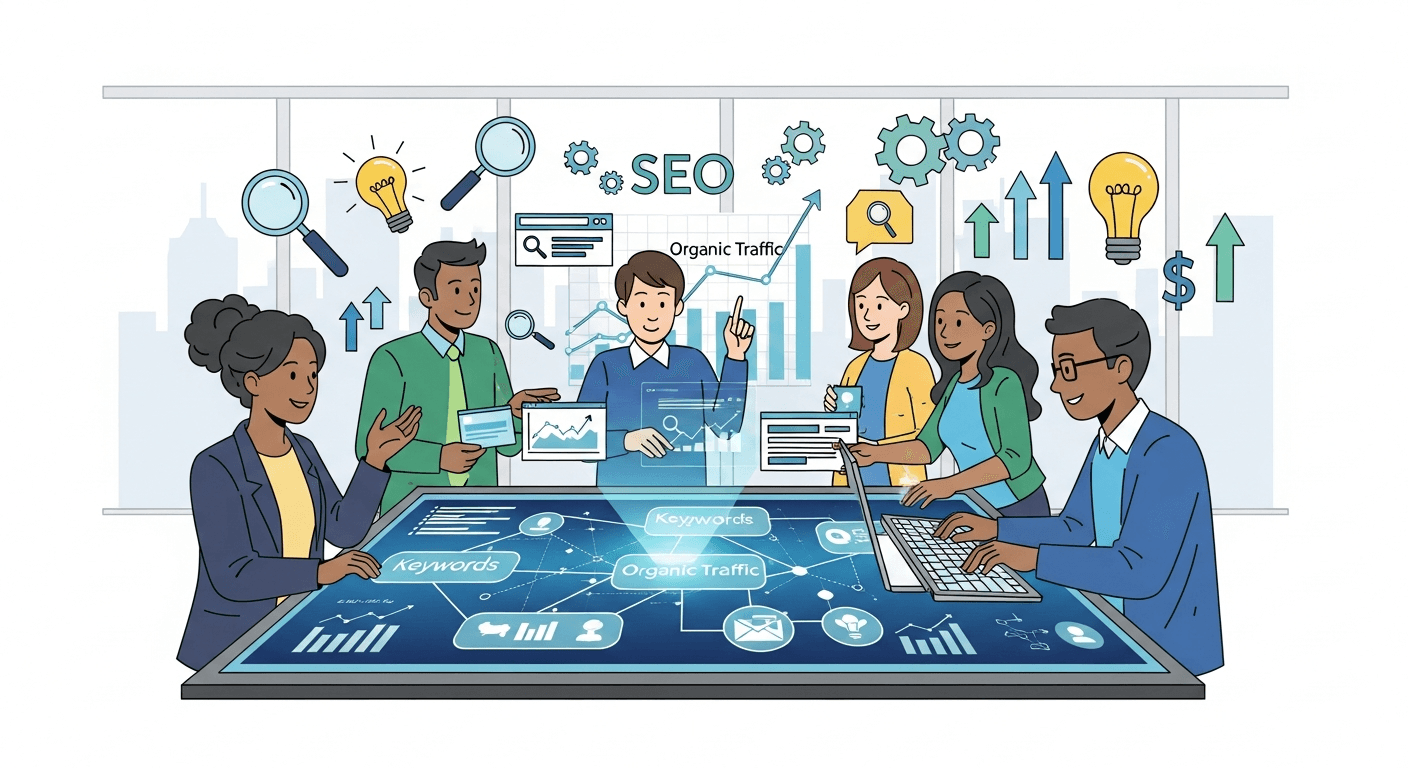
Introduction to SEO for Startups
Why SEO is Crucial for Startups
Let’s be honest: as a startup founder, your to-do list is already three miles long. Adding SEO to the pile might feel like another distraction. But here’s the truth nobody tells you: SEO isn’t a luxury for established brands anymore. It’s foundational infrastructure for startups that want to survive past year two.
The numbers tell a compelling story. According to HubSpot’s 2024 State of Inbound Marketing report, 72% of marketers agree that organic search significantly impacts their revenue. For startups specifically, this matters even more because you’re competing against established players with massive budgets. SEO levels the playing field. You don’t need to outspend your competitors; you need to outsmart them.
Consider this: 68% of online experiences begin with a search engine, whether that’s Google, voice search, or platform-specific searches. If your startup isn’t showing up where your potential customers are looking, you’re invisible. And invisible businesses don’t generate leads, revenue, or growth.
The beauty of SEO for startups is that it compounds. Every piece of content, every technical optimization, and every backlink you build continues working for you months and years later. Unlike paid advertising, where your budget runs out the moment you stop paying, SEO creates a long-term moat around your business. It’s the investment that keeps giving.
Common Misconceptions About SEO
The startup world is littered with myths about SEO that waste time and resources. Let’s demolish a few right now.
Myth #1: SEO Takes Forever
Yes, building authority takes time. But quick wins? Those exist. You can target low-competition long-tail keywords and start ranking within weeks. Voice search optimization, for instance, is still relatively untapped for many startups. Optimizing for voice search queries can deliver results faster because competition is lighter.
Myth #2: You Need a Massive Budget
Wrong. You need strategy and consistency. Some of the best SEO work costs nothing: optimizing your existing website architecture, creating internal linking strategies, and producing genuinely useful content. Tools exist for every budget level. Startups don’t need enterprise-level SEO tools for startups; they need smart ones.
Myth #3: SEO is Dead (It’s Not)
Every time Google updates its algorithm, people proclaim SEO’s demise. Meanwhile, organic search traffic continues growing. What’s changing is how you approach it. User experience matters more. Content quality matters more. Topical authority matters more. These aren’t signs of death; they’re evolution toward what SEO should have been all along.
Myth #4: You Can Ignore Technical SEO
This one gets startups into trouble. You can write the best content in the world, but if your website loads in five seconds or isn’t mobile-optimized, you’ll struggle. Technical SEO isn’t optional; it’s the foundation everything else sits on.

1. Define Your SEO Goals
Setting Clear Objectives
Here’s where most startups stumble: they want “more traffic” without specifying what more actually means. That’s not a goal; that’s a wish.
Effective SEO goals follow the SMART framework adapted for startup reality. Your goals should be Specific, Measurable, Achievable, Relevant, and Time-bound. Instead of “rank higher,” try “rank in the top 10 for our primary keyword within 90 days” or “capture 500 monthly organic visitors from long-tail keywords in our niche.”
Different startups need different goals. A SaaS company might prioritize lead generation over brand awareness. An e-commerce startup might focus on transactional keywords that drive immediate sales. A content platform might want audience growth and authority building.
Start by defining what success looks like for your business model. Is it newsletter signups? Demo requests? Product purchases? Customer acquisition cost? Once you identify the metric that moves your business forward, build SEO goals around it.
Your primary goal might be: “Generate 50 qualified leads per month from organic search within six months.” From there, you break it into sub-goals: keyword rankings, traffic targets, content pieces needed, and technical improvements required.
Measuring Success
Metrics are your accountability system. Without them, you’re flying blind.
The holy trinity of SEO metrics includes organic traffic (tracked via Google Analytics), keyword rankings (track 15-25 primary keywords monthly), and conversion rate (the percentage of visitors who complete your desired action).
For startups, don’t overcomplicate this. Pick three to five metrics that directly connect to your business goals. If you’re tracking 50 metrics, you’re not measuring what matters; you’re creating noise.
Consider using Google Search Console to understand which queries drive your traffic and which pages capture the most impressions. This free tool is invaluable for startups and costs nothing. Cross-reference this with Google Analytics to see which landing pages convert best.
Set baseline measurements before implementing new strategies. If you’re currently getting 500 monthly organic visitors, that’s your starting point. Your first goal might be 750 (50% growth). Once you hit that, aim for 1,500. Progress builds momentum.
2. Understand Your Audience
Creating Audience Personas
This is the part where many startups skip ahead to keyword research without laying proper groundwork. Don’t do that. Understanding your audience deeply changes everything about your SEO strategy.
Audience personas represent your ideal customers. They’re semi-fictional representations built from real data and research. A persona for a startup project management tool might be “Sarah, 32, a startup operations manager juggling five projects simultaneously, frustrated with spreadsheets, and willing to pay for solutions that save her 10 hours weekly.”
Build personas by gathering data from multiple sources: customer interviews (talk to five to ten existing customers), analytics reviews (who actually uses your product?), social listening (what problems do your potential customers mention online?), and competitor analysis (who are your competitors targeting?).
Each persona should include demographics, pain points, goals, objections, and preferred information sources. The last one matters tremendously for SEO. If your audience learns through YouTube tutorials, your written content strategy alone won’t reach them effectively.
For a startup, three to four well-developed personas beat ten generic ones. Quality over quantity applies here.
Identifying User Intent
User intent is the “why” behind every search. Someone searching “best project management tools” has different intent than someone searching “how to use Asana.” One is research-phase intent (they’re comparing options). One is implementation-phase intent (they’ve decided on a tool and need help).
Google’s algorithm increasingly prioritizes matching content to user intent. If you rank for a keyword but your content doesn’t address what searchers actually want, they’ll bounce faster than you can say “high bounce rate.”
There are four primary intent types: informational (how-to, explanations), navigational (finding a specific website), commercial (researching before buying), and transactional (ready to buy). Most startup SEO strategies need content across all four categories.

Map your target keywords to intent. Your keyword research should include intent classification. This informs everything from content structure to which pages you prioritize.
3. Build an SEO-Friendly Website Structure
Importance of Site Architecture
Your website structure is the skeleton that holds your SEO strategy together. A poorly architected site limits how much value your content can generate, no matter how good it is.
Think of site architecture like a retail store layout. You want customers to find what they need easily. Some products are browsable; others need direct pathways. Your website should work the same way. Visitors should understand where they are, why that page exists, and how to find related information.
For startups, a logical hierarchy typically works best. Your homepage represents your broadest category. Main navigation items represent primary topics. Subpages dive deeper into specific subtopics. This structure helps both users and search engines understand topical relationships.
This architecture also supports something called topic clusters and pillar pages. A pillar page covers a broad topic comprehensively (maybe 3,000 to 5,000 words). Related cluster content covers subtopics in depth, each linking back to the pillar page. This structure signals to Google that you’re an authority on that topic. This aligns directly with a proven method like topic clusters.
For example, if your startup focuses on email marketing, your pillar page might be “Complete Guide to Email Marketing.” Your cluster content includes “Email Segmentation Strategies,” “A/B Testing Email Subject Lines,” and “Email Automation Best Practices.” Each cluster piece links to the pillar and to relevant cluster pieces.
Best Practices for URL Structure
Your URL is your first impression on search engines and users. Make it count.
Best practice URLs are short, descriptive, and keyword-relevant. Compare these two: “example.com/p=427” versus “example.com/email-marketing-segmentation-guide.” One tells you nothing. One tells you exactly what you’ll find.
Keep URLs under 75 characters when possible. Each word should be separated by hyphens. Avoid numbers, dates, and parameters when possible. Your URL should be human-readable because humans do see them in search results.
For startups, create a URL structure before you have 500 pages and need to reorganize. Decide whether you’ll organize by topic, customer segment, or content type. Whatever you choose, be consistent.
Avoid deep nesting (more than three levels deep) unless necessary. Shallow URLs rank better than buried content. If your URL is “example.com/resources/guides/email-marketing/segmentation,” that’s probably too deep.
4. Conduct Effective Keyword Research
Tools for Keyword Research
Keyword research is where strategy begins. You can’t optimize for keywords you don’t know about, and you can’t prioritize effectively without understanding search volume and competition.
For startups with limited budgets, start with free options. Google Keyword Planner gives you search volume and competition data directly from Google. Google Search Console shows you keywords that already drive your traffic and where you rank. These two free tools provide incredible insight.
As you grow, paid seo tools for startups like Ahrefs, SEMrush, and Moz offer deeper analysis. They show you competitor keywords, backlink opportunities, and keyword difficulty scores. For most startups in their first year, free tools suffice.
When evaluating seo tools for startups, prioritize those with these features: search volume data, keyword difficulty scoring, SERP analysis, and competitor research capabilities. Don’t prioritize fancy interfaces; prioritize usable data.
Voice search optimization is becoming critical, and some newer tools specifically analyze voice search queries. Since voice searches tend to be longer and more conversational than text searches, understanding voice search patterns helps you target emerging opportunities before competition intensifies.
Long-Tail Keywords vs. Short-Tail Keywords
Short-tail keywords are broad, high-volume searches: “email marketing,” “project management,” “social media.” They’re competitive and expensive to rank for. Ranking for “email marketing” is like winning the Super Bowl. Possible? Yes. Realistic for a startup in year one? Usually not.
Long-tail keywords are specific, lower-volume searches: “how to segment email lists for better engagement,” “free project management tools for freelancers,” “social media content calendar template.” These get fewer searches individually but convert better and face lighter competition.
Here’s the startup strategy: build your foundation on long-tail keywords. Target 50 to 100 long-tail variations before attacking three to five competitive short-tail keywords. Long-tail keywords get you rankings faster, build authority faster, and create compounding authority that eventually helps you rank for broader terms.
Long-tail keywords also align with voice search optimization naturally. People conduct voice searches conversationally: “What’s the best free project management tool for freelancers?” That’s long-tail. People rarely say “project management” as a voice query alone.

5. Create Valuable, Audience-Centric Content
Content Types That Engage
Not all content serves the same purpose. Your content strategy needs variety.
Blog posts work well for how-to content and topic exploration. They’re versatile, scalable, and Google loves them. For startups, 1,500 to 2,500-word articles hit the sweet spot between depth and effort. Need help planning? Try generating a 30-day content calendar to stay consistent.
Guides and resources go deeper. These comprehensive pieces become your pillar content and authority builders. They’re typically 3,000 to 5,000 words and tackle subjects comprehensively.
Case studies and success stories demonstrate real value. They’re particularly effective for SaaS startups because they show potential customers exactly what’s possible.
Videos and interactive content boost engagement. For voice search optimization, transcribed videos help tremendously. Voice searches often trigger video results, so a strong video library supports your voice search strategy.
Tools and templates provide immediate value. A free email template, calculator, or checklist gets shared, linked to, and bookmarked. Shareability equals visibility.
For most startups, focus on 70% educational content (how-to, guides, tutorials) and 30% product-focused content (case studies, comparisons, features). This ratio builds trust and authority without coming across as sales-y.
Optimizing Content for SEO
Writing good content and writing SEO-optimized content aren’t mutually exclusive. They’re the same thing when done right.
Start with your primary keyword. Include it in your headline, first 100 words, and 2 to 3 subheadings. Include it naturally in 1.5% to 2% of your content (roughly every 500 words in a 2,500-word piece). Use variations and related keywords throughout. This is natural keyword integration, not stuffing.
Write for your audience first, search engines second. If your content reads like keyword spam, you’ve failed. Readers bounce quickly, and bounce rate is a ranking factor.
Structure matters. Use short paragraphs (two to three sentences). Use subheadings every 300 to 400 words. Use lists for scannability. Use bold to highlight key takeaways. Format for readability because your actual readers matter.
Include internal links to related content. Three to five internal links per article is optimal. Link to your pillar pages from cluster content. Link to other relevant articles. Internal linking distributes authority and helps Google understand your content relationships. You can learn more about this by identifying content gaps within your strategy.
External links matter too. Link to two to three authoritative sources. This signals that you’ve done research and builds trust.
6. Optimize for Technical SEO
Common Technical Issues to Address
Technical SEO is unsexy but critical. Search engines can’t rank content they can’t crawl and understand properly.
Page speed is issue number one. If your startup uses a heavy WordPress theme with poor optimization, fix it. Compress images. Minify code. Use a content delivery network (CDN). Google’s Core Web Vitals directly impact rankings. Aim for pages that load in under two seconds.
Mobile optimization is no longer optional. Google predominantly crawls the mobile version of your site now. If your site isn’t mobile-friendly, you’re starting with a handicap. Test your site on mobile devices. Check Google Mobile-Friendly Test tool. Fix responsive design issues.
XML sitemaps and robots.txt files help search engines navigate your site. These technical foundations take hours to set up but months to undo if missing. Create your sitemap, submit it to Google Search Console, and maintain your robots.txt file.
Structured data (schema markup) helps search engines understand your content better. You don’t need to become a schema expert as a startup, but mark up basic information: articles (Article schema), organization information (Organization schema), and product details (Product schema).
Duplicate content causes problems. If your startup accidentally creates multiple versions of the same page, Google gets confused about which version to rank. Use canonical tags to specify the preferred version when necessary.
Importance of Mobile Optimization
Mobile devices drive the majority of web traffic. For startups, mobile optimization isn’t a feature; it’s a requirement.
Mobile optimization includes responsive design (your site looks good on all screen sizes), fast loading speeds on mobile networks, and readable font sizes (16px minimum). Test your site on actual devices, not just browser emulators.
Voice search optimization directly connects to mobile optimization because 50% of all searches will be voice searches by 2025. Voice searches happen on mobile devices. Optimizing for voice means optimizing for mobile: fast pages, clear answers to questions, natural language matching.

7. Build Quality Backlinks
Strategies for Earning Backlinks
Backlinks are how Google measures your authority. They’re votes of confidence from other websites. Not all backlinks are created equal. One link from a high-authority industry publication beats 50 links from low-quality directories.
Your backlink strategy should focus on earning links naturally through great content. Create content so valuable that other sites want to link to it. A comprehensive guide, original research, or unique tool naturally attracts links.
Competitor analysis reveals backlink opportunities. Use tools like Ahrefs to see who links to your competitors. Reach out to sites linking to competitor content about similar topics. “We just published a more comprehensive guide on this topic” is a legitimate reason to reach out.
Broken link building works surprisingly well. Find broken links on authority sites in your industry. Create content that addresses the same topic. Contact the site owner: “We noticed your link to [topic] is broken. Here’s a resource on that topic you might link to instead.”
Resource page links come from pages like “Best Tools for Email Marketing” or “Email Marketing Resources.” These pages exist specifically to link to helpful resources. Find them, ensure your startup resource fits, and reach out with a brief pitch.
The Role of Guest Blogging
Guest blogging gets mixed reviews, and rightfully so. Bad guest blogging (posting on irrelevant low-authority sites just for links) wastes time. Strategic guest blogging on relevant, authority sites builds your startup’s brand and generates quality backlinks.
Target publications your audience actually reads. If your startup targets entrepreneurs, pitch to entrepreneur-focused publications. Quality of publication matters more than quantity of posts.
Write posts that genuinely help their audience. Make the publication look good. Include a relevant link back to your startup when it makes sense. Guest posts that are obvious link-bait get flagged and provide little value.
One guest post on a high-authority publication beats ten posts on low-quality sites. Focus on quality over quantity. One post on TechCrunch beats 50 on random blogs.
Conclusion and Next Steps
Recap of Key Strategies
The seven essential SEO strategies every startup should master create a comprehensive foundation:
Define clear, measurable SEO goals that tie to your business growth. Understand your audience deeply through personas and user intent research. Build a logical website structure that supports growth. Conduct thorough keyword research focused on long-tail opportunities. Create valuable, audience-centric content optimized for search. Optimize technical foundations that allow search engines to crawl and rank your site. Build quality backlinks through valuable content and strategic outreach.
These seven strategies aren’t trendy hacks or shortcuts. They’re fundamental SEO practices that work because they’re rooted in how search engines actually function and how humans actually search.
The opportunity for startups is genuinely massive. Established brands often underestimate the power of targeting long-tail keywords and creating niche content authority. While your competitors chase broad keywords with minimal success, you can build a steady stream of qualified organic traffic through focused, strategic execution.
Call to Action: Start Implementing These Strategies Today
Here’s the reality: reading about SEO is easy. Implementing it consistently is where most startups falter. You don’t need perfect; you need progress.
Pick one strategy to start with next week. Don’t try to implement all seven simultaneously. If your website lacks proper architecture, start there. If your content strategy is scattered, start with clear goal-setting and keyword research.
Building sustainable SEO requires consistency over months and years, not perfection in days. One well-researched piece of content today is better than five mediocre pieces next week. One internal linking fix beats obsessing over perfect URLs.
Consider exploring Hovers if you’re struggling with content creation consistency. Hovers automates SEO-friendly content calendars, generates rank-ready articles optimized for your keywords and audience, and enables one-click publishing to platforms like WordPress and Shopify. For startups drowning in tasks, having an AI-powered system handle content planning and generation means you can focus on the strategy while consistent, optimized content works for you automatically.
Your startup’s visibility in search results isn’t determined by luck or budget. It’s determined by strategy, execution, and consistency. Start today. Pick one strategy. Take one action. Build from there. Your future customers are searching right now. Make sure they find you.
*Article created using Hovers.ai